BMW sells eight fully electric cars in the UK in November 2026, priced from £37,065 for the iX1 and iX2 eDrive20 Sport to £164,420 for the i7 M70 xDrive. The new i3 saloon gives the most range for the money, and the cheapest pair are the only BMWs that get the Electric Car Grant.
The newest is the BMW i3 electric saloon, which shares only its name with the small i3 hatchback sold until 2022. It costs £47,925 as the 40 xDrive and £53,425 as the 50 xDrive, and the 50 xDrive has a WLTP range of 566 miles, more than any other BMW.
Its SUV sibling, the BMW iX3, costs from £53,250 with 395 miles of range, or £60,655 for the 50 xDrive with 500 miles. Both are Neue Klasse models, BMW’s new generation of electric cars, and both 50 xDrive versions charge at up to 400 kW on DC.
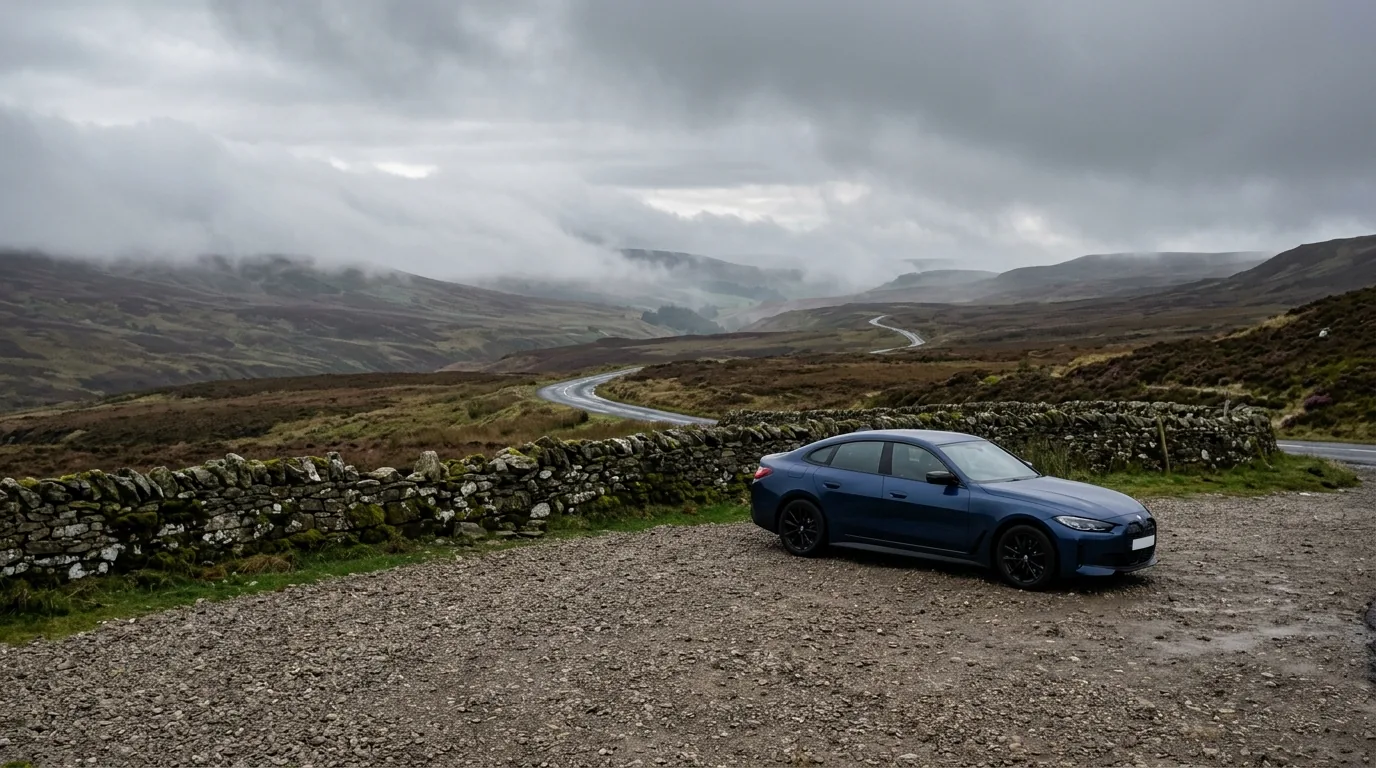
The brand registered 33,945 fully electric cars in the UK in 2025, BMW Group UK said in January 2026, and the BMW i4 electric Gran Coupe was its best seller for a second year with 12,158 registrations, ahead of the iX1 on 6,376.
Who makes BMW electric cars and where are they built?
BMW electric cars are made by BMW AG, a German company whose shares are listed on the Frankfurt and Munich stock exchanges. BMW builds most of its electric cars in Germany; the iX3 comes from Hungary.
The i3 and i4 are built at BMW’s Munich plant. BMW says i3 production began there in August 2026, with first UK deliveries in the autumn, and that the i4 shares a line with the 3 Series. BMW plans for Munich to build only electric cars from the end of 2027.
The BMW i5 saloon and Touring is built at Dingolfing in Lower Bavaria, which InsideEVs described as BMW’s largest European production site when i5 production started in July 2023. BMW’s October 2026 release confirms the updated i7 is built there too, with every 7 Series version on a single line.
The BMW iX large SUV went into series production at Dingolfing on 2 July 2021. The iX1 has been built at Regensburg since November 2022, Electrive reported. The iX3 is built at BMW’s new plant in Debrecen, Hungary, which made its 50,000th iX3 about nine months after production began and added a second shift in February 2026 to keep up with orders.
Every BMW electric car on sale: prices and range
The table lists every electric BMW version in our spec dataset by list price; range is the WLTP figure and charging is the peak DC rate. Some trims, such as the iX1 xLine and M Sport eDrive20, sit between these.
| Version | List price (Nov 2026) | Usable battery | WLTP range | Peak DC charging | Boot |
|---|
| iX1 eDrive20 Sport | £37,065 | 65 kWh | 321 miles | 130 kW | 490 litres |
| iX2 eDrive20 Sport | £37,065 | 65.2 kWh | 319 miles | 130 kW | 525 litres |
| iX1 xDrive30 xLine | £43,005 | 65.2 kWh | 290 miles | 130 kW | 490 litres |
| iX2 xDrive30 M Sport | £45,755 | 65 kWh | 298 miles | 130 kW | 525 litres |
| i3 40 xDrive | £47,925 | 82.8 kWh | 441 miles | 300 kW | 420 litres |
| i4 eDrive35 Sport | £51,370 | 67.1 kWh | 316 miles | 180 kW | 470 litres |
| iX3 40 | £53,250 | 82.6 kWh | 395 miles | 300 kW | 520 litres |
| i3 50 xDrive | £53,425 | 108.7 kWh | 566 miles | 400 kW | 420 litres |
| iX3 40 xDrive | £55,670 | 82.6 kWh | 385 miles | 300 kW | 520 litres |
| i4 eDrive40 Sport | £59,465 | 81.3 kWh | 377 miles | 205 kW | 470 litres |
| iX3 50 xDrive | £60,655 | 108.7 kWh | 500 miles | 400 kW | 520 litres |
| i5 eDrive40 Sport Edition saloon | £67,795 | 81.2 kWh | 369 miles | 205 kW | 490 litres |
| i5 Touring eDrive40 Sport Edition | £70,045 | 81.2 kWh | 352 miles | 205 kW | 570 litres |
| i4 M60 xDrive | £71,525 | 81.1 kWh | 337 miles | 205 kW | 470 litres |
| iX xDrive45 Sport | £75,405 | 94.8 kWh | 374 miles | 175 kW | 500 litres |
| iX xDrive60 M Sport | £93,205 | 109.1 kWh | 426 miles | 195 kW | 500 litres |
| i5 M60 xDrive saloon | £97,845 | 81.2 kWh | 331 miles | 205 kW | 490 litres |
| i5 Touring M60 xDrive | £100,095 | 81.2 kWh | 322 miles | 205 kW | 570 litres |
| i7 50 xDrive | £104,230 | 112.5 kWh | 452 miles | 250 kW | 500 litres |
| iX M70 xDrive | £114,305 | 108.9 kWh | 366 miles | 195 kW | 500 litres |
| i7 60 xDrive M Sport | £120,335 | 112.5 kWh | 451 miles | 250 kW | 500 litres |
| i7 M70 xDrive | £164,420 | 112.4 kWh | 426 miles | 250 kW | 500 litres |
i3 and iX3: the Neue Klasse pair
These are the BMWs to start with. The i3 50 xDrive and iX3 50 xDrive share a 108.7 kWh usable battery and 400 kW charging, and BMW offers 22 kW AC charging and bidirectional charging on the new i3. Auto Express rated the iX3 five out of five in July 2026, praising its efficiency, charging, ride, interior technology and interior quality, and named it its Premium Electric Car of 2026. Its testers disliked the unusual steering wheel, a slightly firm ride on 22-inch wheels and some wind and road noise.
i4
The i4 is a five-door Gran Coupe with a 470-litre boot, from £51,370 for 316 miles of range. Auto Express rated it four out of five in August 2026, calling it sophisticated, well built and great to drive, but it found rear legroom tight, depreciation steep and newer rivals quicker to charge and longer on range. The new i3 now goes further for less.
i5
The i5 is the electric 5 Series, sold as a saloon from £67,795 or as the Touring estate from £70,045, whose 570-litre boot is the biggest of any electric BMW. Every version charges at up to 205 kW.
i7
The i7 is BMW’s electric limousine, updated in September 2026 with new cylindrical battery cells. It costs £104,230 as the 50 xDrive with 452 miles of range, £120,335 as the 60 xDrive M Sport and £164,420 as the 500 kW M70 xDrive. With 112.5 kWh usable in the 50 and 60, it has the biggest battery of any BMW.
iX
The iX is a large five-seat SUV from £75,405, with up to 426 miles of range as the xDrive60. Auto Express rated it 4.5 out of five in September 2026 for its comfort, refinement and spacious interior, while noting a fidgety low-speed ride and a smaller boot than some rivals.
iX1 and iX2
The iX1 and its coupe-styled twin, the iX2, are BMW’s smallest and cheapest electric cars. In July 2026 BMW cut the iX1 eDrive20 Sport by £6,490 and added an iX2 eDrive20 Sport at the same £37,065, so both qualify for the £3,750 Band 1 Electric Car Grant and cost £33,315 after it. Our comparison of the Tesla Model Y and BMW iX1 as company cars sets the smaller BMW against its obvious rival.
What does a BMW electric car cost to run?
Charged at home on a 6.5p/kWh off-peak tariff, every BMW electric car on sale costs between 1.2p a mile (i3 40 xDrive) and 1.9p a mile (iX M70 xDrive). That is our calculation: we divide WLTP range by usable battery to get miles per kWh and ignore charging losses, as set out in our methodology. Over 8,000 miles that is £98 to £155 at home.
On public rapid chargers at Zapmap’s October 2026 average of 82p/kWh the same cars cost 15.4p to 24.4p a mile. The i3 and iX3 make rapid stops short: on our sums the i3 50 xDrive adds 189 miles in ten minutes on a fast enough charger, and the iX3 50 xDrive 167 miles.
| Model | Full charge at home (6.5p/kWh) | Pence per mile at home | Pence per mile, public rapid | List price per mile of range |
|---|
| iX1 eDrive20 Sport | £4.22 | 1.3p | 16.6p | £115 |
| i3 40 xDrive | £5.38 | 1.2p | 15.4p | £109 |
| i3 50 xDrive | £7.07 | 1.2p | 15.7p | £94 |
| iX3 50 xDrive | £7.07 | 1.4p | 17.8p | £121 |
| i4 eDrive35 Sport | £4.36 | 1.4p | 17.4p | £163 |
| i5 eDrive40 saloon | £5.28 | 1.4p | 18.0p | £184 |
| iX xDrive45 Sport | £6.16 | 1.6p | 20.8p | £202 |
| i7 50 xDrive | £7.31 | 1.6p | 20.4p | £231 |
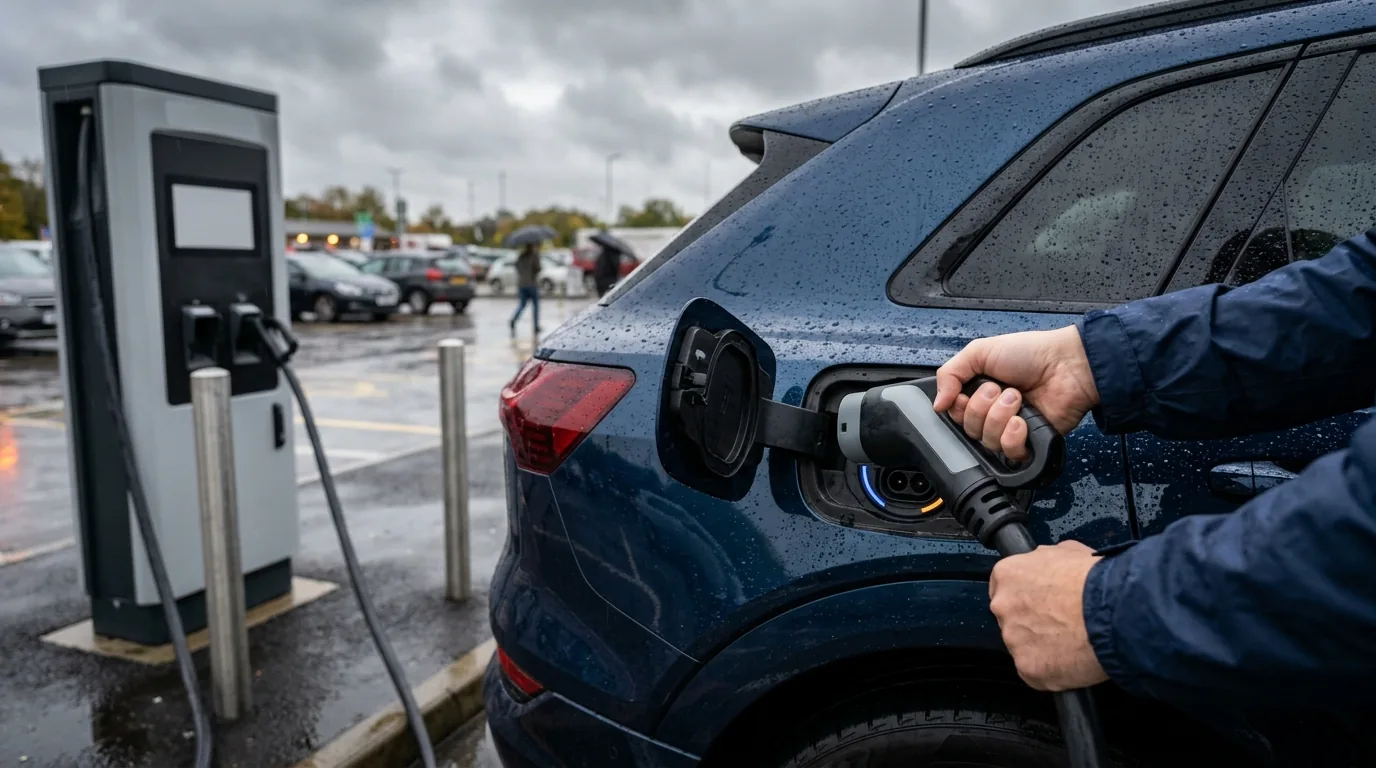
The biggest batteries take time to fill at home: about 15.5 hours for the i3 50 xDrive and 16.1 hours for the i7 on a 7 kW wallbox, against 9.3 hours for the iX1. For help choosing a home charger, our partner site Best Chargers compares wallboxes.
BMW plug-in hybrids: should you go fully electric instead?
BMW also sells plug-in hybrids alongside its electric cars. The best known is the 330e plug-in hybrid, which What Car? rated five stars in March 2025, with a 19.5 kWh battery and an official electric range of up to 62 miles as a saloon and 60 miles as a Touring.
Go fully electric if you can charge at home and most of your driving fits within an electric car’s range. A plug-in hybrid only saves money when you plug it in nearly every day; with a flat battery it runs as a petrol car. The i3 40 xDrive gives you 441 miles of WLTP range in a saloon at 1.2p a mile charged at home off-peak. The 330e plug-in hybrid, with up to 62 miles of electric range, suits drivers whose daily trips fit inside that distance but who regularly drive much further and do not want to stop to rapid charge.
Warranty, dealers and servicing
Every new BMW carries a three-year warranty with unlimited mileage, and the high-voltage battery in its electric cars is covered for eight years or 100,000 miles, whichever comes first. Motorpoint’s September 2025 guide notes that a battery claim applies only if capacity falls below 70% of new within that time. Plug-in hybrid batteries are covered for six years or 62,000 miles on older generations and eight years or 100,000 miles on fifth-generation cars.
If you plan to keep a BMW beyond three years, price an extended warranty before you buy. We could not find a current UK retailer count published by BMW, so we do not give one here.
How safe are BMW electric cars?
Euro NCAP has rated five of BMW’s electric models. The iX3 50 xDrive scored five stars on 8 July 2026, among the first cars rated under Euro NCAP’s new tests, which score four stages: safe driving, crash avoidance, crash protection and post-crash safety.
| Model | Euro NCAP result | Year | Scores |
|---|
| iX3 50 xDrive | 5 stars | 2026 | Safe driving 73%, crash avoidance 83%, crash protection 86%, post-crash 95% |
| i5 (5 Series rating) | 5 stars | 2023 | Adult 89%, child 85%, vulnerable road users 86%, safety assist 78% |
| iX1 (X1 rating) | 5 stars | 2022 | Adult 86%, child 89%, vulnerable road users 76%, safety assist 92% |
| i4 | 4 stars | 2022 | Adult 87%, child 87%, vulnerable road users 71%, safety assist 64% |
| iX | 5 stars | 2021 | Not given in BMW’s release |
The i4 lost marks for a marginal emergency lane keeping result, no centre airbag and no pedestrian braking when reversing, InsideEVs reported. We could not find a Euro NCAP result for the new i3, the updated i7 or the iX2.
Are BMW electric cars reliable?
BMW sits in the middle of the table. What Car?’s 2026 reliability survey placed it 19th of 30 brands with a score of 89.5%, two places above Mercedes. The survey does not give separate scores for BMW’s electric models.
The i3 and iX3 are too new for anyone to know how they will age: the iX3 has been in production for about a year, and UK i3 deliveries are only starting. Their resale values are not yet known either. Auto Express notes that the older i4 depreciates steeply.
What is coming next from BMW?
The next Neue Klasse model for the UK is the iX5, a larger SUV; our report on iX5 order books opening covers its UK price and timing.
A high-performance iX3 is also on the way, and our story on the iX3 M60 for the UK sets out its power and range. Beyond that, BMW says the group will launch 40 new and revised models worldwide by the end of 2027.
Which BMW electric car should you buy?
Buy the i3 50 xDrive if you want the most range for your money: 566 miles of WLTP range for £53,425 works out at £94 of list price per mile, the lowest of any BMW. If you want an SUV, the iX3 40 at £53,250 or the 50 xDrive at £60,655 gives you the same generation of technology and a 520-litre boot. Buyers on a tighter budget should look at the iX1 or iX2 eDrive20, the only BMWs that get the grant, at £33,315 after it.
The i4 and i5 remain well-reviewed cars but now look expensive next to the i3 for the range they give. The iX and i7 suit buyers who want space and comfort first and will pay heavily for them. No electric BMW suits a buyer who wants a long factory warranty: three years is the term on every model. EV Compared has not driven these cars; this verdict rests on published data and the reviews cited above. To weigh a BMW against everything else, start with every electric car we cover.