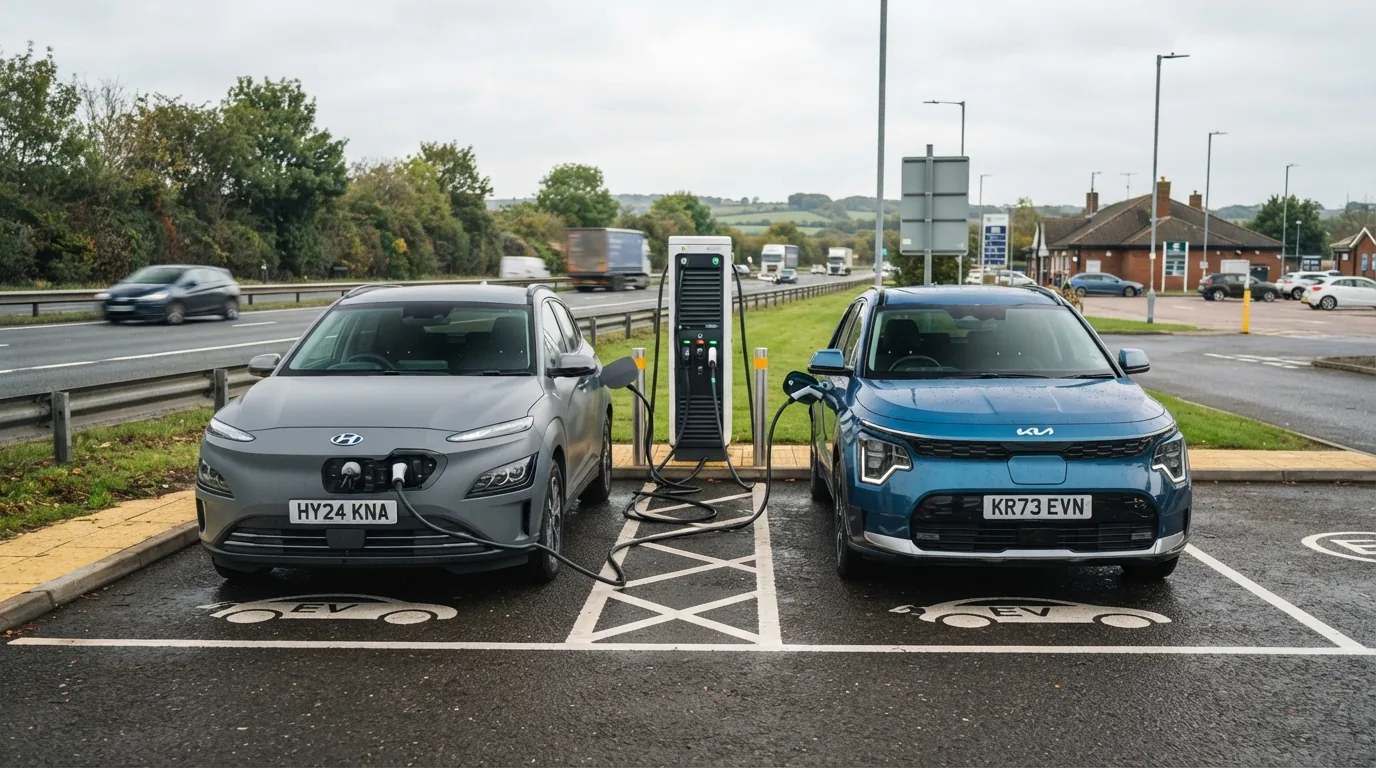
Kia Niro EV / e-Niro review (UK): price, range, charging, verdict
The Kia Niro EV is a roomy, efficient electric family crossover with 285 miles of WLTP range and a seven-year warranty, but its 72 kW charging is slow and Kia stopped selling it new in 2026, so most buyers will now find it used.
Our verdict
The Kia Niro EV suits a family that charges at home, wants a practical crossover with a 475-litre boot, 285 miles of WLTP range and a transferable seven-year warranty, and is happy to buy used or from remaining stock. It does not suit drivers who rely on rapid chargers for long trips, because its 72 kW peak is slow next to newer rivals, and buyers paying close to its final list price should look at the cheaper Kia EV3 first.
For
- 475-litre boot with 1,392 litres seats folded, plus a 20-litre front storage box
- Efficient: 4.4 miles per kWh on the WLTP test, or 1.5p a mile charged off-peak at home on EV Compared's figures
- Kia's seven-year or 100,000-mile warranty, which passes to the next owner
- Comfortable and easy to use, with What Car? measuring 253 miles in its real-world range test
Against
- 72 kW peak DC charging, slower than the 100 kW and above most rivals manage
- Kia no longer lists the Niro EV in its UK model range, so new examples are limited to remaining stock
- Testers found road noise at motorway speeds
- Heat pump optional, and only on the top '4' trim
This is a data verdict: it rests on manufacturer specifications, UK pricing, independent range testing, reliability surveys and owner reports, not on a road test by EV Compared.
Kia Niro EV at a glance
| Price from | £37,325 |
|---|---|
| Battery | 64.8 kWh |
| WLTP range | 285 miles |
| Peak rapid charging | 72 kW |
| Boot | 475 litres |
| Final list price | £37,325 '2', £39,575 '3', £42,325 '4', £43,225 '4' with heat pump (Kia UK, checked November 2026) |
| Trims | '2', '3', '4' |
| Battery | 64.8 kWh (Kia does not say whether usable or gross) |
| Range (WLTP) | 285 miles |
| DC charging | 72 kW maximum |
| AC charging | Up to 11 kW three-phase (Kia) |
| Power and drive | 150 kW (201 bhp), front-wheel drive |
| 0 to 62mph | 7.8 seconds |
| Boot | 475 litres seats up, 1,392 litres seats folded, 20-litre front storage |
| Kerb weight | 1,757 kg |
| Towing (braked) | 750 kg |
| Length, width, height | 4,420 mm, 1,825 mm, 1,585 mm (Auto Express) |
| Warranty | 7 years or 100,000 miles; battery 8 years |
| Euro NCAP | Four stars standard, five with optional safety pack (2022) |
Quick answers
- Kia's UK pricing page lists final Niro EV prices of £37,325 for the '2', £39,575 for the '3', £42,325 for the '4' and £43,225 for the '4' with a heat pump.
- Electrifying.com reported on 11 April 2026 that Kia had killed off the Niro EV, and Kia's UK model range no longer lists it in November 2026.
- Every Niro EV has a 64.8 kWh battery and an official WLTP range of 285 miles, while What Car? measured 253 miles in its real-world test.
- The Niro EV charges at up to 72 kW on a DC rapid charger, which Auto Express, What Car? and DrivingElectric all listed as a weakness.
- A full charge costs about £4.21 at home on a 6.5p/kWh off-peak tariff and £53.14 on a public rapid charger at 82p/kWh, on EV Compared's figures.
- The boot holds 475 litres with the rear seats up and 1,392 litres with them folded, with a 20-litre storage box under the bonnet.
- The first-generation Kia e-Niro, sold from 2019 to 2022, had 282 miles of WLTP range with the 64 kWh battery and 180 miles with the 39 kWh battery.
The Kia Niro EV is a practical electric family crossover with 285 miles of WLTP range, a 475-litre boot and a seven-year warranty, with final UK list prices from £37,325. UK testers rate it as a comfortable, efficient all-rounder held back by slow 72 kW rapid charging, and Kia has stopped selling it as a current model, so most buyers will now find one used.
The Niro EV is the second-generation fully electric Niro, which replaced the Kia e-Niro in 2022. The e-Niro, sold from 2019 to 2022, is now a used-only car too, so this page covers both, with the Niro EV first because it is the newer car. For the rest of the line-up, see our guide to every Kia electric car in the UK.
EV Compared has not driven the Niro EV or the e-Niro. This review rests on Kia’s published prices and specifications, government tax and grant rules, Euro NCAP’s results and the findings of named UK road tests.
Verdict: who should buy the Kia Niro EV, and who should not?
The Kia Niro EV suits a family that charges at home and wants a roomy, efficient crossover with a big boot and a long warranty. Its 285-mile WLTP range covers most weeks on one or two home charges, it costs about 1.5p a mile on an off-peak tariff on our figures, and Kia’s seven-year or 100,000-mile warranty passes to the next owner, which makes a two or three year old car a sensible used buy.
It does not suit a driver who covers long motorway trips and relies on public rapid chargers. Its 72 kW peak is the weakness every UK tester we read singled out, and rivals charge faster. Anyone paying close to the final list price should also look at the newer Kia EV3, which What Car? found cheaper, better equipped, longer-legged and faster to charge.
Is the Kia Niro EV still on sale in the UK?
No, not as a current model. Electrifying.com reported on 11 April 2026 that Kia had killed off the Niro EV, and in November 2026 Kia’s UK model range lists the Niro Plug-In Hybrid but no Niro EV. The 2026 Niro facelift applies to the hybrid, Electrifying.com said.
Kia’s Niro pricing page still carries the final EV prices, so a dealer may have remaining stock. For most buyers, though, the Niro EV is now a used car, and the e-Niro has been one since 2022.
Kia has not named a direct replacement. Its electric line-up now includes the EV2, EV3, EV4, EV5, EV6 and EV9; our explainer on how Kia’s EV range fits together sets out where each sits.
How much is the Kia Niro EV, and what do you get?
Kia’s final list prices for the Niro EV are £37,325 for the ‘2’, £39,575 for the ‘3’, £42,325 for the ‘4’ and £43,225 for the ‘4’ with a heat pump, on its UK pricing page checked in November 2026. When order books opened in September 2022, Electrifying.com reported prices of £34,995, £37,745 and £40,495, so each trim rose by £1,830 to £2,330 over the car’s life.
| Version (2022 to 2026) | Final list price | Battery | WLTP range | DC peak | £ of list price per mile of range |
|---|---|---|---|---|---|
| Niro EV ‘2’ | £37,325 | 64.8 kWh | 285 miles | 72 kW | £131 |
| Niro EV ‘3’ | £39,575 | 64.8 kWh | 285 miles | 72 kW | £139 |
| Niro EV ‘4’ | £42,325 | 64.8 kWh | 285 miles | 72 kW | £149 |
| Niro EV ‘4’ with heat pump | £43,225 | 64.8 kWh | 285 miles | 72 kW | £152 |
The last column is EV Compared’s own measure: the list price divided by the WLTP range. Our methodology explains how we work out every figure on this page. Because every trim has the same battery, motor and range, the ‘2’ gives the most range for the money.
Every version has a 150 kW (201 bhp) motor driving the front wheels and reaches 62mph in 7.8 seconds. Kia’s specification lists what each trim adds:
- ‘2’: 17-inch alloy wheels, halogen headlights, cloth seats, a 10.25-inch driver display, rear parking sensors, Forward Collision-Avoidance Assist and paddles to adjust regenerative braking.
- ‘3’: adds LED headlights, privacy glass, heated front seats and steering wheel, a powered driver’s seat with lumbar support, a wireless phone charger, vehicle-to-load, front parking sensors, blind spot collision avoidance, rear cross-traffic alert and Highway Driving Assist.
- ‘4’: adds a sunroof, artificial leather, heated and ventilated seats, a powered passenger relaxation seat, a powered tailgate, a head-up display, Remote Smart Parking Assist and Highway Driving Assist 2.0.
The heat pump costs £900 on the ‘4’ and is not offered on the other trims, which What Car? and DrivingElectric both noted. Our page on Niro EV prices, specs and trims breaks the line-up down further.
The Niro EV is not on the government’s Electric Car Grant list. The Kia models that are, in November 2026, are the EV2, EV3, EV4 and PV5 Passenger.
What about the Kia e-Niro (2019 to 2022)?
The Kia e-Niro is the first-generation electric Niro, and on paper it is close to the Niro EV. The 64 kWh versions have 282 miles of WLTP range and a 150 kW motor; a cheaper 39 kWh ‘2’, added in June 2020, has 180 miles and a 100 kW motor, Zapmap reported.
| e-Niro version | List price before grant (June 2020) | Battery | WLTP range | AC charging | £ of list price per mile of range |
|---|---|---|---|---|---|
| e-Niro ‘2’ 39 kWh (2020 to 2022) | £32,595 | 39 kWh | 180 miles | 7 kW | £181 |
| e-Niro ‘3’ 64 kWh (2019 to 2022) | £36,850 | 64 kWh | 282 miles | 7 kW | £131 |
| e-Niro ‘4+’ 64 kWh (2019 to 2022) | £39,145 | 64 kWh | 282 miles | 11 kW | £139 |
Those were list prices before the £3,000 Plug-in Car Grant then available; after it, Zapmap gave £29,595, £33,850 and £36,145. Zapmap said every version could charge at up to 100 kW on DC, while Electrifying.com and Auto Express give the e-Niro’s peak as 77 kW.
The Niro EV changed the styling, cabin technology and refinement more than the numbers. Electrifying.com reported that Kia cut torque from 395 Nm to 255 Nm to reduce wheelspin and added battery preconditioning linked to the navigation, and that Kia said the new car charged from 10 to 80% up to nine minutes faster despite its lower peak. Anyone shopping for either generation should read our used Kia Niro EV buying guide on battery health and what to check.
How far does the Kia Niro EV go: WLTP versus real world?
The Kia Niro EV has an official WLTP range of 285 miles on every trim, from a 64.8 kWh battery. Kia rates its combined consumption at 162 Wh/km.
That works out at 4.4 miles per kWh on the WLTP test, on our sums: the WLTP range divided by the battery. Kia publishes 64.8 kWh without saying whether it is the usable or gross capacity, so we have used the published figure. The e-Niro 64 kWh works out at 4.41 miles per kWh, and the 39 kWh version at 4.62.
UK testers found the Niro EV gets close to its official figure. What Car? measured 253 miles in its real-world range test of a ‘4’. Auto Express averaged 3.7 miles per kWh in mixed driving, which it said gives about 240 miles. DrivingElectric called the car very efficient but its range average, and said it wished Kia offered a 300-mile version.
The heat pump, offered only on the ‘4’, is the option to look for if you do a lot of winter driving. Our page on the Niro EV’s real-world range and charging times goes into more detail.
How long does the Kia Niro EV take to charge?
The Kia Niro EV charges at up to 72 kW on a DC rapid charger, and 10 to 80% takes about 45 minutes. Kia quoted about 45 minutes at launch, Electrifying.com reported, and Auto Express and DrivingElectric both give 45 minutes; Kia’s specification lists 1 hour 5 minutes on a 50 kW charger.
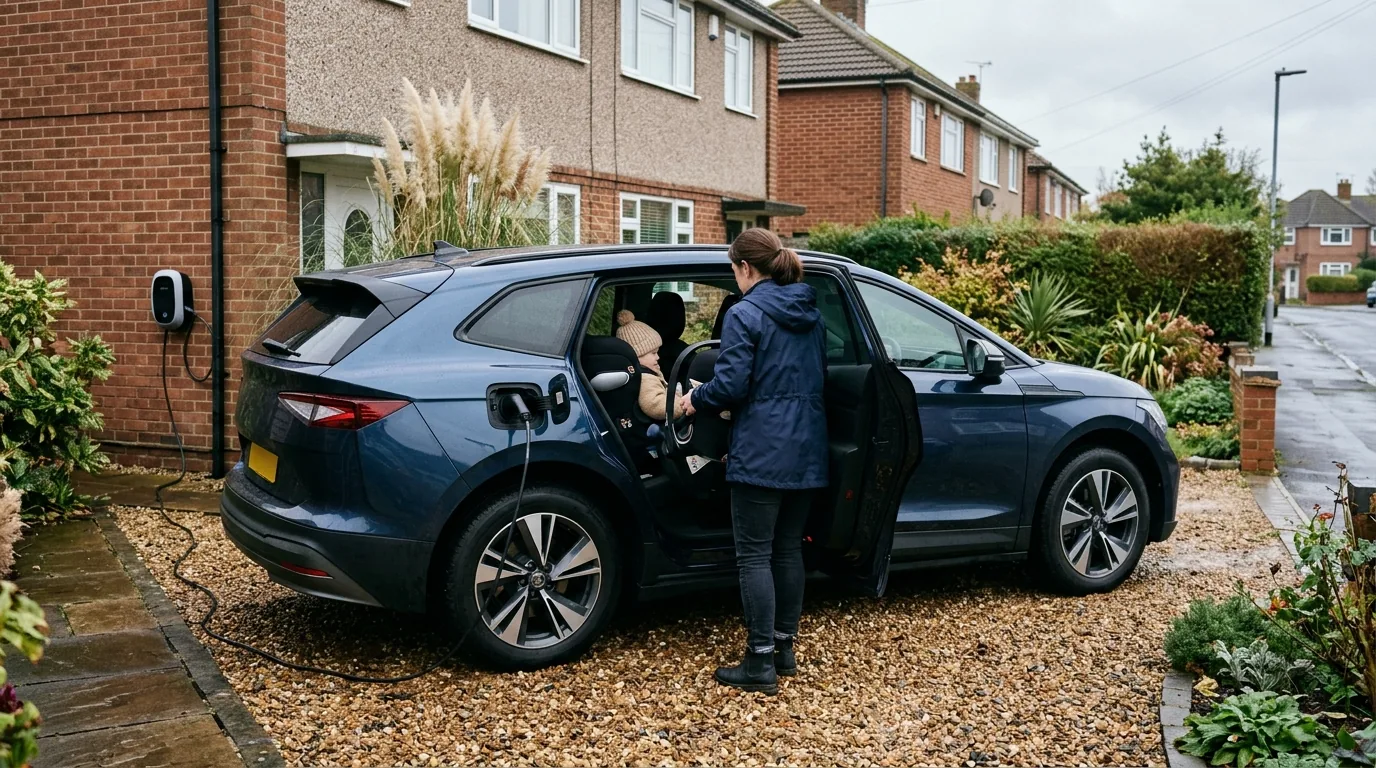
At home, Kia says a 7.2 kW wallbox charges the battery in 9 hours 25 minutes and an 11 kW three-phase charger in 6 hours 20 minutes. Auto Express quotes roughly 9.5 hours at 7.2 kW and DrivingElectric 10 hours 30 minutes at 7.4 kW, so an overnight charge refills it from empty.
| Kia Niro EV charging | Figure | Source |
|---|---|---|
| DC rapid maximum | 72 kW | Kia |
| DC, 10 to 80% | About 45 minutes | Kia at launch, Auto Express, DrivingElectric |
| DC on a 50 kW charger | 1 hour 5 minutes | Kia |
| AC, 7.2 kW wallbox | 9 hours 25 minutes | Kia |
| AC, 11 kW three-phase | 6 hours 20 minutes | Kia |
| Full charge at home, 6.5p/kWh | £4.21 | EV Compared |
| Full charge on the price cap, 26.32p/kWh | £17.06 | EV Compared |
| Full charge on a rapid charger, 82p/kWh | £53.14 | EV Compared |
Our charging costs multiply the 64.8 kWh battery by the price per kWh and ignore charging losses: Intelligent Octopus Go’s 6.5p/kWh off-peak rate, Ofgem’s 26.32p/kWh price cap for October to December 2026 and Zapmap’s October 2026 rapid average of 82p/kWh.
The 72 kW peak is the Niro EV’s clearest weakness. Auto Express pointed out that it is slower than the e-Niro’s 77 kW, and DrivingElectric wrote that “rivals top 100kW or more, which feels more fitting in this day and age.” On a long trip that means longer stops than in most newer rivals.
The older e-Niro takes 54 minutes from 10 to 80% in our data. On our figures, the first 10 minutes on a rapid charger add about 37 miles of WLTP range to an e-Niro 64 kWh and about 23 miles to the 39 kWh version, assuming 70% of the battery goes in during the 10 to 80% time. A full charge on a 7 kW wallbox takes about 9.1 hours for the 64 kWh car and 5.6 hours for the 39 kWh car.
Vehicle-to-load is standard on the Niro EV ‘3’ and ‘4’, so the car can power a device from a three-pin socket. Best Chargers covers choosing a home charger.
What does the Kia Niro EV cost to run?
The Kia Niro EV costs 1.5p per mile charged at home on a 6.5p/kWh off-peak tariff, 6.0p per mile on the price cap rate and 18.6p per mile on a public rapid charger, on our figures. Driving 8,000 miles a year would cost about £118 at home off-peak, £479 at the price cap rate and £1,492 if every mile came from rapid chargers.
The e-Niro 64 kWh costs the same per mile at 1.5p, 6.0p and 18.6p, or £118, £478 and £1,489 over 8,000 miles. The 39 kWh e-Niro costs 1.4p, 5.7p and 17.8p a mile, or £113, £456 and £1,421 a year.
Vehicle tax. Both generations pay the £200 standard rate, as zero-emission cars registered after 1 April 2017. The Niro EV’s list price is below £50,000, and zero-emission cars registered before 1 April 2025 do not pay the £440 expensive car supplement.
Company car tax. The Niro EV falls in the 4% benefit-in-kind band for 2026/27, HMRC’s tables show.
Insurance. Auto Express gives the Niro EV insurance group 28 or 29, depending on trim.
Warranty. Kia’s warranty runs for seven years or 100,000 miles and covers the motor, power electronics and on-board charger. The battery is covered for eight years, and Kia will repair or replace it if its capacity falls below 70%. The cover transfers to the next owner, so a used Niro EV registered in 2023 stays covered until 2030 unless it passes 100,000 miles first.
Kia Niro EV boot, space and towing
The Niro EV’s boot holds 475 litres with the rear seats up and 1,392 litres with them folded, and there is a 20-litre storage box under the bonnet. Auto Express listed “plenty of boot space” among its pros, and What Car? praised the generous rear space and large boot.
The car is 4,420 mm long, 1,825 mm wide and 1,585 mm tall, Auto Express reports, and Kia gives a 10.6-metre turning circle. It weighs 1,757 kg and can tow a 750 kg braked trailer.
What Car? noted weak over-the-shoulder visibility and no ski hatch in the rear seat.
What the testers say
Auto Express gave the Niro EV 4 out of 5 in Max Adams and Alex Ingram’s review, updated 28 March 2024. They called it “among the best electric family cars on the market right now”, praised the tech-filled cabin, boot space and warranty, and listed a “competitive rather than class-leading range”, sub-par rapid charging and road noise as cons. They said the Niro EV “prioritises comfort, and it is at its best when driving around town”.
What Car? reviewed it in Will Nightingale’s review, updated 18 October 2024. It found more than 250 miles of real-world range, a comfortable ride, a modern and easy cabin and a long warranty, but criticised the slow charging, hard plastics, motorway road noise and price. It called the Niro EV “a fine all-rounder that’s relatively practical” but said the Kia EV3 is cheaper, better equipped, goes further and charges faster.
DrivingElectric gave it 4 out of 5 in Tom Jervis’s review of 13 February 2024. He called it “a desirable and well-rounded electric family car with an unbeatable seven-year warranty”, praised its looks, efficiency and technology, and marked it down for average range, slow charging and refinement behind some rivals.
The three agree that the Niro EV is a comfortable, practical and efficient family car, and that its rapid charging lags behind. These are their findings, not EV Compared’s; we have not driven the car.
Is the Kia Niro EV safe and reliable?
The Niro EV has a four-star Euro NCAP rating with its standard equipment, rising to five stars with the optional safety pack, from tests published in September 2022. It scored 91% for adult occupant protection, 84% for child occupants, 75% for vulnerable road users and 60% for safety assist. Euro NCAP tested the electric version, and the rating covers the hybrid and plug-in hybrid too.
On reliability, What Car? reported that the Niro EV finished just outside the top five electric cars in its 2024 reliability survey, and Kia ranked 11th of 31 brands.
We could not confirm a DVSA recall list for the Niro EV or e-Niro by model. Before buying either car used, enter its registration on the DVSA recall checker, which shows any outstanding manufacturer recall and the car’s MOT history, and ask a Kia dealer to confirm all recall work has been done.
How does the Kia Niro EV compare with its rivals?
The Kia Niro EV’s final list price now sits above several newer rivals that come close to its range and charge faster. The Nissan Leaf costs £28,849 with 280 miles of WLTP range, 105 kW charging and a 437-litre boot, and it is in Band 1 of the Electric Car Grant, worth up to £3,750. On our measure the Leaf costs £103 of list price per mile of range, against £131 for the Niro EV ‘2’.
| Model and version | List price | Range (WLTP) | DC charging | Boot |
|---|---|---|---|---|
| Nissan Leaf Engage 52kWh | £28,849 | 280 miles | 105 kW | 437 litres |
| MINI Aceman E | £29,060 | 192 miles | 75 kW | 300 litres |
| Ford Puma Gen-E Select 46.8kWh | £29,995 | 259 miles | 100 kW | 523 litres |
| Toyota C-HR+ Icon 57.7 kWh FWD | £34,495 | 284 miles | 150 kW | 416 litres |
| Kia Niro EV ‘2’ 64.8kWh (2022 to 2026) | £37,325 | 285 miles | 72 kW | 475 litres |
| Hyundai IONIQ 5 Advance 63kWh 170PS RWD | £40,695 | 273 miles | 260 kW | 520 litres |
| Kia EV6 Air 84.0kWh RWD | £45,635 | 361 miles | 258 kW | Not published |
The Niro EV keeps one advantage in this table: its 285-mile WLTP range is the highest of the cars priced below the EV6, if only just ahead of the Toyota C-HR+ at 284 miles. Its 72 kW peak is the lowest. The C-HR+ costs £2,830 less, charges at up to 150 kW and takes 28 minutes from 10 to 80%, though its boot is smaller at 416 litres.
The Ford Puma Gen-E has the biggest boot here, at 523 litres, and costs £29,995 with Band 1 grant eligibility, but its range is 259 miles. The MINI Aceman is smaller, with a 300-litre boot and 192 miles. The Hyundai IONIQ 5 charges at up to 260 kW and goes from 10 to 80% in 18 minutes, with a 520-litre boot, for £40,695.
Kia Niro EV or Kia EV6? The Kia EV6 costs £45,635 and brings 361 miles of WLTP range, 258 kW charging and an 18-minute 10 to 80% time. On our measure it costs £126 of list price per mile of range, less than any Niro EV trim, and it can tow 1,800 kg against the Niro’s 750 kg.
If the EV6 appeals, our comparison of the Kia EV6 and Hyundai Ioniq 5 covers how the two faster-charging cars differ on range and charging.
Kia Niro EV or Kia EV3?
The Kia EV3 is the closest alternative in Kia’s current line-up: Kia lists it from £33,005 in November 2026, and it is in Band 2 of the Electric Car Grant, worth up to £1,500. What Car? found the EV3 cheaper, better equipped and faster to charge, with more range. Choose a used Niro EV over a new EV3 for a lower price and a proven family car; choose the EV3 if you want a new car with faster charging.
Should you buy a Kia Niro EV?
Buy a Kia Niro EV if you can charge at home, need a practical family crossover and want low running costs and a long, transferable warranty. It costs 1.5p a mile on an off-peak home tariff, its 475-litre boot is bigger than the Nissan Leaf’s, Toyota C-HR+‘s or MINI Aceman’s, and UK testers rate it as comfortable and easy to live with. The ‘2’ is the pick if you buy from remaining stock, at £131 of list price per mile of range, and a used Niro EV keeps whatever is left of Kia’s seven-year cover. A ‘4’ with the heat pump is the version to look for if you drive a lot in winter.
Do not buy one if you often drive long distances and depend on public rapid chargers, because the 72 kW peak and roughly 45-minute 10 to 80% time trail most newer rivals. If your budget reaches a new car at the Niro EV’s final list price, the Kia EV3, Toyota C-HR+ and Nissan Leaf all charge faster for less money, and all three are on the government grant list.
A used e-Niro 64 kWh is a cheaper way into the same formula, with 282 miles of WLTP range. Avoid the 39 kWh version if you regularly drive long days, because its WLTP range is 180 miles.
Our verdict rests on published data and the named reviews above: the Kia Niro EV is a sound, sensible electric family car that is best bought used, and its slow charging is the reason to look elsewhere if you travel far.
How we test and where our numbers come from
Range figures are official WLTP combined values taken from manufacturer UK specification pages, with real-world estimates drawn from independent comparative testing. Prices are UK list prices at the time of the latest update. Tax, grant and charging-scheme figures come from GOV.UK and HMRC publications. We re-check every guide when pricing, specification or policy changes. Last checked 27 November 2026. How we work out our own figures.
Frequently asked questions
Is the Kia Niro EV still on sale in the UK?
No, not as a current model. Electrifying.com reported on 11 April 2026 that Kia had killed off the Niro EV, and Kia's UK model range lists only the Niro Plug-In Hybrid in November 2026. Kia's Niro pricing page still shows the final EV prices, from £37,325, so ask a dealer about any remaining stock.
How much is the Kia Niro EV?
Kia's final list prices are £37,325 for the '2', £39,575 for the '3', £42,325 for the '4' and £43,225 for the '4' with a heat pump. When order books opened in September 2022 the '2' cost £34,995. The Niro EV is not on the government's Electric Car Grant list.
What is the range of the Kia Niro EV?
The Kia Niro EV has an official WLTP range of 285 miles on every trim, from a 64.8 kWh battery. What Car? measured 253 miles in its real-world test of a '4', and Auto Express estimated about 240 miles from an average of 3.7 miles per kWh in mixed driving.
How long does a Kia Niro EV take to charge?
Kia says a 7.2 kW home wallbox charges the Niro EV in 9 hours 25 minutes and an 11 kW three-phase charger in 6 hours 20 minutes. On a rapid charger it peaks at 72 kW, and Auto Express, DrivingElectric and Kia's launch figures put 10 to 80% at about 45 minutes.
What are the downsides of the Kia Niro EV?
The main downside is slow rapid charging: the Niro EV peaks at 72 kW, below the e-Niro's 77 kW, Auto Express found. What Car? also criticised road noise on the motorway, hard interior plastics, weak over-the-shoulder visibility and the price against the newer Kia EV3.
Is the Kia Niro only available as an EV?
No. The Niro has also been sold as a hybrid and as a plug-in hybrid. Kia lists the Niro Plug-In Hybrid from £35,485 in November 2026, with an 11.1 kWh battery and 37 to 40 miles of electric-only range. Only the Niro EV, formerly the e-Niro, is fully electric.
What is the difference between the Kia e-Niro and the Niro EV?
The e-Niro is the first-generation car, sold from 2019 to 2022 with a 64 kWh or 39 kWh battery. The Niro EV replaced it in 2022 with new styling and technology, a 64.8 kWh battery and 285 miles of WLTP range against the e-Niro 64 kWh's 282 miles.
Sources and further reading
- kia.comKia UK: Niro pricingNiro EV 64.8 kWh on-the-road prices: '2' £37,325, '3' £39,575, '4' £42,325, '4' with heat pump £43,225; Niro Plug-In Hybrid 11.1 kWh battery.
- kia.comKia UK: Niro specificationNiro EV 64.8 kWh battery, 285 miles WLTP combined, 162 Wh/km; 7.2 kW in 9 hours 25 minutes, 11 kW in 6 hours 20 minutes, 50 kW DC in 1 hour 5 minutes; boot 475 and 1,392 litres plus 20-litre front storage; 10.6 m turning circle; kerb weight 1,757 kg; 750 kg braked towing; 201 bhp; 0 to 62mph 7.8 seconds; standard equipment by grade; heat pump optional on grade 4 only; Niro Plug-In Hybrid 37 to 40 miles in EV mode.
- kia.comKia UK: Model rangeChecked 10 November 2026: no Niro EV listed; Niro Plug-In Hybrid from £35,485; EV3 from £33,005; EV6 from £45,635; electric models EV2, EV3, EV4, EV5, EV6 and EV9.
- kia.comKia UK: 7-year warrantySeven years or 100,000 miles, transferable to later owners; motor, power electronics and on-board charger covered; battery covered for 8 years against capacity falling below 70%.
- electrifying.comElectrifying.com: Kia sells 100,000 EVs in the UK and kills one of its most successful modelsLucas Cochrane, 11 April 2026: the Niro EV has been killed off; 2026 Niro facelift applies to the hybrid; no direct replacement named.
- electrifying.comElectrifying.com: Kia opens order books for new Niro EV and confirms final UK prices and specsLaunch prices £34,995, £37,745 and £40,495; 201 bhp; torque cut from 395 Nm to 255 Nm to reduce wheelspin; 72 kW peak against 77 kW before; Kia quoted about 45 minutes for 10 to 80%, up to nine minutes faster than before; navigation-linked battery preconditioning; vehicle-to-load on '3' and '4'; first deliveries autumn 2022.
- zapmap.comZapmap: Kia adds e-Niro 39 kWh and faster charging to range26 June 2020: e-Niro '2' 39 kWh, 180 miles, 100 kW motor, £29,595 after the £3,000 Plug-in Car Grant; '3' 64 kWh, 282 miles, 150 kW, £33,850; '4+' 64 kWh, 282 miles, 11 kW three-phase AC, £36,145; '2' and '3' 7 kW AC; DC up to 100 kW.
- autoexpress.co.ukAuto Express: Kia Niro EV (2022 to 2026) reviewMax Adams and Alex Ingram, 28 March 2024, 4 out of 5: about 240 miles real-world at 3.7 miles per kWh; 72 kW against the e-Niro's 77 kW; 10 to 80% in at least 45 minutes; about 9.5 hours at 7.2 kW; 4,420 x 1,825 x 1,585 mm; insurance groups 28 to 29; road noise; tech-filled cabin.
- whatcar.comWhat Car?: Kia Niro EV reviewWill Nightingale, updated 18 October 2024: 253 miles in What Car?'s real-world test of a '4'; slow 72 kW charging; comfortable ride; road noise; hard plastics; poor over-the-shoulder visibility; no ski hatch; EV3 cheaper, better equipped, goes further and charges faster; just outside the top five EVs and Kia 11th of 31 brands in its 2024 reliability survey.
- drivingelectric.comDrivingElectric: Kia Niro EV reviewTom Jervis, 13 February 2024, 4 out of 5: spacious, relaxed family car; very efficient; average range; slow charging; 45 minutes 10 to 80% at up to 72 kW; 10 hours 30 minutes at 7.4 kW; heat pump only optional on the '4'.
- euroncap.comEuro NCAP: Kia Niro 2022 resultsPublished 7 September 2022: four stars standard, five with the safety pack; adult occupant 91%, child occupant 84%, vulnerable road users 75%, safety assist 60%; electric 150 kW version tested; applies to hybrid, plug-in hybrid and electric.
- gov.ukGOV.UK: Zero-emission vehicle grants, carsChecked 10 November 2026: Kia models listed are EV2 Long Range and EV4 in Band 1 (up to £3,750) and EV2, EV3 and PV5 Passenger in Band 2 (up to £1,500); no Niro EV; Ford Puma Gen-E and Nissan Leaf in Band 1; Toyota C-HR+ in Band 2.
- gov.ukGOV.UK: Vehicle tax rate tablesZero-emission cars registered from 1 April 2017: £10 first-year rate, £200 standard rate; £440 expensive car supplement above a £50,000 list price, not payable by zero-emission cars registered before 1 April 2025.
- gov.ukHMRC Employment Income Manual: EIM247054% appropriate percentage for zero-emission cars in 2026/27.
- gov.ukGOV.UK: Check if a vehicle, part or accessory has been recalledDVSA recall checker: enter a car's registration to see manufacturer recalls and MOT history.
- ofgem.gov.ukOfgem: Changes to energy price cap between 1 October and 31 December 2026Average electricity unit rate of 26.32p/kWh, used in our charging cost figures.
- zapmap.comZapmap: Charging price indexOctober 2026 average rapid and ultra-rapid pay-as-you-go price of 82p/kWh.
- bestchargers.co.ukBest Chargers: Octopus EV tariffsIntelligent Octopus Go off-peak rate of 6.5p/kWh from 23:30 to 05:30, used in our home charging figures.

EV Compared
The EV Compared editorial team tracks the UK electric vehicle market full time: new model launches, list prices, WLTP and real-world range, public charging tariffs and the tax rules that decide what an EV actually costs to run. Every guide is checked against manufacturer specifications and official GOV.UK figures, and updated whenever the numbers move.