BYD Seal U DM-i review (UK): plug-in hybrid price, electric range, running costs, verdict
The BYD Seal U DM-i is a roomy, well-equipped plug-in hybrid SUV from £33,205 with up to 77 miles of WLTP electric range, but UK testers find it dull to drive with a soft ride, and its 425-litre boot is small for the class.
Our verdict
The BYD Seal U DM-i suits families who can charge at home, want a lot of space and equipment for the money, and do most of their driving within its 50 to 77 miles of electric range. Drivers who care about ride comfort and handling, need a big boot, or cannot plug in regularly should look at its rivals first.
For
- Comfort version has 77 miles of WLTP electric range from a 26.6 kWh battery, and a 7% company car tax rate in 2026/27
- Long standard equipment list: head-up display, heated steering wheel, heated and ventilated front seats, panoramic roof and 360-degree camera on both the Boost and the Design
- Generous rear seat space, praised by Auto Express, Carwow and Drive
- Quiet, smooth hybrid system that UK testers rate highly for refinement
Against
- Auto Express, Carwow, Electrifying.com and Drive all criticise the soft ride, body lean or numb steering
- 425-litre boot is small for a car 4,775 mm long
- DC charging tops out at 18 kW, so a public rapid charger saves little time
This is a data verdict: it rests on manufacturer specifications, UK pricing, independent range testing, reliability surveys and owner reports, not on a road test by EV Compared.
BYD Seal U DM-i at a glance
| Price from | £33,205 |
|---|---|
| Battery | 18.3 kWh |
| WLTP range | 50 miles |
| Peak rapid charging | 18 kW |
| Boot | 425 litres |
| Price (BYD UK on the road) | £33,205 Boost; £35,205 Comfort; £39,905 Design AWD |
| Powertrain | 1.5-litre petrol plug-in hybrid; front-wheel drive (Boost, Comfort) or all-wheel drive (Design) |
| Usable battery | 18.3 kWh (Boost, Design); 26.6 kWh (Comfort) |
| WLTP electric range | 50 miles Boost; 77 miles Comfort; 43 miles Design |
| AC charging | 11 kW (Boost, Design) |
| DC charging | 18 kW (Boost, Design) |
| System power | 160 kW Boost; 238 kW Design |
| 0 to 62mph | 8.9 seconds Boost; 5.9 seconds Design |
| Boot | 425 litres |
| Kerb weight | 1,940 kg Boost; 2,100 kg Design |
| Length, width, height | 4,775 mm, 1,890 mm, 1,670 mm |
| Seats | 5 |
| Warranty | 6 years / 150,000 km; battery 8 years / 250,000 km (70% state of health) |
| Electric Car Grant | Not eligible |
Quick answers
- The BYD Seal U DM-i plug-in hybrid costs £33,205 as the Boost, £35,205 as the Comfort and £39,905 as the Design AWD on BYD UK's on-the-road price list.
- WLTP electric range is 50 miles for the Boost, 77 miles for the Comfort with its larger 26.6 kWh battery, and 43 miles for the four-wheel-drive Design.
- On our sums, charging the Boost's 18.3 kWh battery at a 6.5p/kWh off-peak rate costs £1.19, or 2.4p a mile, against 30.0p a mile on a public rapid charger at 82p/kWh.
- The Boost and Design charge at up to 11 kW on AC and 18 kW on DC, with BYD quoting 35 minutes for a 30 to 80% rapid charge.
- Company car drivers pay 7% benefit in kind on the Comfort and 10% on the Boost and Design in 2026/27, because of their CO2 and electric range.
- Auto Express rates the Seal U DM-i 3.5 out of 5; it and Carwow both praise the space and refinement and criticise the soft ride.
- The boot holds 425 litres with the seats up and 1,440 litres folded, smaller than the Hyundai Tucson plug-in hybrid's 558 litres on Carwow's figures.
The BYD Seal U DM-i is a five-seat plug-in hybrid SUV priced from £33,205 on BYD UK’s list, with 43 to 77 miles of WLTP electric range depending on version. It is roomy, quiet and loaded with equipment, but UK testers find its ride soft and its handling dull, and its 425-litre boot is small for the class.
The Seal U DM-i is BYD’s plug-in hybrid version of its Seal U family SUV. It pairs a 1.5-litre petrol engine with BYD’s Blade battery and one or two electric motors, and it comes in three versions: Boost, Comfort and Design. Our guide to every BYD on sale in the UK covers the rest of the brand’s range. EV Compared has not driven the car; this review rests on BYD’s published data, our own running cost sums and the UK road tests named below.
Verdict: who should buy the BYD Seal U DM-i and who should not?
Buy the Seal U DM-i if you can charge at home, most of your daily driving fits inside its electric range, and you want a spacious, well-equipped family SUV for the money. The Comfort is the one to choose: its 26.6 kWh battery gives 77 miles of WLTP electric range for £35,205, enough for most commutes without starting the engine, and it falls into the 7% company car tax band for 2026/27.
Do not buy one if you enjoy driving or want a settled ride. Auto Express, Carwow, Electrifying.com and Drive all criticise the soft suspension, body lean or numb steering. Look elsewhere too if you carry a lot of luggage, because the 425-litre boot trails family SUVs such as the MG HS, Hyundai Tucson and Volkswagen Tiguan on Carwow’s figures, or if you cannot plug in at home, because a flat battery leaves you with a heavy petrol SUV.
How much is the BYD Seal U DM-i, and which version should you choose?
The Seal U DM-i costs £33,205 as the Boost, £35,205 as the Comfort and £39,905 as the Design AWD, on the on-the-road price list on BYD UK’s media site, checked on 10 November 2026. All three are plug-in hybrids; the difference between them is the battery size and whether you get one electric motor or two.
| Version | Usable battery | Drive | Power | 0 to 62mph | WLTP electric range | Price (BYD UK OTR) |
|---|---|---|---|---|---|---|
| Boost | 18.3 kWh | Front-wheel | 160 kW (218 PS) | 8.9 sec | 50 miles | £33,205 |
| Comfort | 26.6 kWh | Front-wheel | Same as Boost (Auto Express) | 8.9 sec (Auto Express) | 77 miles | £35,205 |
| Design AWD | 18.3 kWh | All-wheel | 238 kW (324 PS) | 5.9 sec | 43 miles | £39,905 |
The Boost uses a 1.5-litre petrol engine with a single 145 kW front motor, and Auto Express lists the Comfort with the same power and performance. The Design swaps in a 1.5-litre turbo engine and uses two motors, 150 kW at the front and 120 kW at the rear, for all-wheel drive, which lifts system torque from 300 Nm to 550 Nm. Top speed is 106 mph for the Boost and 112 mph for the Design.
Equipment barely changes between versions. BYD lists the same core kit on the Boost and the Design: 19-inch alloy wheels, a 15.6-inch rotating touchscreen, a 12.3-inch digital instrument panel, a head-up display, vegan leather seats, heated and ventilated front seats, a heated steering wheel, a panoramic roof, an electric tailgate, a 10-speaker Infinity sound system, two wireless phone chargers, multi-colour ambient lighting and a 360-degree camera. Apple CarPlay and Android Auto are standard, and so is vehicle-to-load, which lets you run electrical equipment from the battery. The main difference BYD lists is that the Design adds Sand and Muddy driving modes.
That is why the testers steer buyers away from the top version. Electrifying.com’s reviewer recommended the cheaper Boost over the Design, because the extra £6,700 buys little more equipment, and Auto Express names the Comfort as the best buy for its larger battery. For £2,000 over the Boost, the Comfort adds 27 miles of electric range.
No version qualifies for the Electric Car Grant. The government’s list includes no BYD, and eligible cars must emit nothing at the tailpipe, which rules out every plug-in hybrid.
How far does the BYD Seal U DM-i go on electric power?
The Seal U DM-i has a WLTP electric range of 50 miles as the Boost, 77 miles as the Comfort and 43 miles as the Design AWD. BYD also quotes total ranges, with a full battery and a full 60-litre fuel tank, of 671 miles for the Boost, 699 miles for the Comfort and 540.6 miles for the Design.
The system is designed to run on electricity first. Our explainer on plug-in hybrids, mild hybrids and electric cars sets out how this differs from a self-charging hybrid. In a plug-in hybrid like the Seal U, the official mpg figure depends heavily on how often you charge: BYD quotes 44.0mpg combined for the Boost and 38.0mpg for the Design.
UK testers have recorded a wide range of results. Electrifying.com averaged 82mpg in the Boost over a 30-mile mixed route, and 45mpg in the Design. Auto Express recorded 50.5mpg in the Comfort in its own economy test and called that competitive with a diesel. Drive warns that without regular charging, fuel use approaches that of a large petrol SUV.
The practical answer is simple. If your daily driving fits well inside the Boost’s 50 miles and you plug in every night, you will rarely use the engine. The Comfort’s 77 miles gives you a wider margin for cold weather and motorway speeds, which both cut electric range.
How fast does the BYD Seal U DM-i charge?
The Boost and Design charge at up to 11 kW on AC and 18 kW on DC. BYD says an 11 kW AC charge from 15 to 100% takes 120 minutes, and an 18 kW DC charge from 30 to 80% takes 35 minutes. BYD’s model page does not list charging figures for the Comfort.
| Charging | Boost (18.3 kWh) | Comfort (26.6 kWh) |
|---|---|---|
| 7 kW home wallbox, empty to full (our sums) | 2.6 hours | 3.8 hours |
| Full charge at 6.5p/kWh off-peak | £1.19 | £1.73 |
| Full charge at 26.32p/kWh price cap | £4.82 | £7.00 |
| Full charge at 82p/kWh public rapid | £15.01 | £21.81 |
| BYD’s quoted DC time | 30 to 80% in 35 minutes at 18 kW | Not listed by BYD |
These are our own figures: the usable battery multiplied by the price per kWh, and divided by 7 kW for the wallbox time, ignoring charging losses, as set out in our methodology. The 6.5p rate is Octopus’s Intelligent Octopus Go off-peak price, 26.32p is Ofgem’s average price cap rate for October to December 2026, and 82p is Zapmap’s average rapid charger price for October 2026.
A 7 kW home wallbox refills even the Comfort’s larger battery in under four hours on our sums, well inside a night’s off-peak window. If you need help choosing or installing a home charger, our partner site Best Chargers compares them.
Public rapid charging makes little sense in this car. At 18 kW, a DC charger adds energy only a little faster than an 11 kW AC point, and at 82p/kWh a full Boost battery costs £15.01 for 50 miles of WLTP range.
What does the BYD Seal U DM-i cost to run?
On electricity alone, the Boost costs 2.4p a mile charged at home at 6.5p/kWh, 9.6p a mile at the 26.32p price cap rate and 30.0p a mile on public rapid chargers at 82p/kWh. We divided the 50-mile WLTP range by the 18.3 kWh battery to get 2.73 miles per kWh, then divided each electricity price by that figure.
| Running cost on electricity | Boost | Comfort | Design AWD |
|---|---|---|---|
| Miles per kWh (WLTP range ÷ battery) | 2.73 | 2.89 | 2.35 |
| Pence a mile, home off-peak 6.5p | 2.4p | 2.2p | 2.8p |
| Pence a mile, price cap 26.32p | 9.6p | 9.1p | 11.2p |
| Pence a mile, public rapid 82p | 30.0p | 28.3p | 34.9p |
| 8,000 miles, home off-peak | £190 | £180 | £221 |
| 8,000 miles, price cap | £771 | £727 | £896 |
| List price per mile of WLTP electric range | £664 | £457 | £928 |
The 8,000-mile figures assume every mile is driven on electricity charged at home, which no plug-in hybrid driver manages, so read them as the lowest possible energy bill rather than a forecast. Our comparison of running costs for electric and hybrid cars puts these numbers alongside petrol.
The Comfort is the most efficient version on paper and the cheapest per mile of electric range, at £457 against £664 for the Boost and £928 for the Design. That is our own sum: list price divided by WLTP electric range.
| Tax and ownership | Boost | Comfort | Design AWD |
|---|---|---|---|
| CO2 (BYD) | 20.5 g/km | 9 g/km | 26 g/km |
| Company car tax, 2026/27 | 10% | 7% | 10% |
| First-year VED | £115 | £115 | £115 |
| VED from year two | £200 a year | £200 a year | £200 a year |
| Expensive car supplement | Not payable | Not payable | Not payable |
| Warranty | 6 years / 150,000 km | 6 years / 150,000 km | 6 years / 150,000 km |
Company car drivers gain most. HMRC’s 2026/27 table puts a car with 1 to 50 g/km and 70 to 129 miles of electric range at 7%, so the Comfort’s taxable benefit on its £35,205 list price is £2,464 a year: about £493 for a basic-rate taxpayer and £986 at 40%. The Boost and Design, with 40 to 69 miles of range, sit at 10%: £3,321 and £3,991 of taxable benefit, or £664 and £798 a year at 20%. The real P11D value excludes first-year VED and the registration fee, so actual bills will be slightly lower.
All three versions are under the £40,000 threshold for the £440 expensive car supplement, the Design by £95. Private buyers pay £115 for the first year of VED and £200 a year after that, the standard rate for petrol and alternative fuel cars.
How big is the BYD Seal U DM-i, and how practical is it?
The Seal U DM-i is 4,775 mm long, 1,890 mm wide and 1,670 mm high, with a 425-litre boot that grows to 1,440 litres with the rear seats folded. It seats five.
That boot is the weak point. Carwow compares it with 507 litres in the MG HS, 558 litres in the Hyundai Tucson and 652 litres in the Volkswagen Tiguan, and notes a shallow floor and a lip at the opening. Auto Express says the plug-in hybrid hardware takes up space and leaves little room under the floor, and Drive calls the boot only average.
Rear seat space is the strength. Auto Express found room for three adults across the back, Carwow calls it really spacious, and Drive praises the generous rear legroom and raised driving position. Carwow adds that door bins and the glovebox are modest, but the deep armrest cubby is useful.
The car is heavy: BYD gives a kerb weight of 1,940 kg for the Boost and 2,100 kg for the Design. BYD’s model page does not list a towing limit.
What do the testers say about the BYD Seal U DM-i?
UK testers agree that the Seal U DM-i is good value, quiet and roomy, and that it is not a good car to drive. Here is what four of them found.
Auto Express rated the Seal U 3.5 out of 5 in a review updated in April 2026. Its testers called the ride soft and wallowy on bumpy A-roads, said level crossings and speed bumps quickly became sources of dread, and said the steering is devoid of any feedback. They praised the quiet cabin at motorway speeds, the reasonably upmarket feel and the rear space, but found the engine harsh when pushed and the car entirely forgettable to drive. They named the Comfort as the best buy.
Carwow’s review, updated in July 2026, lists a smooth, refined hybrid engine, a really spacious cabin and great value for money as the strengths. Against those it sets a soft ride that sends a shudder through the cabin over potholes, heavy body lean in corners, plain styling and an adaptive cruise control that pulses the power. Its reviewers say the Ford Kuga is far more enjoyable to drive.
Electrifying.com reviewed the Seal U DM-i in September 2024. Its reviewer called the hybrid system easily the quietest they had come across and found no fault with the fit and finish, but described a ride that wallows over crests and steering that feels over-assisted and remote. The review called the 425-litre boot a bit of a let-down next to the Toyota RAV4 and Volkswagen Tiguan plug-in hybrids.
Drive’s review by Al Suttie found the car easy to drive in town and stable on the motorway, but unsettled on rough country roads, with little steering feedback. It praised the spacious, well-finished cabin and long equipment list, found the on-screen climate controls distracting, and recommended the Comfort for its range. Drive’s conclusion: not the most polished SUV to drive, but an appealing family car for anyone who charges regularly.
The pattern across all four is consistent. Price, space, equipment and refinement earn praise; the ride, handling and boot draw criticism.
Is the BYD Seal U DM-i safe and reliable?
The Seal U DM-i carries a five-star Euro NCAP rating. Euro NCAP tested the Seal U in 2023, and its 2024 update says additional tests and checks confirm that the rating applies to the plug-in hybrid. BYD reports that the Seal U scored 90% for adult occupant protection and 86% for child occupant protection.
The DVSA’s vehicle recall service listed no recalls for the 2024 or 2025 Seal U DM-i when we checked on 10 November 2026. If you are buying a used one, enter its registration on the DVSA service before you pay.
Standard driver assistance on the Boost and Design, according to BYD, includes adaptive cruise control, blind spot detection, lane keep assistance and rear cross traffic alert with automatic braking. Carwow’s reviewer found the adaptive cruise control’s pulsing of the power unpleasant.
Warranty cover is long. BYD gives six years or 150,000 km on the car, and in January 2026 extended its Blade Battery warranty to eight years or 250,000 km, with a guaranteed 70% state of health, for UK cars including those already on the road. We found no independent UK reliability survey that has published a score for the Seal U DM-i yet.
How does the BYD Seal U DM-i compare with its rivals?
At its £33,205 starting price, the Seal U DM-i Boost’s nearest rivals on list price in our spec data are one other plug-in hybrid SUV and five fully electric ones. The plug-in hybrid is the Chery Tiggo 8 Super Hybrid, which costs £340 more, gives 56 miles of WLTP electric range and seven seats, but has a 117-litre boot with every seat in use.
The others in the table are fully electric, with 209 to 392 miles of WLTP range. They include the Omoda E5 electric SUV, the Kia EV3, the Volvo EX30, the Renault Scenic E-Tech and the Toyota Urban Cruiser.
| Car | List price | WLTP range | Peak DC charging | Boot |
|---|---|---|---|---|
| Kia EV3 Air SR 58.3 kWh (electric) | £33,055 | 270 miles | Not listed | 460 litres |
| Volvo EX30 Core P5 51 kWh (electric) | £33,060 | 209 miles | 134 kW | 318 litres |
| Omoda E5 Knight (electric) | £33,065 | 267 miles | Not listed | 370 litres |
| BYD Seal U DM-i Boost (plug-in hybrid) | £33,205 | 50 miles (electric) | 18 kW | 425 litres |
| Renault Scenic E-Tech Techno 220hp Long Range (electric) | £33,245 | 392 miles | 150 kW | 545 litres |
| Toyota Urban Cruiser Design 61 kWh (electric) | £33,495 | 264 miles | 67 kW | 244 litres |
| Chery Tiggo 8 Super Hybrid Aspire (plug-in hybrid) | £33,545 | 56 miles (electric) | 40 kW | 117 litres |
| BYD Seal U DM-i Design AWD (plug-in hybrid) | £39,905 | 43 miles (electric) | 18 kW | 425 litres |
Against the Tiggo 8, the Seal U trades two extra seats for a much bigger everyday boot, and its Comfort version beats the Tiggo’s electric range by 21 miles. The Tiggo charges faster on DC, at 40 kW against 18 kW.
Every electric car in the table costs less per mile to run on home electricity. On our sums at 6.5p/kWh, the Kia EV3 costs 1.4p a mile, and the Omoda E5, Volvo EX30, Renault Scenic and Toyota Urban Cruiser 1.5p, against 2.4p for the Seal U Boost on electricity alone. The Renault Scenic has the longest range in this group, 392 miles, and the largest boot, 545 litres, for £40 more than the Seal U Boost.
If you are comparing Chinese plug-in hybrid SUVs more widely, our Jaecoo 7 review covers another choice in this price band.
Should you go fully electric instead?
Go fully electric if you can charge at home and your longer trips fit comfortably inside the 209 to 392 miles of WLTP range the electric cars in the table above offer. They cost about the same as the Seal U Boost, run for 1.4p to 1.5p a mile at home on our sums, and never need petrol.
The plug-in hybrid only saves money if you plug it in nearly every day. Choose the Seal U DM-i over an electric car if you regularly drive long distances and would rather refuel than stop to charge, or if rapid chargers are scarce on your usual routes. BYD’s quoted 671 to 699 miles of total range is the plug-in hybrid’s real selling point.
If you like BYD but want to drop the engine, the brand’s Sealion 7 electric SUV is its fully electric family SUV. For company car drivers, a fully electric car’s benefit in kind rate in 2026/27 is 4%, lower than the Comfort’s 7%, so an electric rival usually costs less in tax as well as energy.
Should you buy a BYD Seal U DM-i?
The Seal U DM-i suits a family with a driveway, a daily commute inside its electric range and the occasional long trip, who wants rear seat space, a quiet cabin and a long equipment list for the money. Choose the Comfort: for £35,205 it gives 77 miles of WLTP electric range, costs 2.2p a mile on electricity charged at home off-peak on our figures, and sits in the 7% company car tax band for 2026/27.
It does not suit drivers who want a comfortable, composed ride or any enjoyment from the steering, since all four UK reviews above fault how it drives. It does not suit buyers who need a large boot, or anyone without home charging, who would mostly be paying for petrol in a car weighing 1,940 kg or more. The Design AWD is hard to justify: it costs £6,700 more than the Boost, has the shortest electric range of the three and adds little equipment.
EV Compared has not driven the Seal U DM-i. This verdict rests on BYD’s published figures, our own running cost sums and the UK reviews named above.
How we test and where our numbers come from
Range figures are official WLTP combined values taken from manufacturer UK specification pages, with real-world estimates drawn from independent comparative testing. Prices are UK list prices at the time of the latest update. Tax, grant and charging-scheme figures come from GOV.UK and HMRC publications. We re-check every guide when pricing, specification or policy changes. Last checked 10 November 2026. How we work out our own figures.
Frequently asked questions
What is the best spec BYD Seal U DM-i?
The Comfort is the version Auto Express and Drive recommend. Auto Express names it the best buy, because its 26.6 kWh battery gives 77 miles of WLTP electric range, against 50 for the Boost, for £2,000 more at £35,205. It also falls into the 7% company car tax band in 2026/27.
Is the BYD Seal U DM-i a plug-in hybrid or electric?
The Seal U DM-i is a plug-in hybrid. It pairs a 1.5-litre petrol engine with electric drive and a battery you charge from a socket, giving 43 to 77 miles of WLTP electric range depending on version.
How far can the BYD Seal U DM-i go on electric power?
The Comfort goes 77 miles on electricity on the WLTP test, the Boost 50 miles and the Design AWD 43 miles. BYD quotes a total range of 671 miles for the Boost and 699 miles for the Comfort with a full battery and a full 60-litre fuel tank.
How long does the BYD Seal U DM-i take to charge?
BYD says the Boost and Design charge from 15 to 100% in 120 minutes on an 11 kW AC charger, and from 30 to 80% in 35 minutes on an 18 kW DC charger. On a 7 kW home wallbox, a full 18.3 kWh charge takes about 2.6 hours on our sums.
Is the BYD Seal U DM-i a good car?
It is good value but not good to drive, according to UK testers. Auto Express rates it 3.5 out of 5. Auto Express and Carwow both praise the rear space and the quiet, refined hybrid system, and both criticise the soft ride, body movement and steering that gives little feedback.
How big is the BYD Seal U DM-i boot?
The boot holds 425 litres with the rear seats up and 1,440 litres with them folded, on BYD's figures. Testers call it small for the class: Carwow compares it with 507 litres in the MG HS, 558 in the Hyundai Tucson and 652 in the Volkswagen Tiguan.
What warranty does the BYD Seal U DM-i have?
BYD gives six years or 150,000 km on the car. In January 2026 it extended the Blade Battery warranty to eight years or 250,000 km, with a guaranteed 70% state of health, for cars in the UK, including existing owners.
Sources and further reading
- bydukmedia.comBYD SEAL U DM-i: models, specifications and pricesBYD UK's on-the-road prices for Boost, Comfort and Design; battery sizes; WLTP electric and total ranges; 11 kW AC (15 to 100% in 120 minutes) and 18 kW DC (30 to 80% in 35 minutes); power, motor outputs, torque, 0 to 62mph, top speed, CO2, mpg, 60-litre tank, boot, kerb weight, dimensions, standard equipment and driver assistance (checked 10 November 2026).
- bydukmedia.comBYD extends warranty of Blade Battery to eight years or 250,000kmBattery warranty of eight years or 250,000 km with 70% minimum state of health, applying in the UK and to existing owners; six-year or 150,000 km vehicle warranty (15 January 2026).
- autoexpress.co.ukBYD Seal U reviewAuto Express rating of 3.5 out of 5; Comfort named best buy with the same power and 8.9-second 0 to 62mph as the Boost; soft, wallowy ride, steering without feedback, harsh engine when pushed, quiet cabin, roomy rear seats, 425-litre boot, 50.5mpg in its own economy test (updated 9 April 2026).
- carwow.co.ukBYD Seal U reviewBoost most popular; soft ride, body lean, light steering, smooth and refined hybrid system, spacious rear, boot compared with MG HS, Hyundai Tucson and VW Tiguan (updated 27 July 2026).
- electrifying.comBYD Seal U DM-i reviewVery quiet hybrid system, soft ride that wallows over crests, over-assisted and remote steering, 82mpg for the Boost and 45mpg for the Design on a 30-mile mixed route, Boost recommended over the Design, boot called a let-down (23 September 2024).
- drive.co.ukBYD Seal U DM-i reviewDrive's UK review by Al Suttie: Comfort recommended for its range, unsettled ride on rough roads, little steering feedback, spacious and well-finished cabin, distracting on-screen climate controls, boot only average (2026).
- news.euroncap.comBYD SEAL-U: Euro NCAP 2023 results, 5 starsFive-star rating released 6 December 2023; 2024 update says additional tests and checks confirm the rating applies to the SEAL-U PHEV variant.
- byd.comBYD SEAL U and BYD TANG awarded 5 stars in Euro NCAP safety testsSeal U scores of 90% for adult occupant protection and 86% for child occupant protection (December 2023).
- check-vehicle-recalls.service.gov.ukCheck vehicle recalls: BYD Seal U DM-i 2024DVSA recall service listed no recalls for the 2024 Seal U DM-i when checked on 10 November 2026.
- check-vehicle-recalls.service.gov.ukCheck vehicle recalls: BYD Seal U DM-i 2025DVSA recall service listed no recalls for the 2025 Seal U DM-i when checked on 10 November 2026.
- gov.ukEIM24705: appropriate percentages for cars with CO2 emissions of 1 to 50 g/kmCompany car tax rates for 2026 to 2027: 7% for 70 to 129 miles of electric range and 10% for 40 to 69 miles, up from 6% and 9% in 2025 to 2026; 4% for 0 g/km cars in 2026 to 2027.
- gov.ukVehicle tax rate tablesFirst-year rate of £115 for 1 to 50 g/km, standard rate of £200, and the £440 expensive car supplement above a £40,000 list price for petrol cars.
- gov.ukElectric Car Grant: eligible carsNo BYD model is on either grant band, and eligible cars must emit 0 g/km at the tailpipe (checked 10 November 2026).
- octopus.energyIntelligent Octopus Go6.5p/kWh off-peak EV charging rate (checked 10 November 2026).
- ofgem.gov.ukEnergy price cap unit rates and standing chargesAverage Direct Debit electricity unit rate of 26.32p/kWh from 1 October to 31 December 2026.
- zapmap.comZapmap charging price indexAverage pay-as-you-go price of 82p/kWh on rapid and ultra-rapid chargers in October 2026.

EV Compared
The EV Compared editorial team tracks the UK electric vehicle market full time: new model launches, list prices, WLTP and real-world range, public charging tariffs and the tax rules that decide what an EV actually costs to run. Every guide is checked against manufacturer specifications and official GOV.UK figures, and updated whenever the numbers move.
Rivals and related reading
View all
MHEV meaning: mild hybrid vs plug-in hybrid vs electric car explained
MHEV stands for mild hybrid electric vehicle: a petrol or diesel car with a small 48-volt motor that helps the engine but can never drive the car on electricity alone.
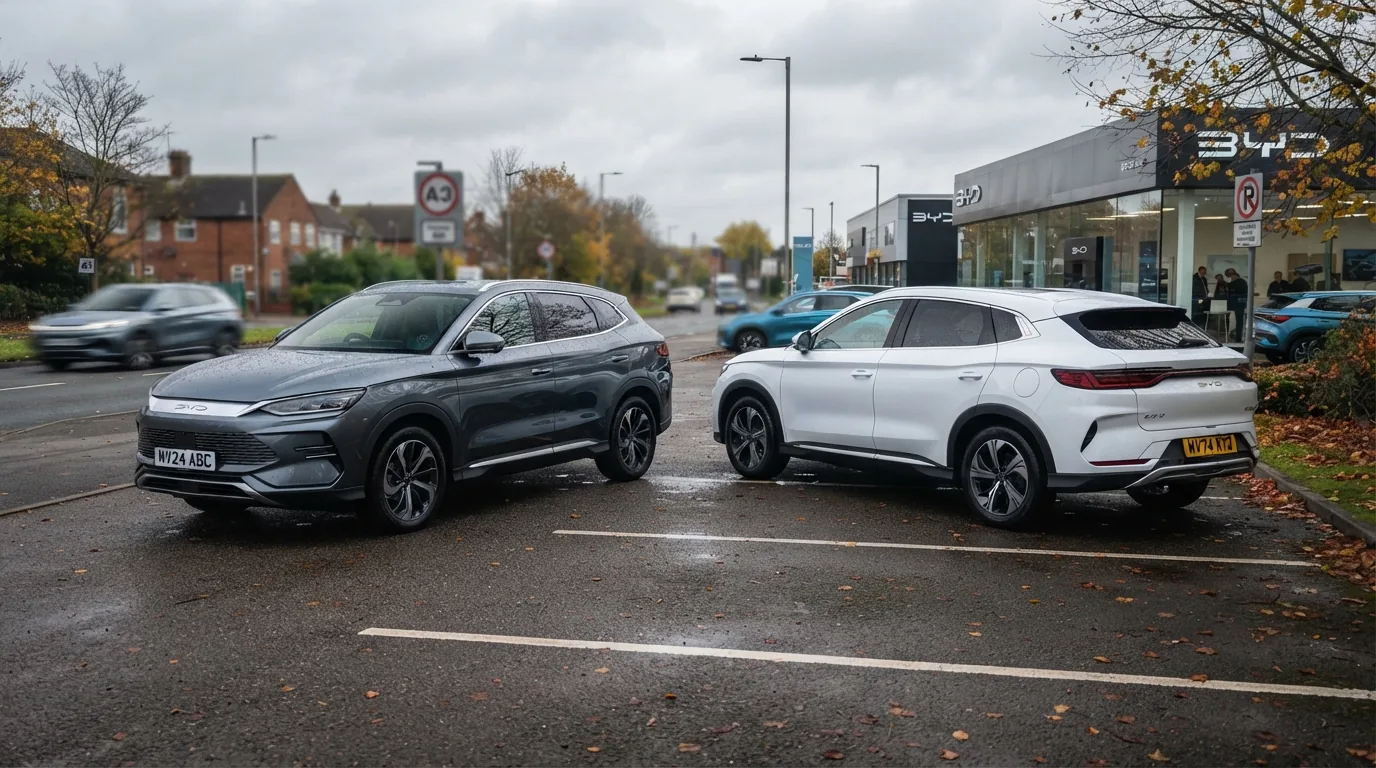
BYD hits record 20,129 UK sales in September, second only to VW
BYD outsold every brand except Volkswagen without any Electric Car Grant help, and plug-in hybrids appear to have done much of the lifting. Here is what its push means for deals and resale values.