VW ID.7 review (UK): price, range, charging, verdict
The VW ID.7 is a large, quiet and roomy electric saloon from £51,445 with up to 433 miles of official range, but UK testers find it dull to drive, and every version costs enough to pay the expensive car tax supplement.
Our verdict
The VW ID.7 suits high-mileage drivers and families who charge at home and want a big, quiet, comfortable electric car with up to 433 miles of official range and a 532-litre boot, or 605 litres in the Tourer estate. It does not suit buyers who want an engaging drive, physical buttons or the most range for their money, because the BMW i3, Tesla Model 3 and Mercedes CLA Electric all give more WLTP miles per pound of list price.
For
- Up to 433 miles of WLTP range from the Pro S Match Plus 86kWh saloon
- 532-litre hatchback boot, or 605 litres in the ID.7 Tourer estate
- Quiet, refined and comfortable on the motorway, according to Auto Express, Carwow and Drive
- About 1.3p to 1.5p a mile when charged at home on an off-peak tariff, on EV Compared's sums
Against
- Every version costs over £50,000, so it pays the £440 expensive car supplement for five years
- UK testers find it unexciting to drive and too reliant on touchscreen controls
- £140 of list price per mile of WLTP range for the entry saloon, more than any rival in our table
This is a data verdict: it rests on manufacturer specifications, UK pricing, independent range testing, reliability surveys and owner reports, not on a road test by EV Compared.
Volkswagen ID.7 at a glance
| Price from | £51,445 |
|---|---|
| Battery | 77 kWh |
| WLTP range | 368 miles |
| Peak rapid charging | 185 kW |
| Boot | 532 litres |
| Price from (saloon) | £51,445, Pro Match Plus 77kWh (November 2026) |
| Price from (Tourer estate) | £52,225, Pro Match Plus 77kWh (November 2026) |
| Battery (usable) | 77 kWh or 86 kWh |
| Range (WLTP, saloon) | 364 to 433 miles |
| Range (WLTP, Tourer) | 357 to 422 miles |
| Peak DC charging | 185 kW (77 kWh saloon), 199 kW (Pro S saloon), 200 kW (GTX Plus) |
| AC charging | 11 kW |
| Power | 210 kW, or 250 kW for the GTX Plus |
| 0 to 62mph | 5.4 to 6.6 seconds (saloon) |
| Drive | Rear-wheel drive; four-wheel drive (4MOTION) on the GTX Plus |
| Boot | 532 litres (saloon), 605 litres (Tourer) |
| Length, width, height | 4,961 mm, 1,862 mm, 1,536 mm (Tourer 1,551 mm tall) |
| Seats | 5 |
| Warranty | 3 years or 60,000 miles; battery 8 years or 100,000 miles |
Quick answers
- The VW ID.7 saloon costs from £51,445 for the Pro Match Plus 77kWh in November 2026, rising to £54,930 for the Pro S Match Plus 86kWh and £59,640 for the four-wheel-drive GTX Plus.
- The Pro S Match Plus has the longest official range of the three saloons at 433 miles; the Pro Match Plus manages 368 miles and the GTX Plus 364 miles.
- A full charge of the 77 kWh battery costs about £5.00 at home on a 6.5p/kWh off-peak tariff, or about 1.4p a mile, against 17.2p a mile at an 82p/kWh public rapid charger, on EV Compared's sums.
- The ID.7 Tourer estate costs from £52,225 and has a 605-litre boot, 73 litres more than the saloon's 532 litres.
- Every ID.7 is priced above £50,000, so from the second year it pays £200 standard road tax plus the £440 expensive car supplement, for five years.
- Volkswagen UK's battery recall, campaigns 93MV and 93MF, covers some ID.7s with batteries made by one supplier between 2022 and 2025, which are capped at 80% charge until a free check.
- Euro NCAP gave the ID.7 five stars in December 2023, with 95% for adult occupants, and the rating also covers the Tourer.
The VW ID.7 is Volkswagen’s large electric saloon, priced from £51,445 in November 2026 with a 77 kWh battery and 368 miles of WLTP range, or £54,930 for an 86 kWh version that goes 433 miles. UK testers praise it as quiet, roomy and comfortable on long journeys, and criticise its touchscreen controls, unexciting handling and price. EV Compared has not driven the ID.7; this review rests on Volkswagen’s published figures, Euro NCAP’s results and the named UK reviews below.
Verdict: who should buy the VW ID.7 and who should not
Buy a VW ID.7 if you cover long distances, can charge at home, and want a big, hushed five-seater with a large boot. The Pro S Match Plus 86kWh is the one to pick on these figures: £3,485 more than the entry car buys 65 more miles of official range, and it costs £127 of list price per mile of range against £140 for the Pro Match Plus, on EV Compared’s sums. On a 6.5p/kWh overnight tariff, each mile costs about 1.3p.
Do not buy one if you want a car that is fun on a country road, if you dislike controlling the heating through a touchscreen, or if price matters most. Every UK tester we read finds the ID.7 competent rather than engaging, and the BMW i3, Tesla Model 3 and Mercedes CLA Electric all deliver more WLTP range per pound of list price than any ID.7. Every ID.7 also costs more than £50,000, so it pays an extra £440 a year in road tax for five years.
If you want a smaller, cheaper electric Volkswagen, our guide to every Volkswagen electric car on sale in the UK sets the ID.7 against the ID.3, ID.4 and the rest of the range.
How much is the VW ID.7, and what trims are there?
The ID.7 saloon costs from £51,445 in November 2026, and there are three trims, according to Drive and Volkswagen UK. All have five seats and an 11 kW onboard charger. The Pro versions drive the rear wheels with 210 kW; the GTX Plus adds a front motor for four-wheel drive (Volkswagen’s 4MOTION) and 250 kW.
| Trim (saloon) | List price (November 2026) | Battery (usable) | Range (WLTP) | Peak DC charging | 0 to 62mph | Drive |
|---|---|---|---|---|---|---|
| Pro Match Plus 77kWh | £51,445 | 77 kWh | 368 miles | 185 kW | 6.5 seconds | Rear-wheel |
| Pro S Match Plus 86kWh | £54,930 | 86 kWh | 433 miles | 199 kW | 6.6 seconds | Rear-wheel |
| GTX Plus 4MOTION 86kWh | £59,640 | 86 kWh | 364 miles | 200 kW | 5.4 seconds | Four-wheel |
The ID.7 Tourer estate comes in the same three trims at £52,225, £55,710 and £60,400, according to the RAC: £780 more than the saloon for the Pro trims and £760 more for the GTX Plus. We cover it in its own section below.
No ID.7 qualifies for the government’s Electric Car Grant. GOV.UK’s list of eligible cars includes the ID.3, ID.3 Neo, ID.4, ID.5, ID. Cross and ID. Polo, but not the ID.7.
Options come in packs. Auto Express’s price list shows the Interior Plus pack adding £2,020 to the Pro Match Plus and the Exterior Plus pack with a panoramic roof adding £2,880, so a fully optioned entry car costs £4,900 more than its base price. Our ID.7 price, specs and trims guide breaks down each version and pack in detail.
Volkswagen UK also runs an “ID. Promise” on new ID. models ordered between 3 November 2025 and 31 December 2026: you can return the car between 80 and 100 days after delivery for a refund, minus deductions that include 3% depreciation and any damage.
What equipment and interior does the ID.7 have?
The Pro Match Plus and Pro S Match Plus come with a 15-inch touchscreen, an augmented reality head-up display, a 360-degree Area View camera and keyless entry, according to Volkswagen UK’s Tourer page, which lists the standard equipment the two trims share. Auto Express adds that wireless Apple CarPlay and Android Auto and a nine-speaker stereo are standard, and that the 12-speaker Harman Kardon system needs the £2,000 Interior Pack.
Volkswagen UK lists a heat pump as standard on the Tourer Pro Match Plus and Pro S Match Plus. Carwow’s saloon review describes it as an optional extra, so confirm whether the car you order has one; it matters for winter range.
Testers agree the cabin is a step up from older ID. models. Auto Express found more soft-touch materials on the doors and dashboard and a responsive screen, though some functions sit deep in sub-menus. Carwow called the infotainment a major improvement over the ID.3, ID.4 and ID. Buzz systems but found the dashboard dark and button-free and the centre console cupholders cheap. Drive’s review calls the cabin too reliant on touchscreen controls, and the RAC singles out the touchscreen-only control of the air vents.
How far does the VW ID.7 go on a charge?
The ID.7 saloon has an official WLTP range of 368 miles with the 77 kWh battery, 433 miles as the Pro S Match Plus with the 86 kWh battery, and 364 miles as the four-wheel-drive GTX Plus. That works out at 4.78 miles per kWh for the Pro Match Plus, 5.03 for the Pro S Match Plus and 4.23 for the GTX Plus. Our method divides the WLTP range by the usable battery capacity and ignores charging losses, as set out in our methodology.
Real-world range is lower, as on every electric car. Auto Express recorded 3.4 miles per kWh from a 77 kWh Pro in a group test, which it says is about 262 miles, and 3.6 miles per kWh over 5,000 miles in a long-term Pro S, about 310 miles. Carwow’s testers estimate about 300 miles in real-world driving if you avoid heavy acceleration. These are their findings, not EV Compared’s.
The gap between the two batteries is the main reason to pay for the Pro S. Its extra 9 kWh adds 65 miles of WLTP range, and its efficiency is slightly better on paper. The GTX Plus gives up 69 miles against the Pro S for its extra motor and quicker acceleration.
For WLTP and real-world figures side by side, plus winter range, see our ID.7 real-world range and charging guide.
How long does the ID.7 take to charge?
On a 7 kW home wallbox, a full charge takes about 11 hours for the 77 kWh battery and about 12.3 hours for the 86 kWh battery, on EV Compared’s sums, so either fills up overnight. Drive gives the same picture: about 11 and 12 hours on a 7.2 kW wallbox. The 11 kW onboard charger cuts that to about 8 hours, Carwow says, if you have three-phase power at home or use 11 kW public posts.
On a rapid charger, the saloon peaks at 185 kW with the 77 kWh battery, 199 kW as the Pro S Match Plus and 200 kW as the GTX Plus. Volkswagen does not publish a 10 to 80% time for the saloon on its UK page. Carwow quotes about 28 minutes for the 77 kWh car, Drive says “a little less than half an hour” in ideal conditions, and Auto Express measured 20 to 80% in 21 minutes in a Pro S Tourer. The Tourer, which uses the same batteries, takes about 27 minutes for the 77 kWh car and 26 minutes for the 86 kWh cars, according to the RAC.
| Where you charge (Pro Match Plus 77kWh) | Price per kWh | Full charge (EV Compared) | Cost per mile (EV Compared) | Cost of 8,000 miles (EV Compared) |
|---|---|---|---|---|
| Home, Intelligent Octopus Go off-peak | 6.5p | £5.00 | 1.4p | £109 |
| Home, standard tariff at the Ofgem price cap | 26.32p | £20.27 | 5.5p | £441 |
| Public rapid charger, Zapmap October 2026 average | 82p | £63.14 | 17.2p | £1,373 |
For the Pro S Match Plus 86kWh, a full charge costs £5.59 at home off-peak, £22.64 at the price cap and £70.52 on a rapid charger, or 1.3p, 5.2p and 16.3p a mile. The GTX Plus costs the same to fill but uses more per mile: 1.5p, 6.2p and 19.4p.
These figures use the usable battery and WLTP range. The off-peak rate is Intelligent Octopus Go’s 6.5p/kWh, the standard rate is Ofgem’s 26.32p/kWh average for 1 October to 31 December 2026, and the rapid rate is Zapmap’s October 2026 average of 82p/kWh. To get the home figures you need a wallbox and a smart tariff; Best Chargers covers choosing and installing a home charger.
What does the ID.7 cost to run?
The ID.7 is cheap to fuel at home, but its list price adds road tax costs that cheaper electric cars avoid. Here are the main costs in November 2026.
Road tax. From the second year, electric cars pay the £200 standard rate. Every ID.7 has a list price above £50,000, so it also pays the £440 expensive car supplement for five years from the second time it is taxed, according to GOV.UK. That makes £640 a year in years two to six.
Company car tax. The ID.7 sits in the 4% benefit-in-kind band for 2026 to 2027, according to GOV.UK. On the £51,445 list price, which is slightly above the P11D value company car tax uses, that is about £412 a year for a 20% taxpayer and £823 for a 40% taxpayer, on our sums. Company car drivers are the buyers for whom the ID.7’s price matters least.
Insurance. Auto Express lists groups 39E for the Pro and Pro S and 41E for the GTX, and Drive gives groups 38 or 39 for the Pro models.
Warranty. Volkswagen covers the car for 3 years or 60,000 miles and the battery for 8 years or 100,000 miles. Drive says Volkswagen will repair or replace the battery if its capacity falls below 70% in that time.
List price per mile of range. The Pro Match Plus costs £140 of list price for each mile of WLTP range, the Pro S Match Plus £127 and the GTX Plus £164, on our sums. We compare those figures with rivals further down.
How big is the ID.7, and how practical is it?
The ID.7 is a large car: 4,961 mm long, 1,862 mm wide and 1,536 mm tall, with five seats. The saloon is actually a hatchback, with a tailgate that opens on to a 532-litre boot. Carwow gives 1,586 litres with the rear seats folded, and notes a ski hatch but no front boot.
Rear space is a strength. Auto Express found generous knee room and more headroom than in the BMW i4 or Tesla Model 3. Carwow found plenty of legroom but limited headroom for anyone over about six feet, and a narrow centre seat. The 60/40 rear bench folds almost flat, according to Auto Express.
Size cuts both ways. Drive notes that the ID.7’s length is worth considering if you drive mostly in town.
Towing is modest. Auto Express gives a braked limit of up to 1,200 kg for the GTX, with a towbar costing about £1,000, and points out that a Volkswagen Passat can tow up to 1,800 kg. If you tow a caravan, get the figure for your exact trim from the retailer before you order.
ID.7 Tourer: is the estate worth the extra?
If you need a bigger boot, yes: the ID.7 Tourer costs £780 more than the equivalent Pro saloon, or £760 more as a GTX Plus, and gives 605 litres of boot space, 73 litres more. It is the same length and width, 15 mm taller at 1,551 mm, and uses the same batteries and motors.
| Trim (Tourer) | List price (November 2026) | Battery (usable) | Range (WLTP) | Peak DC charging | 10 to 80% | Boot |
|---|---|---|---|---|---|---|
| Pro Match Plus 77kWh | £52,225 | 77 kWh | 371 miles | 175 kW | 27 minutes | 605 litres |
| Pro S Match Plus 86kWh | £55,710 | 86 kWh | 422 miles | 200 kW | 26 minutes | 605 litres |
| GTX Plus 4MOTION 86kWh | £60,400 | 86 kWh | 357 miles | 200 kW | 26 minutes | 605 litres |
The Tourer Pro S Match Plus adds about 114 miles of range in 10 minutes on a rapid charger, and the Pro Match Plus and GTX Plus about 96, on our sums. That assumes 70% of the battery goes in during the 10 to 80% time. The Pro S Match Plus costs £132 of list price per mile of range, against £141 for the Pro Match Plus and £169 for the GTX Plus.
The RAC’s Lawrence Allan reviewed the Tourer in July 2026 and called it Volkswagen’s best electric car, praising its range, space and comfort. He found more fun-to-drive rivals, some fiddly cabin technology, and little reason to pay for the GTX over the cheaper versions.
Is the ID.7 safe, and has it been recalled?
Euro NCAP gave the ID.7 five stars on 6 December 2023, with 95% for adult occupants, 88% for child occupants, 83% for vulnerable road users and 80% for safety assist. The rating covers the hatchback and the estate, including right-hand-drive cars.
Volkswagen UK has opened safety recall campaigns 93MV and 93MF for ID.3, ID.4 and ID.7 cars fitted with high-voltage batteries made by one supplier between 2022 and 2025. Volkswagen says charging these batteries above 80% can cause overheating and a fire risk, so it is limiting affected cars to 80% charge, in most cases remotely, until a dealer has checked them. DC rapid charging still works within the limit, and checks and any battery module replacement are free. Our report on the ID.7 battery recall and its 80% charge cap explains what the cap means in miles and how to tell whether it is active.
Not every ID.7 is affected; it depends on the battery’s supplier and build date. If you are looking at a used ID.7, check its registration on the GOV.UK vehicle recall checker and ask the seller whether the recall work has been done.
What the testers say
UK reviewers agree that the ID.7 is comfortable, quiet, spacious and long-legged, and that it is neither exciting to drive nor cheap. Here is what four published reviews found; none of these findings are EV Compared’s own.
Auto Express, 4 out of 5 (May 2026). Shane Wilkinson and Richard Ingram called the ID.7 the best EV in Volkswagen’s line-up and said it justifies its price with its cabin, technology and driving experience. They found the ride supple at low speeds, especially with the optional adaptive suspension, and the motorway refinement strong, but the car fidgety on rough surfaces. It leans in bends and responds lazily to quick changes of direction, and the brakes feel soft.
Carwow. Tom Wiltshire summed the ID.7 up as a “long-range EV with plenty of space and a posh interior”, adding: “just don’t expect it to be exciting to drive”. He found it a relaxed motorway cruiser, very quiet at speed, with an “extremely pillowy” softest suspension setting.
Drive. Richard Aucock called the ID.7 “a very impressive all-rounder” and “exceptionally refined and grown-up to drive”, with a spacious interior, a useful hatchback boot and much-improved infotainment. He criticised the price, the narrow choice of trims and powertrains, the reliance on touchscreen controls and the effect of larger wheels on ride comfort.
RAC, Tourer (July 2026). Lawrence Allan rated the Tourer highest for safety, strong for interior and technology, practicality, and range and charging, and lowest for value.
How does the VW ID.7 compare with its rivals?
The entry ID.7 is the second most expensive car in the table below, and its 532-litre boot is beaten only by the Tesla Model 3’s 594 litres, but it gives less WLTP range per pound than any of its rivals.
| Model and version | List price | Battery (gross) | Range (WLTP) | DC charging | Boot |
|---|---|---|---|---|---|
| Tesla Model 3 Rear-Wheel Drive | £37,990 | 62.5 kWh | 332 miles | 175 kW | 594 litres |
| Mercedes-Benz CLA Electric CLA 200 Sport 58kWh | £39,150 | not published | 331 miles | 200 kW | 405 litres |
| MG IM5 75 Standard Range | £39,950 | 75 kWh | 304 miles | 153 kW | 457 litres |
| BYD Seal Design RWD 82.5kWh (MY26) | £45,730 | 82.5 kWh | 354 miles | 150 kW | 485 litres |
| BMW i3 40 xDrive | £47,925 | 86.9 kWh | 441 miles | 300 kW | 420 litres |
| Volkswagen ID.7 Pro Match Plus 77kWh | £51,445 | 82 kWh | 368 miles | 185 kW | 532 litres |
| Mercedes-Benz C-Class Electric C 400 4MATIC Sport | £57,995 | not published | 452 miles | 330 kW | 470 litres |
On our list price per mile of range figure, the entry ID.7 costs £140 for each mile of WLTP range, against £109 for the BMW i3, £114 for the Tesla Model 3, £118 for the Mercedes CLA, £128 for the Mercedes C-Class Electric, £129 for the BYD Seal and £131 for the MG IM5. The ID.7 Pro S Match Plus, at £127, edges ahead of the C-Class, Seal and IM5 but still trails the BMW, Tesla and CLA.
BMW i3. The new BMW i3 40 xDrive costs £3,520 less, goes 441 miles, charges at up to 300 kW and has four-wheel drive. It was open for orders rather than on the road on 10 November 2026, and its 420-litre boot is 112 litres smaller.
Tesla Model 3. The Model 3 is £13,455 cheaper and costs about 1.2p a mile at home against 1.4p, on our sums, with a 594-litre boot. Our ID.7 vs Tesla Model 3 range comparison sets the two side by side.
BYD Seal. The BYD Seal electric saloon costs £45,730, goes 354 miles and charges at up to 150 kW, with a 485-litre boot. It is £5,715 cheaper, but the ID.7 goes further and charges faster.
MG IM5. The MG IM5 electric saloon is the budget alternative at £39,950, with 304 miles and a 7-year or 80,000-mile warranty, far longer than Volkswagen’s 3 years.
Mercedes CLA and C-Class Electric. The CLA 200 is a smaller, cheaper car with 331 miles and a 405-litre boot. The C 400 4MATIC costs £1,645 less than the ID.7 GTX Plus, goes 452 miles and charges at up to 330 kW, though its boot is 62 litres smaller.
If you want an electric Volkswagen with a higher driving position instead, the VW ID.4 family SUV is the brand’s mid-size alternative.
Should you buy a VW ID.7?
Yes, if you drive long distances, charge at home and want a comfortable, quiet and roomy car that feels well made. The Pro S Match Plus 86kWh at £54,930 is the version to choose on the figures: 433 miles of official range, about 310 miles in Auto Express’s long-term test, and about 1.3p a mile on an overnight tariff on our sums. Families who need more space should pay £780 more for the Pro S Tourer and its 605-litre boot.
No, if you want an enjoyable drive, physical controls, or the most range for your money. The BMW i3 and Tesla Model 3 give more WLTP miles per pound, the MG IM5 and BYD Seal cost much less, and the ID.7’s price means £640 a year in road tax from year two. If you are buying used, check whether the battery recall applies. EV Compared has not driven the ID.7; this verdict rests on Volkswagen’s figures, Euro NCAP’s results and the four UK reviews above.
How we test and where our numbers come from
Range figures are official WLTP combined values taken from manufacturer UK specification pages, with real-world estimates drawn from independent comparative testing. Prices are UK list prices at the time of the latest update. Tax, grant and charging-scheme figures come from GOV.UK and HMRC publications. We re-check every guide when pricing, specification or policy changes. Last checked 10 November 2026. How we work out our own figures.
Frequently asked questions
Is the VW ID.7 a good car?
UK testers rate it highly as a comfortable long-distance car. Auto Express gives it 4 out of 5 and calls it the best EV in Volkswagen's line-up, Carwow calls it a long-range EV with plenty of space and a posh interior, and the RAC calls the Tourer Volkswagen's best electric car. The common criticisms are dull handling, touchscreen-heavy controls and a high price.
How much is the VW ID.7 in the UK?
The ID.7 saloon costs from £51,445 for the Pro Match Plus 77kWh in November 2026. The Pro S Match Plus 86kWh costs £54,930 and the GTX Plus £59,640. The ID.7 Tourer estate costs £52,225, £55,710 and £60,400 for the same three trims. No version qualifies for the Electric Car Grant.
What is the real-world range of the VW ID.7?
Expect roughly 260 to 310 miles in mixed use, based on UK tests. Auto Express recorded 3.4 miles per kWh, about 262 miles, from a 77kWh Pro in a group test, and 3.6 miles per kWh, about 310 miles, over 5,000 miles in a Pro S. The official WLTP figures are 368 and 433 miles.
How long does the VW ID.7 take to charge?
About 11 hours from empty on a 7 kW home wallbox for the 77 kWh battery and about 12.3 hours for the 86 kWh battery, on EV Compared's sums. On a rapid charger, Carwow quotes about 28 minutes from 10 to 80% for the 77 kWh saloon, and the RAC gives 27 and 26 minutes for the 77 kWh and 86 kWh Tourer.
What is the difference between the ID.7 and the ID.7 Tourer?
The Tourer is the estate version. It has the same length, batteries and trims, but its boot holds 605 litres against 532 litres in the saloon, and it is 15 mm taller. It costs £780 more for the Pro trims and £760 more for the GTX Plus, and its official ranges are slightly lower: 357 to 422 miles against 364 to 433 miles.
Is the VW ID.7 affected by the battery recall?
Some ID.7s are. Volkswagen UK's campaigns 93MV and 93MF cover ID.3, ID.4 and ID.7 cars with batteries from one supplier made between 2022 and 2025. Affected cars are capped at 80% charge until a free dealer check, and Volkswagen says full range returns once the work is done.
Sources and further reading
- drive.co.ukDrive: Volkswagen ID.7 reviewRichard Aucock's review: £51,445, £54,930 and £59,640 trim prices, 368 and 433 miles WLTP, 185 kW and 199 kW peak DC charging, about 11 and 12 hours on a 7.2 kW wallbox, 532-litre boot, insurance groups 38 and 39, warranty and 70% battery threshold, verdict and praise and criticism.
- volkswagen.co.ukVolkswagen UK: ID.7Three trims (Pro Match Plus, Pro S Match Plus, GTX Plus), 77 kWh and 86 kWh batteries, 364 to 433 miles WLTP, 0 to 62mph in 5.4 to 6.6 seconds, ID. Promise return offer (80 to 100 days after delivery).
- volkswagen.co.ukVolkswagen UK: ID.7 TourerTourer trims, 371 and 422 miles WLTP, 357 to 422 mile range, 0 to 62mph in 5.5 to 6.7 seconds, standard equipment on the Pro Match Plus and Pro S Match Plus including 15-inch screen, augmented reality head-up display, Area View camera, Keyless Access and heat pump.
- autoexpress.co.ukAuto Express: Volkswagen ID.7 reviewShane Wilkinson and Richard Ingram, 13 May 2026, 4 out of 5: verdict, ride, handling, interior, wireless Apple CarPlay and Android Auto, £2,000 Interior Pack, rear space, real-world efficiency of 3.4 and 3.6 miles per kWh, 20 to 80% in 21 minutes in a Pro S Tourer, insurance groups 39E and 41E, 1,200 kg GTX towing limit, rivals.
- autoexpress.co.ukAuto Express: Volkswagen ID.7 prices and specsVariant list showing 0 to 62mph of 6.5, 6.6 and 5.4 seconds for the 77 kWh, 86 kWh and GTX Plus versions, and Pro Match Plus prices with the Interior Plus pack (£2,020 more), the Exterior Plus pack with panoramic roof (£2,880 more) and both (£4,900 more).
- carwow.co.ukCarwow: Volkswagen ID.7 reviewTom Wiltshire: verdict, comfort, interior, infotainment, rear headroom, 532 and 1,586-litre boot, ski hatch, no front boot, about 300 miles real-world, 10 to 80% in about 28 minutes, about 8 hours on 11 kW, heat pump described as optional, rivals.
- rac.co.ukRAC Drive: Volkswagen ID.7 Tourer reviewLawrence Allan, 3 July 2026: Tourer prices of £52,225, £55,710 and £60,400, 175 kW and 200 kW peak DC, 10 to 80% in about 27 and 26 minutes, 605-litre boot, category ratings, verdict, praise and criticism.
- euroncap.comEuro NCAP: Volkswagen ID.7 2023Five stars published 6 December 2023: 95% adult, 88% child, 83% vulnerable road users, 80% safety assist; rating covers the hatchback and estate in left and right-hand drive.
- volkswagen.co.ukVolkswagen UK: 93MV and 93MF high voltage battery safety recallID.3, ID.4 and ID.7 with batteries from one supplier made 2022 to 2025, overheating and fire risk above 80%, temporary 80% cap, DC charging still possible, free checks and repairs.
- gov.ukGOV.UK: Vehicle tax rate tables£200 standard rate for zero emission cars and the £440 expensive car supplement for electric cars over £50,000, for five years from the second time the car is taxed.
- gov.ukGOV.UK: Company car benefit, the appropriate percentage4% benefit-in-kind rate for zero-emission cars in 2026 to 2027.
- gov.ukGOV.UK: Electric Car Grant, eligible carsEligible Volkswagen models are the ID.3, ID.3 Neo, ID.4, ID.5, ID. Cross and ID. Polo; the ID.7 is not listed.
- bestchargers.co.ukBest Chargers: Octopus EV tariffsIntelligent Octopus Go off-peak rate of 6.5p/kWh in November 2026, used in our home charging figures.
- ofgem.gov.ukOfgem: Energy price cap unit rates and standing chargesAverage electricity unit rate of 26.32p/kWh for Direct Debit customers, 1 October to 31 December 2026, used in our standard-tariff figures.
- zapmap.comZapmap: charging price indexOctober 2026 average pay-as-you-go rapid and ultra-rapid price of 82p/kWh, used in our public charging figures.

EV Compared
The EV Compared editorial team tracks the UK electric vehicle market full time: new model launches, list prices, WLTP and real-world range, public charging tariffs and the tax rules that decide what an EV actually costs to run. Every guide is checked against manufacturer specifications and official GOV.UK figures, and updated whenever the numbers move.
Rivals and related reading
View all
How Does the Heater Work in an Electric Car? Heat Pumps Explained
An electric car heats its cabin with power from the drive battery, either through a resistive heater or a more efficient heat pump that moves heat in from outside and from the car's own motors.
VW ID.3, ID.4 and ID.7 battery recall: UK cars capped at 80% charge
Volkswagen UK has opened safety recall campaigns 93MV and 93MF for cars with high-voltage batteries from one supplier. Charging is being limited to 80% while dealers check the batteries. Here is what the cap means in miles, how to check it is active and what to do next.
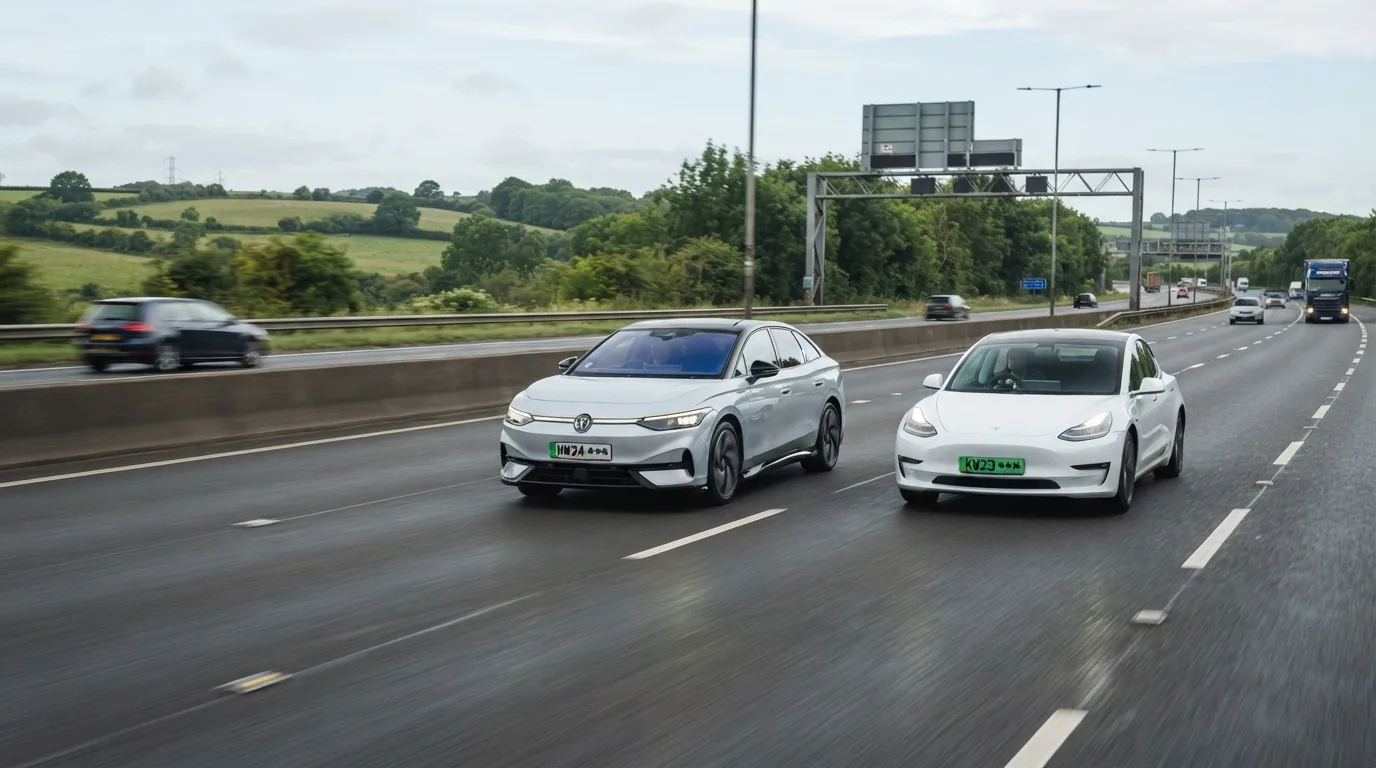
Volkswagen ID.7 vs Tesla Model 3: UK Range Showdown
The ID.7 goes further on paper, costs more and offers more space. The Model 3 charges better and comes with a superior network. Which wins?