Mercedes C-Class Electric UK reviews: 452 miles, 489bhp and a £58,000 start
The first UK drives are in. Reviewers praise its calm, quiet ride, range and charging, but are less sure about the looks, rear foot space and some cabin materials. Cheaper rear-drive versions will follow.
Quick answers
- The Mercedes C-Class Electric arrives in the UK at the end of 2026 as the C 400 4Matic, from £57,995 according to Fleet News, with nearly 500PS; PistonHeads puts the start at about £60,000.
- Its 94kWh battery gives up to 452 miles of WLTP range in UK specification, and 429 miles as Top Gear tested it; Mercedes quotes up to 473 miles in its most efficient form.
- It charges at up to 330kW on an 800-volt system, 10% to 80% in about 22 minutes, adding up to 198 miles in 10 minutes.
- It does 0-62mph in about 4.0 to 4.1 seconds and uses a two-speed gearbox on the rear motor for efficient motorway cruising.
- At nearly 4.9 metres long, it is about 13cm longer than the petrol C-Class, with a 470-litre boot and a 101-litre front boot.
- Cheaper rear-wheel-drive versions with more than 500 miles of range are promised, close in price to the plug-in hybrid C-Class at a little over £50,000.
- Its main rival is the BMW i3, which claims about 559 miles from a 109kWh battery and 400kW charging.
The Mercedes C-Class Electric has been driven on UK roads for the first time, and the verdicts are largely positive. The all-new electric saloon arrives in the UK at the end of 2026 as the twin-motor C 400 4Matic, from £57,995 according to Fleet News, with nearly 500PS and up to 452 miles of WLTP range in UK specification. Fleet News calls it “a highly impressive EV”.
It matters because the C-Class is one of the most important company cars in Britain, and this is Mercedes’ first electric C-Class built from scratch rather than adapted. Its main rival is BMW’s new i3, which claims even more range. Here is what UK reviewers say, and how it compares.
What is the C-Class Electric?
It is a new car on Mercedes’ 800-volt MB.EA electric platform, not a converted petrol C-Class. Top Gear describes it as “a lowered GLC Electric” rather than a stretched CLA. It sits alongside the petrol and plug-in hybrid C-Class, which continues with a different body.
| Mercedes C 400 4Matic Electric | Figure |
|---|---|
| UK price | From £57,995 (Fleet News); about £60,000 (PistonHeads) |
| Power | 489bhp (nearly 500PS) |
| 0-62mph | About 4.0 to 4.1 seconds |
| Battery | 94kWh |
| WLTP range | Up to 452 miles (UK spec); up to 473 miles quoted in most efficient form |
| Peak charging | 330kW |
| 10% to 80% | About 22 minutes |
| Length | Nearly 4.9 metres |
| Boot | 470 litres, plus a 101-litre front boot |
| Weight | About 2,500kg |
The rear motor has a two-speed gearbox: the first gear for acceleration and the second for efficient motorway cruising. The front motor can disconnect when not needed, which Mercedes says cuts losses at the front axle by up to 90%. The drag coefficient is a very low 0.22.
What do UK reviewers say about the drive?
Very good, especially if you value comfort and calm. PistonHeads said it “takes all the strengths innate to EVs and makes even greater virtues of them”, calling it “quieter than a silent disco at the morgue”. It praised the optional adaptive suspension as “very good indeed” and said the C-Class “is a very convincing argument for all of the EV benefits with none of the downsides”.
Top Gear scored it 8 out of 10. “Stable, quiet, comfortable and rangey, so it’s a great long-distance machine,” it said, adding that “there’s a fine solidity to the way it goes down the road” and that the steering gets livelier when pushed. It expects the BMW i3 to be “a smidge more engaging to drive”.
The optional air suspension uses cloud data from other Mercedes cars to prepare the dampers for bumps ahead, and the chassis package adds rear-wheel steering of up to 4.5 degrees.
How efficient is it?
Impressively. PistonHeads quotes efficiency of up to 4.4 miles per kWh, better than the smaller CLA despite about 100 more horsepower. Regenerative braking can handle almost all stopping, adjustable with the steering wheel paddles.
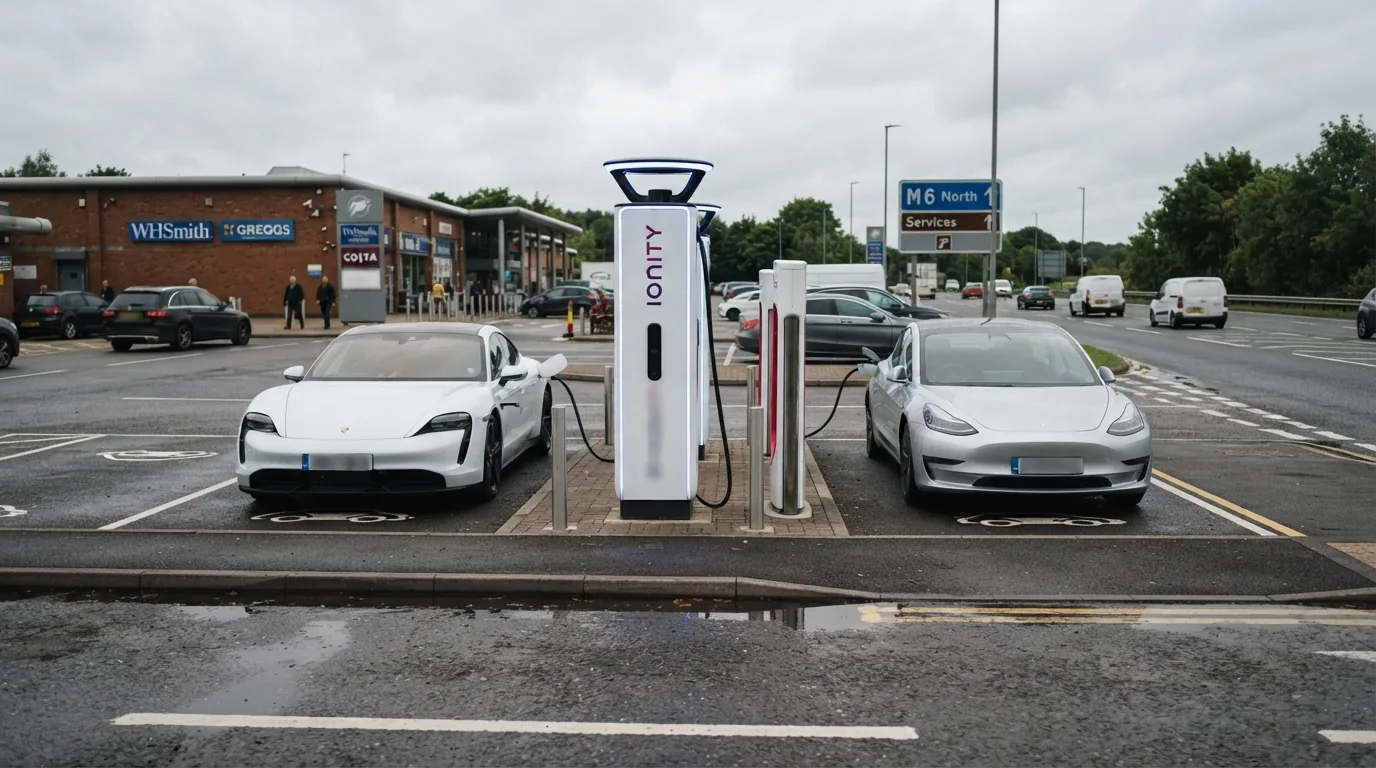
On charging, the C-Class takes up to 330kW, adding up to 198 miles in 10 minutes and going from 10% to 80% in about 22 minutes. Few UK chargers deliver that much power yet, but it will still charge quickly on 150kW units. Our Ionity and Tesla Supercharger comparison explains which networks have the fastest chargers.
What are the downsides?
Reviewers raise three:
- Looks. PistonHeads called the front “too busy and too snouty” and the rear “a weird mismatch of hatch and saloon”. Top Gear compared the grille to “a piggy’s snout”.
- Rear foot space. Despite the long wheelbase, Top Gear and PistonHeads both note limited foot room under the front seats, a common EV issue.
- Cabin details. PistonHeads said some parts “didn’t feel expensive enough for a car that starts at £60,000”, and that the driver can see too much of the large passenger screen. Top Gear criticised the need for a subscription to use the full driver assistance systems, even though the hardware is standard.
The boot is a conventional saloon opening rather than a hatchback, though Fleet News notes it is wide and holds 470 litres, plus a 101-litre front boot you open by pressing the Mercedes badge.
Is it good for company car drivers?
Fleet News thinks so, despite the high launch price. It calls the C-Class Electric “perhaps the firm’s most significant electric car yet” and praises rear space, comparable to an E-Class or BMW 5 Series, which beats a petrol C-Class and a BMW i4.
The catch is the launch version. The C 400 4Matic is “not so fleet-friendly” with its high power and price. Mercedes promises cheaper rear-wheel-drive versions with more than 500 miles of range, likely priced close to the plug-in hybrid C-Class at a little over £50,000. Those will be the company car sweet spot. As an EV, it will pay the low electric benefit-in-kind rate, as our company car tax guide explains.
At this price, the C-Class Electric is above the Electric Car Grant’s price cap and will also pay the expensive car supplement on Vehicle Excise Duty.
How does it compare with the BMW i3 and Tesla Model 3?
| Mercedes C 400 4Matic | BMW i3 | Tesla Model 3 Long Range RWD | |
|---|---|---|---|
| Battery | 94kWh | 109kWh | Not disclosed |
| Claimed WLTP range | Up to 452 to 473 miles | About 559 miles | 466 miles |
| Peak charging | 330kW | 400kW | Not stated here |
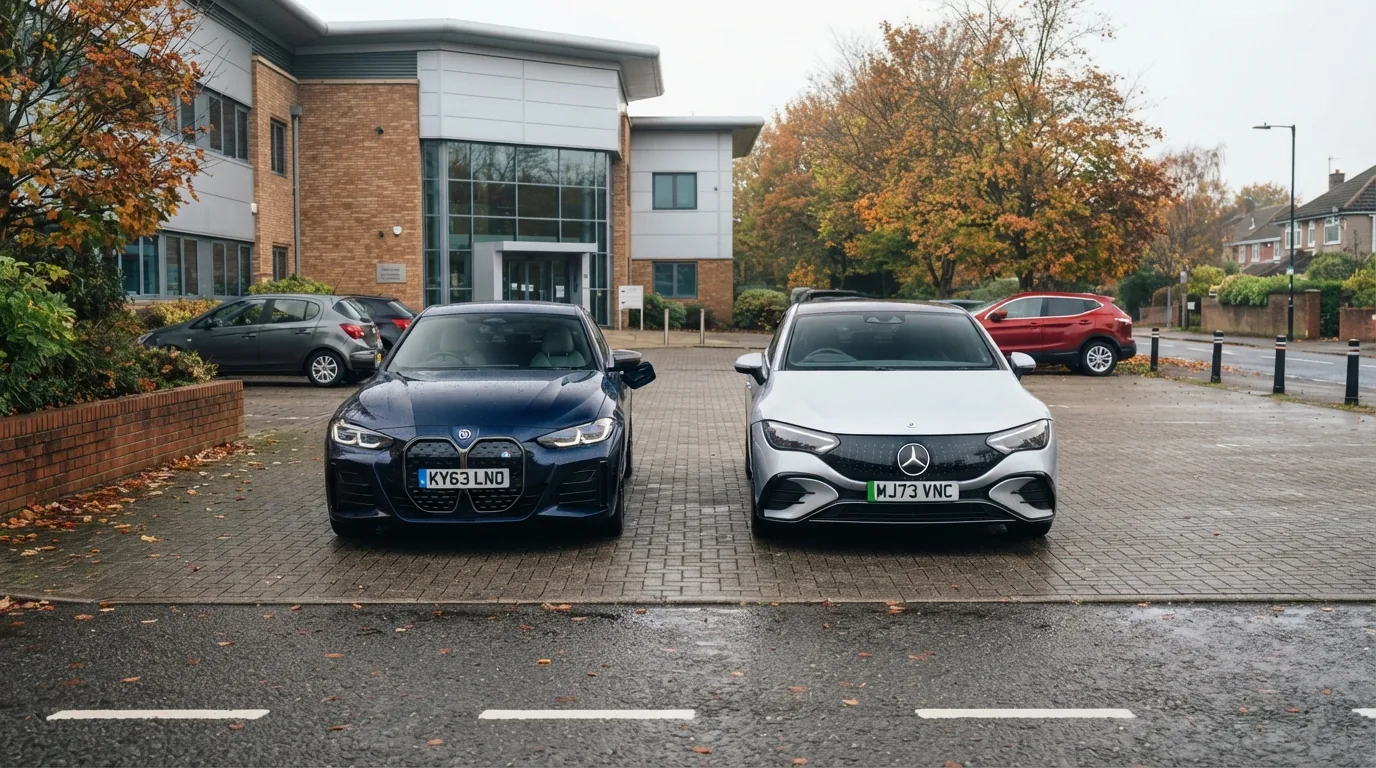
Figures from evo and Fleet News. On paper the BMW goes further and charges faster, though from a bigger and probably heavier battery. The Mercedes leans on comfort and refinement. Our BMW iX3 range report shows how well BMW’s Neue Klasse technology performs in the real world.
How does it compare with the petrol and plug-in hybrid C-Class?
Mercedes is selling the electric C-Class alongside the combustion and plug-in hybrid versions, which will get a facelift to look more like the EV later in 2026. The key differences:
| C-Class Electric (C 400 4Matic) | C-Class plug-in hybrid | |
|---|---|---|
| Body | New electric-only design, nearly 4.9m long | Existing C-Class body |
| Starting price | About £57,995 to £60,000 | A little over £50,000 |
| Rear space | Comparable to an E-Class | Tighter |
| Company car tax 2026-27 | 4% | Higher, based on CO2 and electric range |
| Electric range | Up to 452 miles | Short electric range, then petrol |
Fleet News says the electric C-Class is about 13cm longer than the regular C-Class and closer in size to an E-Class, which shows in its interior space. The future rear-drive electric versions are expected to be priced close to the plug-in hybrid.
What is the technology like?
The C-Class Electric is packed with screens and software. Top-spec versions can have a dashboard-spanning “Hyperscreen” that Top Gear likened to “a seamless 8k IMAX”, and all versions get a high-resolution central screen and driver display. The system connects to both Mercedes’ own AI and Google’s, and can hold fluent voice conversations and act on commands.
Mercedes has reintroduced proper scroll wheels on the steering wheel in place of the haptic buttons it used for several years, which Fleet News welcomed. The C-Class Electric is also certified by the Vegan Society, a first for a saloon, according to Fleet News, though Premier Edition models use Nappa leather.
Its optional air suspension uses cloud-based data from other Mercedes cars to prepare for bumps ahead, and its “one-box” braking system lets regenerative braking handle almost all stopping, even in hard or wet braking.
What about driver assistance?
The C-Class Electric has the sensors and actuators for advanced driver assistance as standard, including Mercedes’ Level 2 MB.Drive Assist Pro, which can help steer through city streets while allowing the driver to adjust steering at any time without switching it off. But Top Gear notes that some features require a subscription to use, which it says should be standard on a car at this price.
In the UK, hands-off systems are only allowed on approved roads, so check what is enabled and legal here before relying on it.
Should you wait for the rear-drive version?
For most buyers, yes. The launch C 400 4Matic is powerful and expensive. Mercedes says rear-wheel-drive versions with more than 500 miles of range will follow, priced closer to the plug-in hybrid. They should be cheaper to buy, cheaper to tax as a company car (because benefit-in-kind is based on list price) and go further on a charge.
If you need a car now, the C 400 is a very capable executive EV. But if you can wait, the rear-drive versions are likely to be the better buy.
Our view
The C-Class Electric looks like the most convincing electric Mercedes saloon yet: quiet, comfortable, roomy in the back and genuinely long-legged. The launch C 400 is a lot of car, and a lot of money. For most UK buyers and company car drivers, the rear-drive versions due later, with more range and a lower price, will be the ones to wait for. If you can live with the styling, it is a serious alternative to the BMW i3.
How we test and where our numbers come from
Range figures are official WLTP combined values taken from manufacturer UK specification pages, with real-world estimates drawn from independent comparative testing. Prices are UK list prices at the time of the latest update. Tax, grant and charging-scheme figures come from GOV.UK and HMRC publications. We re-check every guide when pricing, specification or policy changes. Last checked 24 October 2026. How we work out our own figures.
Frequently asked questions
How much is the Mercedes C-Class Electric in the UK?
Fleet News lists the launch C 400 4Matic from £57,995, while PistonHeads puts the starting price at about £60,000. Cheaper rear-wheel-drive versions are due later and are expected to be priced close to the plug-in hybrid C-Class.
What range does the Mercedes C-Class Electric have?
UK-specification C 400 4Matic models quote up to 452 miles WLTP from a 94kWh battery. Top Gear quotes 429 miles as tested, and Mercedes has quoted up to 473 miles in its most efficient form. Future rear-drive versions are promised more than 500 miles.
How fast does the Mercedes C-Class Electric charge?
It uses an 800-volt system and charges at up to 330kW. Mercedes says 10% to 80% takes about 22 minutes on a suitable charger, and that it can add up to 198 miles in 10 minutes.
When does the Mercedes C-Class Electric arrive in the UK?
Fleet News says it arrives in the UK at the end of 2026, launching with the C 400 4Matic twin-motor version in Sport, AMG Line, AMG Line Premium, AMG Line Premium Plus and Premier Edition trims.
Is the Mercedes C-Class Electric better than the BMW i3?
UK reviewers have not yet compared them directly. On paper, the BMW i3 claims more range and faster charging, while the Mercedes is praised for comfort and refinement. Top Gear expects the BMW to be slightly more engaging to drive.
Sources and further reading
- fleetnews.co.ukFleet NewsPrimary source referenced in this article.
- pistonheads.com2027 Mercedes C-Class Electric UK ReviewUK drive verdict, efficiency of up to 4.4 miles per kWh, the 0.22 drag coefficient, the design and cabin criticisms and the £60,000 start.
- topgear.comMercedes-Benz C-Class Electric reviewThe 94kWh battery, 429 and 452-mile ranges, 22-minute charging, 489bhp, 2,500kg weight, rear space, ADAS subscription and driving verdict.
- evo.co.ukMercedes C-class electric revealed to face the BMW i3 and Tesla Model 3473-mile WLTP figure, 330kW charging, 198 miles in 10 minutes, two-speed rear motor, rear-wheel steering and the BMW i3 and Tesla Model 3 comparisons.

EV Compared
The EV Compared editorial team tracks the UK electric vehicle market full time: new model launches, list prices, WLTP and real-world range, public charging tariffs and the tax rules that decide what an EV actually costs to run. Every guide is checked against manufacturer specifications and official GOV.UK figures, and updated whenever the numbers move.
Related reading
View all
How Does Company Car Tax Work for Electric Vehicles?
Understand the P11D value, appropriate percentage and how the tax is collected through your pay, everything you need to know about EV company car tax in 2026/27.
Ionity vs Tesla Supercharger: Best for Non-Tesla EVs in the UK?
Two ultra-rapid networks compared on price, speed, coverage and real-world experience for CCS drivers

Range Rover Electric UK reviews: quieter, more capable and from £154,000
After a decade in development, the electric Range Rover has been driven on UK roads and in the Highlands. Reviewers say it is the best Range Rover yet in most respects, with the price, weight and a 330-mile real-world range as the caveats.

Polestar 5 UK review roundup: £89,500 electric GT takes on the Porsche Taycan
Polestar's flagship four-door grand tourer has launched in the UK with two Launch Edition versions. Early UK reviews praise its ride, pace and build, with caveats on rear foot space, boot size and touchscreen controls.
BMW i3 vs Mercedes C-Class Electric: UK prices and range
The BMW i3 starts at £47,925 and the Mercedes C-Class Electric at £57,995. We compare UK price, range, charging and acceleration for drivers who would once have chosen a 320d or C220d.
Diesel vs Electric for High Mileage UK Drivers
A direct comparison for drivers doing 15,000 miles or more per year