China starts producing all-solid-state EV battery cells: what it means for UK buyers
Greater Bay Technology's cells rolled off the line in Guangzhou on 13 October, weeks after Beijing set a 2030 target for large-scale use. But battery makers still say true mass production in cars is years away.
Quick answers
- China's first all-solid-state battery cell to meet its new national standard began mass production on 13 October 2026 in Guangzhou, made by Guangzhou Greater Bay Technology.
- The cells have an energy density of 260 to 480 Wh/kg, a cycle life comparable to conventional batteries and stable fast charging, according to China Daily.
- Their first announced uses are high-end electric motorcycles, low-altitude aircraft, computing centres and energy storage, not mainstream cars.
- Seven Chinese government bodies have set 2030 as the target for 'initial large-scale' use of all-solid-state batteries.
- CATL targets small-scale production around 2027 but its manufacturing chief says true mass production needs at least five more years; BYD points to 2027 demonstrations and wider use around 2030.
- Toyota aims to commercialise all-solid-state batteries in 2027 to 2028 and Nissan in its 2028 financial year.
- Semi-solid-state batteries, a halfway step, are already on sale in some Chinese cars.
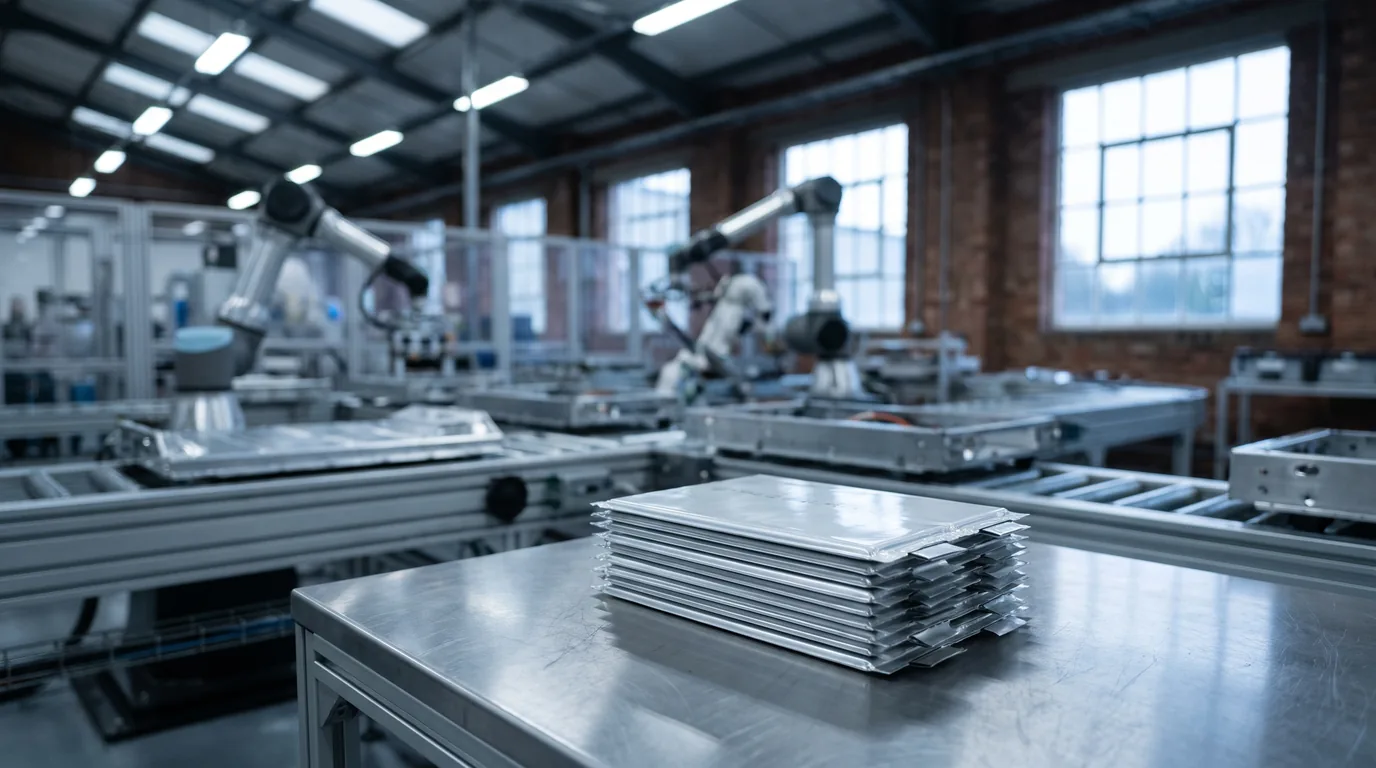
China has started producing all-solid-state battery cells that meet its new national standard, a milestone in the race for the next generation of EV batteries. The cells, made by Guangzhou Greater Bay Technology, rolled off the production line in Guangzhou on 13 October 2026, according to China Daily. They have an energy density of 260 to 480 Wh/kg, a cycle life comparable to conventional batteries and support stable fast charging.
Solid-state batteries are often described as the breakthrough that will give EVs much longer range, faster charging and lower fire risk. This news is real progress. But the first uses are motorcycles, aircraft and storage, not family cars, and the world’s biggest battery maker says true mass production in cars is at least five years away. Here is what has happened and what it means if you are buying an EV in the UK. Our solid-state battery timeline for UK buyers has the longer view.
What exactly has started production?
Greater Bay Technology’s all-solid-state cells are the first in China to pass testing by the China Automotive Battery Research Institute against a new national standard for solid-state batteries, introduced in August, and then begin mass production.
Key details:
- Energy density: 260 to 480 Wh/kg. For comparison, many current EV battery cells sit in the range of roughly 160 to 300 Wh/kg depending on chemistry.
- Cycle life: comparable to conventional batteries.
- Charging: supports stable fast charging.
- Cost: described as “controllable”.
At the production ceremony, the company signed agreements to use the cells in high-end electric motorcycles, the “low-altitude economy” (drones and small aircraft), computing centres and high-end energy storage. Cars were not on that first list.
What is an all-solid-state battery?
A conventional lithium-ion battery uses a liquid electrolyte to carry lithium ions between the electrodes. An all-solid-state battery replaces that liquid with a solid material.
In theory, that brings several benefits, as Gulf News explains:
| Potential benefit | Why it matters for EVs |
|---|---|
| Higher energy density | More range from the same weight, or a lighter car |
| Faster charging | Shorter stops |
| Longer service life | Batteries that last longer |
| Lower fire risk | No flammable liquid electrolyte |
The difficulties are real too. China’s own plan lists the bottlenecks: ionic conductivity, cycle stability, keeping good contact between electrodes and the solid electrolyte, and manufacturing at scale.
What is China’s plan?
Seven government bodies, led by the Ministry of Industry and Information Technology, have issued a 2026 to 2030 plan setting 2030 as the target for the “initial large-scale deployment” of all-solid-state batteries, according to China Daily. It calls 2026 to 2030 a “strategic window” and covers not only cars but ships, aircraft, robots, machinery, power grids and data centres.
Investment is already pouring in. China announced about 60 new solid-state battery projects in 2025, with 189GWh of planned capacity and about 67.7bn yuan ($10.1bn) of investment, and more than 40 projects worth over 50bn yuan in the first half of 2026 alone.
When will solid-state batteries be in cars?
Battery makers are more cautious than car makers. Here is where the main players say they are:
| Company | Stated timeline |
|---|---|
| CATL | Small-scale production around 2027; manufacturing chief says true mass production needs at least five more years |
| BYD | Initial vehicle demonstrations in 2027, wider use around 2030 |
| Gotion High-Tech | Cells of about 400 Wh/kg; developing a 2GWh line |
| Toyota (with Idemitsu Kosan) | Commercialisation in 2027 to 2028 |
| Nissan | Pilot line in Yokohama; commercialisation in its 2028 financial year |
| Honda | Pilot line in Tochigi; cars in the late 2020s |
CATL’s chief manufacturing officer, Ni Jun, said in September that all-solid-state batteries are still at stage 4 on a nine-stage maturity scale, laboratory samples and small prototypes, and need “at least another five years” for true mass production, as reported by Takumi Tanaka. Ouyang Minggao of the Chinese Academy of Sciences said that even if the first cars arrive in 2027, it will take “another 5 to 10 years from there to reach 1% market share”.
What about semi-solid-state batteries?
They are already here, in China at least. Semi-solid-state batteries use a gel or partly solid electrolyte, a halfway step that brings some of the benefits with fewer manufacturing hurdles. While attention has focused on all-solid-state, semi-solid cells have quietly gone on sale in some Chinese cars.
Some brands coming to the UK may use semi-solid cells in future models, so watch for the term in spec sheets. It is a genuine improvement, but it is not the same as all-solid-state.
Do EVs need solid-state batteries?
Not to work well. The think tank RethinkX argues that existing technologies, particularly lithium iron phosphate (LFP) and emerging sodium-ion batteries, are already good enough to drive rapid EV adoption through lower cost and long life. LFP avoids cobalt and nickel, is generally safer and lasts a long time, which is why many affordable EVs, including several BYD models, use it.
Fast charging is also improving without solid-state. BYD’s Atto 8 claims 10% to 97% in nine minutes on its Flash Charging network using LFP cells, as we report in our BYD Atto 8 story.
What does it mean for UK buyers?
In the short term, nothing. No car on sale in the UK uses an all-solid-state battery, and the first ones are likely to be expensive, low-volume models later this decade. Today’s EVs already offer:
- Range of 250 to 400 miles or more on many models.
- Battery warranties typically of eight years.
- Fast charging that keeps improving, especially on 800-volt cars.
If you are waiting for solid-state batteries before you buy an EV, you could be waiting a long time while paying more to run a petrol or diesel car. With diesel near £2 a litre, that is a costly wait. Our cost per mile analysis shows the gap.
In the longer term, solid-state batteries should make EVs lighter, longer-range and possibly cheaper. They may also help used EVs, as better batteries filter into second-generation models.
What is energy density and why does it matter?
Energy density, measured in watt-hours per kilogram (Wh/kg), is how much energy a battery stores for its weight. Higher energy density means either more range from the same weight of battery, or the same range from a lighter, smaller battery.
Greater Bay Technology’s cells span 260 to 480 Wh/kg. The upper end of that range would be a big step up on many current EV cells, which could allow a car to go much further, or to use a smaller, cheaper pack. Gotion High-Tech has disclosed all-solid-state cells of around 400 Wh/kg. But energy density is only one measure. Cost, lifespan, charging speed, safety and how well cells work in cold weather all matter just as much in a car.
What are the main battery types today?
| Battery type | Strengths | Weaknesses | Typical use |
|---|---|---|---|
| NMC lithium-ion | High energy density, good range | Uses nickel and cobalt, more expensive | Many premium and long-range EVs |
| LFP lithium-ion | Cheaper, long-lasting, stable, happy to charge to 100% | Lower energy density | Affordable EVs, many BYD models, entry versions |
| Sodium-ion | Very cheap materials, good in cold | Lower energy density still | Emerging, small cars and storage |
| Semi-solid-state | Some solid-state benefits, easier to make | Still partly liquid or gel | On sale in some Chinese cars |
| All-solid-state | Potentially higher density, safety and life | Hard and costly to make at scale | Early production, not yet in mainstream cars |
Most EVs on sale in the UK today use NMC or LFP. Volkswagen, for example, now offers both in its ID. Cross, with LFP in the cheaper version, as we report in our VW ID. Cross story.
Why is China so focused on batteries?
China already dominates global lithium-ion battery production, and its plan aims to extend that lead into the next generation. Beyond cars, the plan covers grid storage, ships, aviation, low-altitude aircraft, robots, heavy machinery, power grids, industrial parks and data centres. Nan Cewen of the Chinese Academy of Sciences described it as the first time China had systematically mapped out the emerging battery industry in a national five-year plan, shifting competition “from expanding production capacity toward broader rivalry over product value”.
The plan is also frank about weaknesses, including “insufficient original and disruptive innovation”, overcapacity, “disorderly competition” and gaps in standards and intellectual property.
What does this mean for Europe and the UK?
Battery supply is a strategic issue for European car makers. China’s lead in conventional batteries is one reason Chinese brands can sell EVs so competitively. If China also leads in solid-state, that advantage could last into the 2030s.
Japanese firms are strong too: Panasonic and Toyota rank first and second in the world for all-solid-state battery patents, according to the Japan Patent Office, and Japanese companies hold 14 of the top 20 places. Europe has less of a head start, which is why the EU’s Made in Europe plans include rules on battery sourcing, and why car makers such as Xpeng say finding European battery suppliers that meet their needs is difficult.
Our view
Greater Bay Technology’s production start is a genuine milestone, and China’s national plan shows how seriously it is taking the next battery generation. But the most credible voices, including CATL, say mainstream solid-state cars are still years away. For anyone buying an EV now, today’s LFP and lithium-ion batteries are proven, improving and covered by long warranties. Solid-state is worth watching, not waiting for.
How we test and where our numbers come from
Range figures are official WLTP combined values taken from manufacturer UK specification pages, with real-world estimates drawn from independent comparative testing. Prices are UK list prices at the time of the latest update. Tax, grant and charging-scheme figures come from GOV.UK and HMRC publications. We re-check every guide when pricing, specification or policy changes. Last checked 24 October 2026. How we work out our own figures.
Frequently asked questions
What is a solid-state battery?
A solid-state battery replaces the flammable liquid electrolyte in a conventional lithium-ion cell with a solid material. In theory that allows higher energy density, faster charging, longer life and lower fire risk, which could mean longer range or lighter EVs.
Are solid-state batteries in production?
Yes, at small scale. Guangzhou Greater Bay Technology began mass production of all-solid-state cells meeting China's new national standard on 13 October 2026. Their first uses are in motorcycles, aircraft, data centres and storage rather than mainstream cars.
When will solid-state battery cars be on sale in the UK?
Not soon in any numbers. Battery makers expect the first cars with all-solid-state batteries around 2027 to 2028, and CATL's manufacturing chief says true mass production needs at least five more years. A leading Chinese academic expects it to take five to ten years after 2027 to reach 1% of the market.
Should I wait for solid-state batteries before buying an EV?
For most people, no. Today's lithium-ion and LFP batteries already offer 250 to 400 miles of range and long warranties, and solid-state cars will be expensive and rare for years. Our solid-state battery timeline explains why waiting rarely pays.
What is a semi-solid-state battery?
A semi-solid-state battery uses a gel or partly solid electrolyte rather than a fully solid one. It is a halfway step that is already on sale in some Chinese cars, offering some of the benefits with fewer manufacturing hurdles.
Sources and further reading
- chinadaily.com.cnChina DailyPrimary source referenced in this article.
- chinadaily.com.cnSolid-state batteries seen charging sectorThe 2026-2030 national plan, investment figures and CATL, BYD and Gotion timelines.
- gulfnews.comWhat China has that Elon Musk doesn't: A state-backed solid-state battery pushHow solid-state differs from lithium-ion, the plan's technical targets and RethinkX's case for LFP and sodium-ion.
- note.comWhile All-Solid-State is Said to be '5 Years Away,' Semi-Solid is Already on SaleCATL's Ni Jun on five more years to mass production, Ouyang Minggao's 1% market share outlook and Japanese makers' timelines.

EV Compared
The EV Compared editorial team tracks the UK electric vehicle market full time: new model launches, list prices, WLTP and real-world range, public charging tariffs and the tax rules that decide what an EV actually costs to run. Every guide is checked against manufacturer specifications and official GOV.UK figures, and updated whenever the numbers move.
Related reading
View all
VW ID. Cross gets a cheaper 37kWh battery from €27,995: what it means for UK buyers
The electric equivalent of the T-Cross now comes in an entry-level version aimed at town and commuter driving. It trades range and towing for price, and VW is lining up an even cheaper ID. Up! for 2027.
BYD Atto 8: seven-seat electric SUV charges 10-97% in nine minutes
BYD's new European flagship takes on the Kia EV9, Hyundai Ioniq 9 and Volvo EX90 with a huge battery, a 764hp top model and the fastest charging claim of any seven-seater. The catch is the chargers it needs.
Diesel tops 200p a litre: how much cheaper an EV is per mile
Diesel passed £2 a litre for the first time on 2 October, putting a 50mpg diesel at about 18p a mile. Home charging costs 2.3p to 7.5p a mile, but rapid chargers now cost more.

Denza Z9GT to get BYD's 'God's Eye' city driving assistant in Europe in 2027
The Porsche Taycan-rivalling shooting brake already brings BYD's five-minute Flash Charging to Europe. Now it will be the first BYD-group car in Europe to offer supervised address-to-address driving in towns.
Honda will test charging EVs while they drive on a Japanese motorway in 2027
Coils buried in the road would top up electric trucks, and eventually cars, at motorway speeds. It is a promising idea, already being tried in France and Germany, but the hard part is cost.
Uber starts robotaxi testing in Manchester with Pony.ai and Verne
Pony.ai's seventh-generation robotaxis are mapping Manchester's roads with safety drivers on board and no passengers. No application to run a passenger service has been made yet.