Honda will test charging EVs while they drive on a Japanese motorway in 2027
Coils buried in the road would top up electric trucks, and eventually cars, at motorway speeds. It is a promising idea, already being tried in France and Germany, but the hard part is cost.
Quick answers
- Honda, construction firm Taisei and road builder Taisei Rotec plan to test in-road wireless charging for moving vehicles on a public Japanese motorway from Japan's 2027 financial year, starting 1 April 2027.
- The test is part of East Nippon Expressway's Tateyama Project, on a 300-metre stretch of the E14 Tateyama Expressway near the Kimitsu rest area in Chiba.
- The system aims to deliver up to 150kW to vehicles at up to 120km/h using coils under the road and a receiver under the vehicle.
- Honda says its unit is the first to combine the inverter and coil in one, cutting components and roadworks; the road and equipment have already supported 20-tonne vehicles on a test track.
- Trucks come first; Honda says the technology works in cars too and could allow smaller, cheaper batteries in future.
- France's A10 trial already delivers more than 200kW to a truck, a bus and a car at once, and France targets 5,000km of electric road by 2030.
- A Honda engineer said economic viability still needs to be assessed.
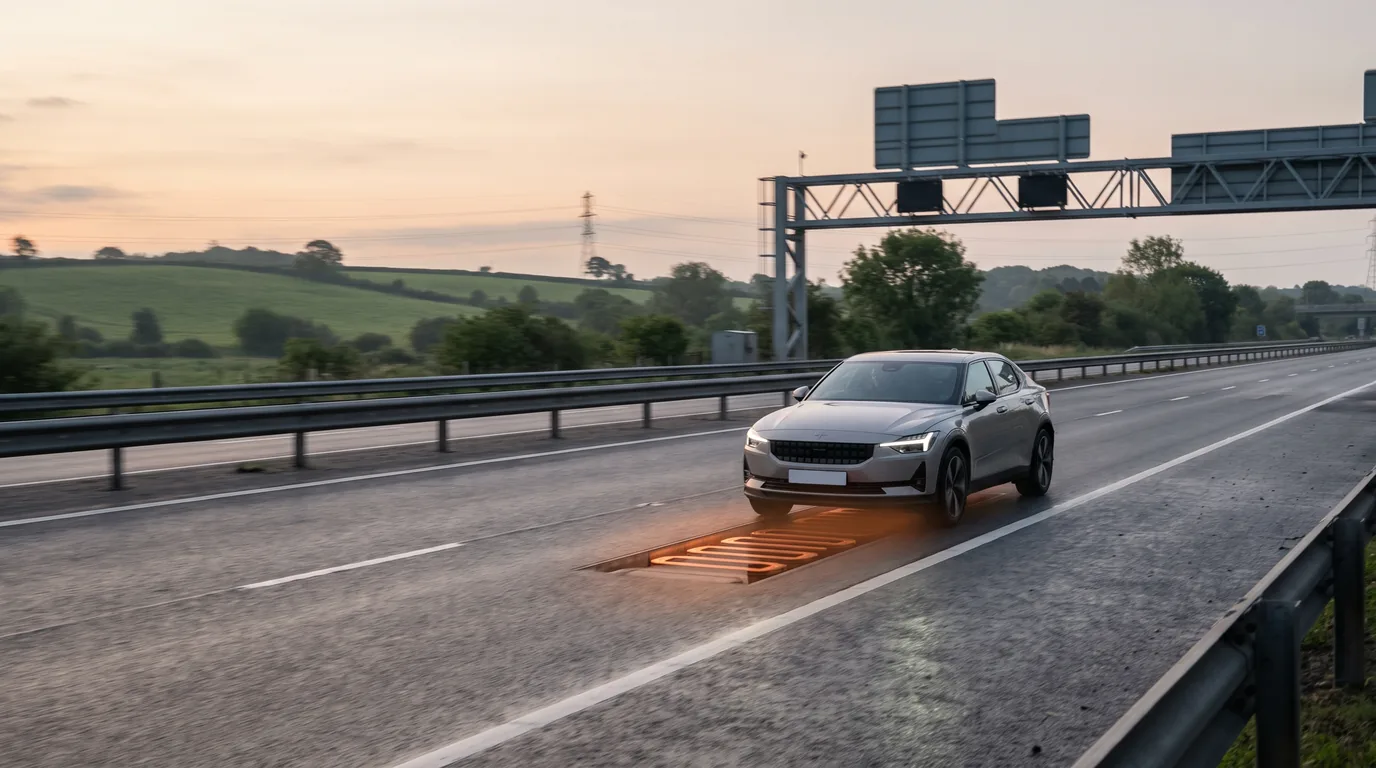
Honda plans to test charging electric vehicles while they drive along a public motorway. With construction firm Taisei and road builder Taisei Rotec, it will trial in-road wireless charging on a 300-metre stretch of Japan’s E14 Tateyama Expressway from April 2027, aiming to deliver up to 150kW to vehicles at up to 120km/h, as Yahoo News and The Next Web reported.
The first target is lorries, which lose time and money every time they stop to charge. If it works, Honda says the same technology could reach its future electric SUVs, and even let carmakers fit smaller, cheaper batteries. It is an idea Europe is also testing. The big question, as always with charging roads, is who pays.
How does Honda’s in-road charging work?
The system is a “magnetic coupling dynamic wireless power transfer” road. In plain terms:
- Transmitter coils are buried under the road surface.
- A receiver is mounted underneath the vehicle.
- Power is transferred through a magnetic field as the vehicle drives over the coils, without any cables or contact.
Honda builds the hardware on both the road and vehicle sides, using direct current. It says its unit is the first to combine the inverter and the coil in a single unit, which cuts the number of components and reduces the roadworks needed for each installation. Taisei is developing a fast-responding DC power supply to feed the coils, and Taisei Rotec is working out how to install them in existing roads without weakening the surface.
Honda has worked on dynamic wireless charging since 2021 and has focused on this approach with its partners since 2025.
What testing has been done?
On a private Taisei test road at Satte, the pavement and embedded equipment have supported vehicles of about 20 tonnes, matching the heavy trucks targeted first, according to Fox Business.
A tougher test is due in late 2026 at Taisei’s T-Field site, where real vehicles will put the system through one million wheel-load cycles at about 5 tonnes per wheel, condensing years of wear into a short period. Engineers will also measure electromagnetic field leakage, push output to 150kW and check that charging stays stable at motorway speeds.
If that goes well, the partners will join East Nippon Expressway’s Tateyama Project in Japan’s 2027 financial year, on 300 metres of the E14 near the Kimitsu rest area in Chiba prefecture.
Why start with trucks?
Because trucks have the most to gain. A lorry that stops to charge loses driving time and delivery slots, and large truck batteries are heavy and expensive. Topping up on the move could cut stops and reduce the battery size each truck needs. Trucks are also heavy, which makes them the toughest test of whether the road equipment lasts.
That matters in the UK too. Electric truck registrations halved in the third quarter of 2026, and hauliers cite charging and cost as the main barriers, as we cover in our electric HGV report.
Could it work for cars?
Honda says yes. If the truck trials succeed, it believes its future electric SUVs could use the technology. Taku Ueda, Honda’s chief engineer of research and development, told Nikkei Asia that it could cut the number of battery cells in future electric cars and ease “charging anxiety”.
A smaller battery means a cheaper and lighter car, and weight is a big factor in both energy use and road wear. If major roads could top up cars as they drive, the battery would no longer need to carry the whole journey.
Is anyone else doing this?
Yes, and Europe is ahead on scale:
| Project | What it does |
|---|---|
| France, A10 near Paris | Vinci and Gustave Eiffel University; delivers more than 200kW and charges a truck, a bus and a car at once |
| France, national plan | Targets 5,000km of electric road by 2030 and 9,000km by 2035 |
| Germany, near Balingen | Electreon and EnBW; one kilometre of electric road under a public bus route from 2022 |
| Sweden, E20 | A 21km permanent electric road announced in 2023, intended to open by 2026 |
Honda’s contribution is a more integrated design that could be cheaper and simpler to install. But it is not the first to put power into a road.
What are the obstacles?
Two big ones, according to the reporting: the cost of building a charging road and whether maintaining it can be economically viable at scale. A Honda engineer declined to compare the cost with conventional fast-charging networks, saying economic viability would need to be assessed, as Reuters reported via TimesLIVE.
Other practical questions include:
- Who pays for electricity drawn from the road, and how is it billed?
- Which vehicles are compatible? A common standard would be needed across makers.
- Maintenance. Roads are resurfaced and dug up regularly, so embedded equipment must survive or be easy to replace.
- Electromagnetic safety, which Honda is specifically testing.
Could the UK get charging roads?
There are no announced plans. If the UK did try it, freight routes such as major motorways near logistics hubs would be the logical place to start, given the problems hauliers face with depot grid connections. For now, the UK is focused on conventional charging, from motorway hubs to dedicated truck sites such as Electroway’s at Magna Park, which we cover in our Electroway report.
For car drivers, home charging remains the cheapest option by far, and rapid charging keeps getting faster. Our Ionity and Tesla Supercharger comparison covers the fastest networks today.
How does wireless charging work?
Wireless charging uses magnetic induction, the same basic principle as a wireless phone charger, scaled up. A coil connected to a power supply creates a changing magnetic field. A second coil nearby, in this case under the car or truck, picks up that field and turns it back into electricity to charge the battery.
There are two kinds for vehicles:
- Static wireless charging, where you park over a pad, for example in a garage or taxi rank. No cable is needed, but the car must stand still.
- Dynamic wireless charging, where coils are laid along a stretch of road and vehicles charge as they drive over them. This is what Honda is testing.
Dynamic charging is much harder. The system must switch power on and off coil by coil as a vehicle passes, keep the transfer efficient at speed, cope with vehicles that are not perfectly centred over the coils, and stay safe for people, animals and other vehicles nearby. Honda’s tests include measuring electromagnetic field leakage for exactly that reason.
Why is road durability such a big test?
Roads take a beating, especially from heavy lorries. Anything buried in the surface has to survive millions of wheel passes, temperature swings, rain and frost, and the occasional dig by utility companies. If embedded coils fail early or crack the road around them, maintenance costs would make the system uneconomic.
That is why Honda and Taisei are running an accelerated test at Taisei’s T-Field site: one million wheel-load cycles at about 5 tonnes per wheel, squeezing years of wear into a short period. The earlier trial at Satte already showed the pavement and equipment could support vehicles of about 20 tonnes. Taisei Rotec’s job is to find ways to install the system in existing roads without weakening them, which would make roll-out cheaper than rebuilding roads from scratch.
Could it shrink EV batteries?
Potentially. If cars and lorries could top up on main roads as they drive, they would not need to carry enough energy for an entire long journey. Honda’s chief engineer Taku Ueda suggested it could cut the number of battery cells in future electric cars. Smaller batteries mean lower prices, less weight and less demand for battery materials.
That benefit only works if electrified roads cover the routes people actually drive, which brings the argument back to cost. Covering motorways and major freight corridors would be a huge infrastructure project. For now, it is more realistic to see electric roads as a way to help heavy freight, where batteries are biggest and charging stops cost most.
What would it mean for UK drivers?
In the near term, very little. There are no UK electric road plans, and the cheapest and most reliable way to charge an EV remains at home. For long trips, rapid charging keeps getting faster: many new cars now charge from 10% to 80% in around 20 minutes, and BYD claims nine minutes on its own network, as we report in our BYD Atto 8 story.
Longer term, if trials in Japan and Europe prove the technology can be built and maintained affordably, electric roads could become part of the answer for freight, and perhaps eventually for cars on busy routes.
Our view
Charging while you drive is one of the most appealing ideas in EV technology, and Honda’s motorway trial is a serious step. But 300 metres of test road is a long way from a network, and Europe’s earlier projects show the technology works while the economics remain unproven. Expect electric roads, if they come, to start with freight corridors rather than the roads you drive every day.
How we test and where our numbers come from
Range figures are official WLTP combined values taken from manufacturer UK specification pages, with real-world estimates drawn from independent comparative testing. Prices are UK list prices at the time of the latest update. Tax, grant and charging-scheme figures come from GOV.UK and HMRC publications. We re-check every guide when pricing, specification or policy changes. Last checked 24 October 2026. How we work out our own figures.
Frequently asked questions
What is Honda's non-stop EV charging technology?
It is a dynamic wireless power transfer system. Coils buried under the road transmit power through a magnetic field to a receiver under the vehicle, charging it while it drives. Honda developed it with Taisei and Taisei Rotec.
When will Honda test in-road charging?
Further durability testing starts on a Taisei test site in late 2026. A public motorway trial is planned from Japan's 2027 financial year, starting 1 April 2027, on 300 metres of the E14 Tateyama Expressway in Chiba.
How much power can Honda's wireless road charging deliver?
Honda aims for up to 150kW for large commercial vehicles, at speeds of up to 120km/h. That is similar to a good public rapid charger, although only while the vehicle is over the charging section.
Will cars be able to use wireless road charging?
Honda is starting with trucks but says the system works in passenger cars too, and that its future electric SUVs could use it. It says in-road charging could let future cars use smaller batteries.
Is wireless road charging coming to the UK?
There are no announced UK plans. Trials are running in France, Germany and Sweden, and the cost of building and maintaining charging roads is the main question everywhere. Any UK roll-out would most likely start with freight routes.
Sources and further reading
- uk.news.yahoo.comYahoo News UKPrimary source referenced in this article.
- foxbusiness.comHonda plans highway test of tech that charges moving trucksThe joint development since 2025, 20-tonne vehicles, late-2026 testing and the April 2027 public road trial.
- thenextweb.comHonda will test wireless EV charging on 300 metres of motorway in 2027120km/h and 150kW, Honda's comments on smaller batteries and European electric road projects.
- timeslive.co.zaHonda to test wireless charging for trucks on highwaysReuters report including the Honda engineer's comment on economic viability.

EV Compared
The EV Compared editorial team tracks the UK electric vehicle market full time: new model launches, list prices, WLTP and real-world range, public charging tariffs and the tax rules that decide what an EV actually costs to run. Every guide is checked against manufacturer specifications and official GOV.UK figures, and updated whenever the numbers move.
Related reading
View all
Electroway opens UK's largest electric truck charging hub at Magna Park
Built without public funding in the Midlands' Golden Triangle, the site lets fleets book a specific charger with guaranteed power. It opens as electric truck registrations fall, which makes charging the industry's biggest test.
BYD Atto 8: seven-seat electric SUV charges 10-97% in nine minutes
BYD's new European flagship takes on the Kia EV9, Hyundai Ioniq 9 and Volvo EX90 with a huge battery, a 764hp top model and the fastest charging claim of any seven-seater. The catch is the chargers it needs.
Ionity vs Tesla Supercharger: Best for Non-Tesla EVs in the UK?
Two ultra-rapid networks compared on price, speed, coverage and real-world experience for CCS drivers

China starts producing all-solid-state EV battery cells: what it means for UK buyers
Greater Bay Technology's cells rolled off the line in Guangzhou on 13 October, weeks after Beijing set a 2030 target for large-scale use. But battery makers still say true mass production in cars is years away.

Denza Z9GT to get BYD's 'God's Eye' city driving assistant in Europe in 2027
The Porsche Taycan-rivalling shooting brake already brings BYD's five-minute Flash Charging to Europe. Now it will be the first BYD-group car in Europe to offer supervised address-to-address driving in towns.
Uber starts robotaxi testing in Manchester with Pony.ai and Verne
Pony.ai's seventh-generation robotaxis are mapping Manchester's roads with safety drivers on board and no passengers. No application to run a passenger service has been made yet.