Diesel tops 200p a litre: how much cheaper an EV is per mile
Diesel passed £2 a litre for the first time on 2 October, putting a 50mpg diesel at about 18p a mile. Home charging costs 2.3p to 7.5p a mile, but rapid chargers now cost more.
Quick answers
- The RAC says the average UK price of diesel hit a record 200.01p a litre on 2 October 2026, with unleaded at 174.71p, so a 55-litre diesel fill now costs £110.01.
- At those prices a 50mpg diesel costs about 18.2p a mile in fuel and a 45mpg petrol car about 17.6p, on EV Compared calculations.
- An EV doing 3.5 miles per kWh costs about 7.5p a mile on the 26.32p price cap and 2.3p on ScottishPower's 8p EV Optimise rate.
- At Zapmap's 77p per kWh rapid average the same EV costs about 22p a mile, more than the diesel, while 54p standard public chargers work out at about 15.4p.
- Battery electric registrations rose 36.3% to a record 99,199 in September, and ScottishPower says enquiries for its EV offers are up about 630% on a year ago.
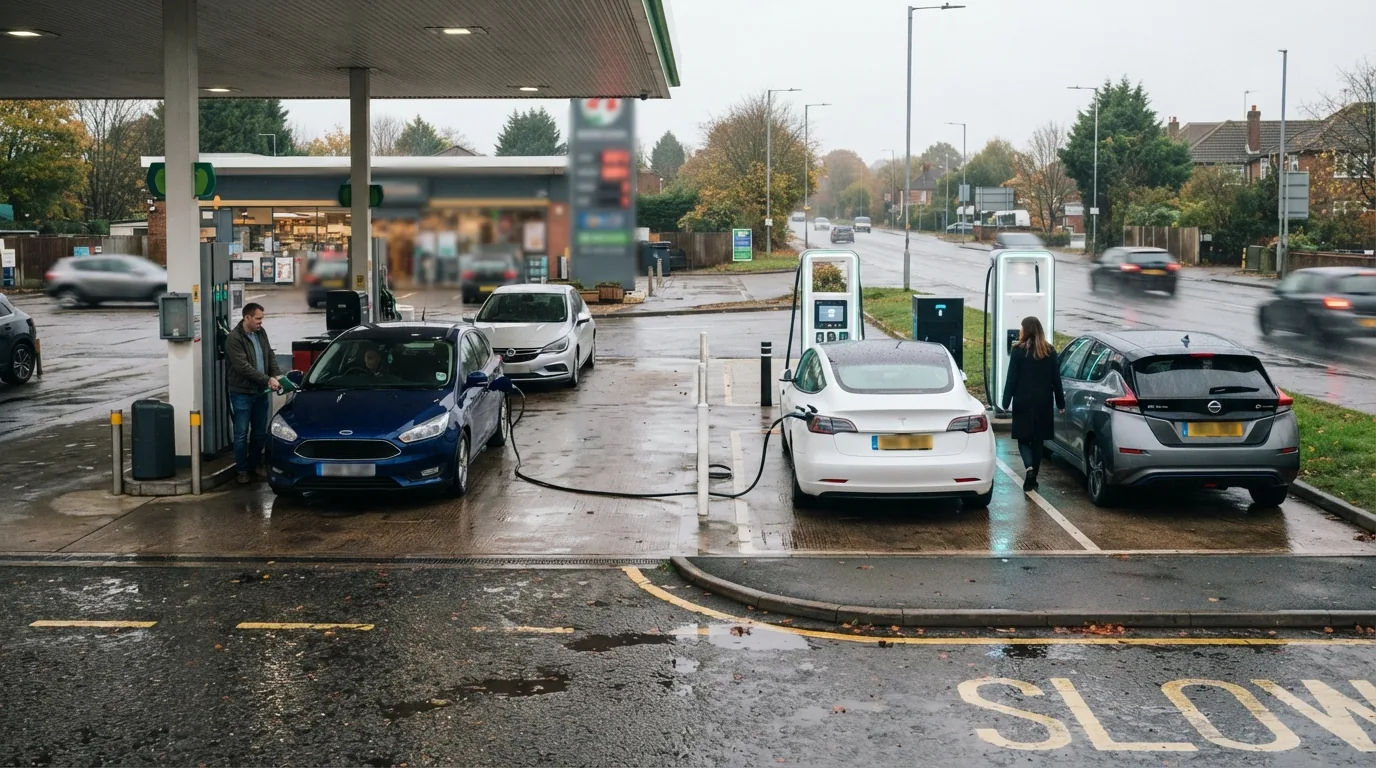
The average price of diesel in the UK passed £2 a litre for the first time on 2 October, reaching a record 200.01p, according to the RAC. By our sums that puts fuel for a 50mpg diesel at about 18.2p a mile, against 7.5p for an electric car charged at home on the price cap and 2.3p on an 8p smart charging deal. The catch for drivers without a driveway: at the average rapid charger price, an EV now costs more per mile than that diesel.
Unleaded averaged 174.71p on the same day, so a 55-litre tank now costs £96.09 in petrol and £110.01 in diesel. The RAC links the rise to disrupted supplies during the Middle East conflict and the lack of an agreement to reopen the Strait of Hormuz.
How far have pump prices risen this year?
Diesel first broke its June 2022 record on 28 September (RAC). It has climbed almost 58p a litre since the US-Iran war began on 28 February, and a 55-litre fill now costs £31.70 more than it did then. Oil topped $100 a barrel in September (Fuel Finder).
| Date | UK average diesel | What happened |
|---|---|---|
| June 2022 | 199.09p | Previous diesel record |
| 28 February 2026 | 142.38p | US-Iran war begins |
| 28 September 2026 | 199.18p | Diesel beats its 2022 record; petrol reached 174.13p in September |
| 2 October 2026 | 200.01p | Diesel passes £2 a litre; petrol averages 174.71p |
Source: RAC.
Oil slipped on 5 October as Middle East crude exports rose and the G7 moved to release stocks (CNBC), but the RAC has said it takes a sustained lower oil price, over several weeks rather than days, to bring wholesale fuel costs down meaningfully.
What does a mile cost in diesel, petrol and electric?
The table assumes 50mpg for diesel, 45mpg for petrol and 3.5 miles per kWh for an EV, before charging losses. It uses the Ofgem cap rate from 1 October, ScottishPower’s EV Optimise rate and Zapmap’s August averages for public chargers.
| Fuel or charging rate | Price | Cost per mile | Cost over 10,000 miles |
|---|---|---|---|
| Diesel, 50mpg | 200.01p a litre | 18.2p | £1,819 |
| Petrol, 45mpg | 174.71p a litre | 17.6p | £1,765 |
| EV at home, Ofgem price cap | 26.32p per kWh | 7.5p | £752 |
| EV at home, ScottishPower EV Optimise | 8p per kWh | 2.3p | £229 |
| EV at public standard chargers | 54p per kWh | 15.4p | £1,543 |
| EV at public rapid chargers | 77p per kWh | 22.0p | £2,200 |
Charging at home on the capped rate costs about two-fifths of what diesel does per mile, a saving of about £1,067 over 10,000 miles. On an 8p smart rate the EV costs about one-eighth as much, and the saving rises to about £1,590. Our October price cap analysis shows what a home top-up now costs.
Most drivers mix home and public charging. Split 80% home on the cap and 20% rapid and the blended cost is about 10.4p a mile, or about 6.2p with the home share at 8p. Both are well below diesel.
Is rapid charging now dearer than diesel?
Yes, at the national average. A 77p rapid kWh works out at 22p a mile, almost 4p more than a 50mpg diesel. For rapid charging to match diesel, the EV would need to manage about 4.2 miles per kWh, or diesel would have to reach about 242p a litre.
In April, trade body ChargeUK said rising pump prices had made public charging cheaper than fuel for most drivers, putting a typical EV on 54p standard chargers at 15p a mile against 17p for petrol and 17.5p for diesel. Drivers using only ultra-rapid chargers paid 21p a mile, more than either fuel, and diesel’s rise since has not closed that gap. Prices vary widely between networks, as our public charging price report shows.
Are fuel prices pushing drivers to go electric?
Partly. Battery electric registrations rose 36.3% to a record 99,199 in September, a 28.3% share of a market up 12.1% to 350,536 cars (SMMT). SMMT chief executive Mike Hawes called September’s record EV performance “a major achievement” and said high fuel prices are “undoubtedly giving more consumers reason to consider going electric” (see our September sales report).
Diesel buyers have not vanished, though. Diesel registrations rose 11.5% to 14,061, or 4.0% of the market, and Carwow noted that diesel sales grew despite higher fuel costs.
Energy suppliers see the shift too. ScottishPower says enquiries for its EV offers are up around 630% year on year, customer numbers on EV Optimise are up 430% and its EV Saver tariff has grown by over 10%. Charger maker Easee says its UK sales volumes are up 37% year on year (Renewable Energy Magazine).
What does an 8p “anytime” rate really mean?
ScottishPower says a 55-litre tank of petrol costs about £96 to fill, while covering the same distance on EV Optimise costs about £10. On our more cautious 3.5 miles per kWh, the 544 miles a 45mpg car gets from 55 litres would cost about £12.44 at 8p, still a saving of more than £80.
The “anytime” label needs reading closely. EV Optimise is a free add-on to an existing ScottishPower tariff, but it cannot be added to the supplier’s EV, Heat or Solar Saver time-of-use tariffs. You set how much charge you need and by when in the ScottishPower app, and it schedules charging at the cheapest and greenest times. The 8p rate applies only within those smart charging sessions, which do not run from 4pm to 8pm. Even so, it is about 70% below the 26.32p cap rate. Compare it with rival deals in our EV tariffs guide.
What this means for you
If you can charge at home, the record widens a gap that was already large. Even at February’s 142.38p, a 50mpg diesel cost about 12.9p a mile, well above today’s 7.5p capped home rate. Moving from the cap to an 8p smart rate is the biggest single saving, worth about £523 over 10,000 miles.
If you rely on rapid chargers, an EV will not save you money on fuel at today’s average prices. Standard public chargers at around 54p still beat diesel, so use them where you can.
High-mileage drivers stand to gain most, as our diesel versus electric guide explains. Our view: do not choose a car on one week’s pump price, as oil prices have started to slip. But with off-street parking, the per-mile case for electric held long before diesel hit £2, and it is stronger now.
How we test and where our numbers come from
Range figures are official WLTP combined values taken from manufacturer UK specification pages, with real-world estimates drawn from independent comparative testing. Prices are UK list prices at the time of the latest update. Tax, grant and charging-scheme figures come from GOV.UK and HMRC publications. We re-check every guide when pricing, specification or policy changes. Last checked 6 October 2026.
Frequently asked questions
How much does diesel cost per mile now?
At the RAC's record average of 200.01p a litre on 2 October 2026, a car returning 50mpg spends about 18.2p a mile on fuel. A 45mpg petrol car at the 174.71p unleaded average costs about 17.6p a mile.
Is it cheaper to charge an electric car than fill up with diesel?
At home, by a wide margin: about 7.5p a mile on the 26.32p per kWh price cap and 2.3p on an 8p smart charging rate, for a car doing 3.5 miles per kWh. At the 77p average rapid charger price it costs about 22p a mile, which is more than a 50mpg diesel.
What is ScottishPower EV Optimise?
It is a free add-on to ScottishPower tariffs that schedules your car's charging through the ScottishPower app and charges 8p per kWh within those smart charging sessions. It cannot be added to the supplier's EV, Heat or Solar Saver time-of-use tariffs, and smart charging does not run between 4pm and 8pm.
Are high fuel prices making people buy electric cars?
SMMT chief executive Mike Hawes said high fuel prices are 'undoubtedly giving more consumers reason to consider going electric' as battery electric registrations hit a record 99,199 in September. Diesel registrations also rose, by 11.5% to 14,061.
Sources and further reading
- media.rac.co.ukRACPrimary source referenced in this article.
- media.rac.co.ukRAC: Price of diesel reaches record highConfirms the 199.18p record on 28 September 2026, the 199.09p June 2022 high and the 142.38p average on 28 February 2026.
- smmt.co.ukSMMT: Record electric car market powers bumper SeptemberConfirms 99,199 battery electric registrations (up 36.3%), the 28.3% share, diesel registrations and Mike Hawes's comment on fuel prices.
- scottishpower.comScottishPower: EV enquiries surge as fuel costs riseConfirms the 630% rise in EV offer enquiries, the 430% rise in EV Optimise customers and the £96 against £10 fill-up comparison.
- scottishpower.co.ukScottishPower: Charge your EV anytime at 8p per kWhConfirms the 8p per kWh smart charging rate, the 4pm to 8pm exclusion and which tariffs EV Optimise can be added to.
- chargeuk.orgChargeUK: Public EV charging now cheaper than petrol for most driversGives the April analysis of 15p a mile at 54p per kWh against 17p for petrol, 17.5p for diesel and 21p on ultra-rapid chargers only.
- zapmap.comZapmap: UK EV Charging Price IndexGives the August 2026 averages of 77p per kWh on rapid chargers and 54p on standard public chargers.
- ofgem.gov.ukOfgem: Energy price cap unit rates and standing chargesConfirms the 26.32p per kWh electricity unit rate from 1 October to 31 December 2026.

EV Compared
The EV Compared editorial team tracks the UK electric vehicle market full time: new model launches, list prices, WLTP and real-world range, public charging tariffs and the tax rules that decide what an EV actually costs to run. Every guide is checked against manufacturer specifications and official GOV.UK figures, and updated whenever the numbers move.
Related reading
View all
Diesel vs Electric for High Mileage UK Drivers
A direct comparison for drivers doing 15,000 miles or more per year
Zapmap: rapid charging averages 77p/kWh as MFG keeps 59p app price
Rapid public charging averaged 77p/kWh in August, and MFG has kept its 59p summer price for drivers who use its app. Here is what the big networks charge, and the off-peak and subscription deals that cut the bill.
What Is the Cost Per Mile of an Electric Car in the UK?
From 2p per mile at home to 23p on a rapid charger, where you charge changes everything
Ofgem price cap: home EV charging now costs 26.32p per kWh
October's price cap barely moves the cost of charging at home, but a forecast points to 15% more in January. Here is what a charge and a mile now cost, and what an EV tariff saves.
UK electric car sales hit record 99,199 in September
Battery electric cars took 28.3% of the plate-change month, the best ever for UK EV registrations. The year to date is still 26.2%, well short of this year's 33% ZEV mandate target.
Best EV Tariffs UK 2026: Off-Peak Rates Compared (p/kWh)
Every major UK EV electricity tariff compared by rate, window, compatibility, and annual saving