Public EV chargers face cyber security, anti-tamper and meter rules as DfT consults
The Department for Transport wants every public charge point sold or installed in Great Britain to meet a recognised cyber security standard, resist physical tampering and use a legally approved electricity meter. Home chargers have had security rules since 2022. Public ones have none. The consultation closes on 20 December 2026.
Quick answers
- The Department for Transport published a consultation on 29 October 2026 proposing a cyber security baseline for public EV charge points sold or installed in Great Britain.
- Charge points would have to comply with the cyber security standard ETSI EN 303 645, with EN 18031 possibly accepted as an equivalent route.
- Public chargers would also need physical anti-tamper protections, such as a tamper seal and a sensor that detects a breach of the casing.
- Each charger would need an electricity meter that meets the Measuring Instruments Regulations 2016, at least Class B, which the DfT describes as accurate to within 2%.
- The DfT says the rules would apply only to newly sold and installed public chargers and that it will not require existing ones to be retrofitted.
- Home chargers have had to meet security requirements under the Electric Vehicles (Smart Charge Points) Regulations 2021 if sold from 30 December 2022, but public and rapid chargers are excluded from those rules.
- The consultation closes at 11:59pm on 20 December 2026; no start date or enforcement body has been set.
Public electric car chargers in Great Britain could soon have to meet a recognised cyber security standard, resist physical tampering and use a legally approved electricity meter. The Department for Transport (DfT) opened a consultation on 29 October 2026, and it closes at 11:59pm on 20 December 2026.
For drivers, the proposals are about trust: that a charger cannot easily be hacked or opened up, and that the kilowatt hours you pay for are measured to a legal standard. That matters because public charging costs far more per kWh than charging at home. Nothing changes yet. This is a consultation, and no start date has been set.
What has the DfT proposed?
The consultation says that “there are currently no specific cyber security requirements for public charge points”. It proposes four things for public charge points “sold or installed in GB”:
| Proposal | What it would mean |
|---|---|
| Cyber security standard | Chargers must comply with ETSI EN 303 645, a European standard for internet-connected consumer devices |
| Alternative route | EN 18031 may be accepted as equivalent, so makers already certified to it would not need separate ETSI compliance |
| Anti-tamper protection | Chargers must be built to resist physical damage and show or detect any attempt to get inside |
| Approved meters | Chargers must have electricity meters that meet the Measuring Instruments Regulations 2016 |
The DfT’s consultation document says attacks on chargers “could potentially disrupt and negatively impact drivers, businesses and national infrastructure”. It describes two kinds of risk: direct attacks on charge points, and chargers being “manipulated or misused to compromise other parts of the charging network”.
Which chargers would the rules cover?
Only new ones. The consultation document says: “If proceeded with, we intend to apply the requirements in these proposals to sold and installed public charge points only. We will not require retrofitting.” When existing chargers reach the end of their life, the DfT says, “they will need to be replaced with compliant devices”.
The scope is public charge points sold or installed in Great Britain, so it reaches chargers at the point of sale as well as at installation. The document does not set different rules for slow, fast or rapid chargers. The proposal is for Great Britain, and the consultation page does not mention Northern Ireland.
What would anti-tamper protection involve?
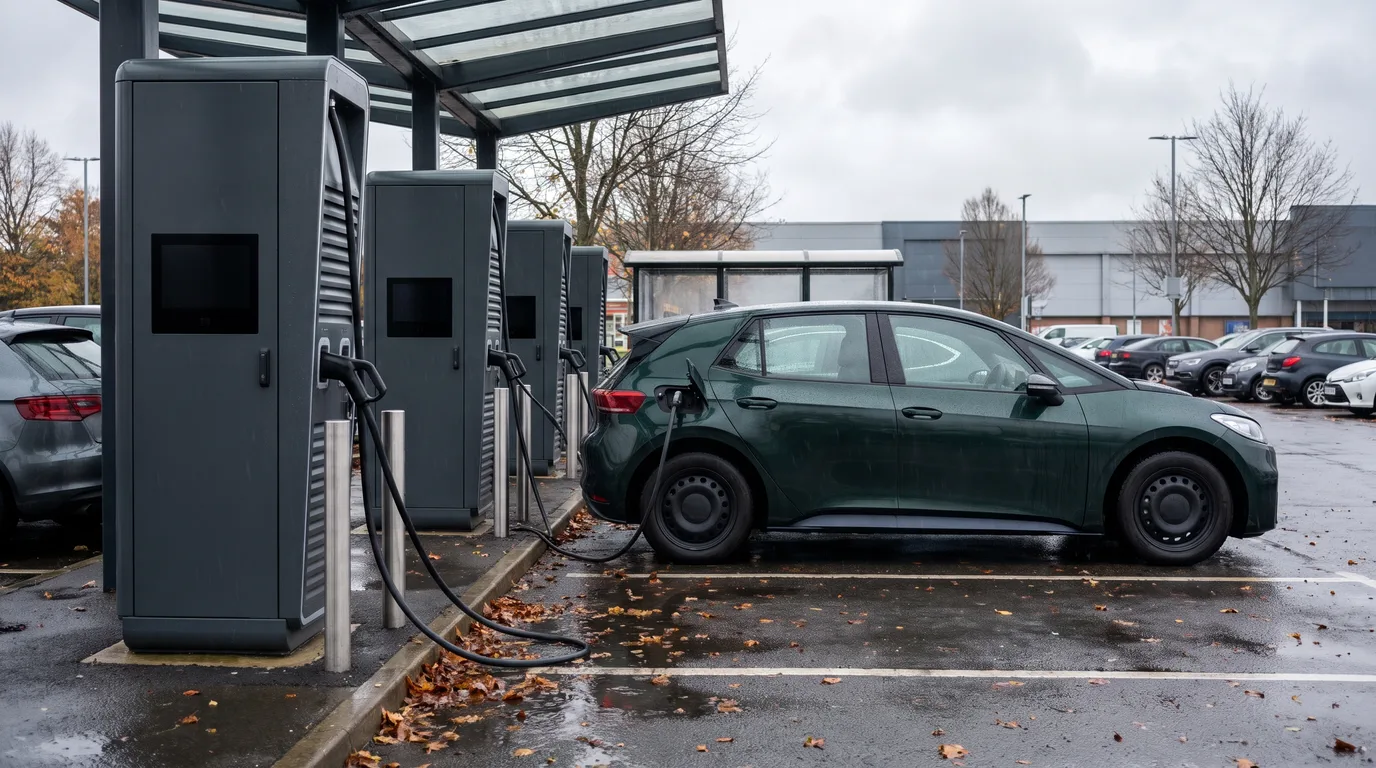
Public chargers sit in car parks and on pavements, often unattended for hours. The DfT says that makes them vulnerable to physical attacks, “potentially exacerbated by their location in public places”, and that they are “at risk of meter tampering for fraud”.
The measures it proposes include:
- Physical strength: chargers built or configured to give “an adequate level of protection against physical damage”.
- A tamper seal or sticker, so it is obvious if someone has opened the unit.
- A tamper sensor “on or within their casing to detect any breach of the casing”.
- An alert: if anyone tries to get at the internal components, the device notifies the end-user.
The consultation asks for views on each of these and on what they would cost. It does not mention card skimming or fake QR codes, the scam drivers are most likely to have heard of. Our guide to the fake QR code scam on EV chargers explains how that one works and how to avoid it.
Why does the meter rule matter to drivers?
Because you pay by the kWh, and public kWh are expensive. The DfT proposes that every public charger has a meter that meets the Measuring Instruments Regulations 2016, at minimum a Class B meter, which the consultation describes as accurate “to within 2%”. It says this “would support consumer and CPO interests by ensuring the accuracy of public charge points” and reduce the risk of fraud through meter tampering.
The consultation does not say how many public chargers already use approved meters, so we cannot say how much would change in practice. What we can show is why accuracy matters more at a public charger than at home. The figures below use Zapmap’s September 2026 average pay as you go prices, checked today, and Ofgem’s capped electricity rate for October to December 2026. The 40kWh charge is our example, roughly a 10% to 80% top up on a mid-sized EV.
| Where you charge | Price per kWh | Cost of 40kWh | 2% of that bill |
|---|---|---|---|
| Rapid or ultra-rapid public charger | 79p (Zapmap average) | £31.60 | 63p |
| Slow or fast public charger | 54p (Zapmap average) | £21.60 | 43p |
| Home, standard capped rate | 26.32p (Ofgem cap) | £10.53 | 21p |
The 2% figure is the outer limit the DfT gives for a Class B meter, not a typical error, and a meter’s error could just as easily favour the driver as the operator. The point is scale. At rapid charging prices, any measurement error costs three times as much per kWh as it would at the capped home rate.
Over a year the numbers add up. A driver covering 8,000 miles at 3.5 miles per kWh uses about 2,290kWh. Bought entirely at the 79p rapid average, that is about £1,810, and 2% of it is about £36. Most drivers charge partly at home and pay far less, but for people without a driveway who rely on public chargers, a legal standard for the meter is a real consumer protection. Zapmap’s latest figures are covered in our report on public EV charging prices in October 2026.
How does this compare with home charger rules?
Home chargers are already regulated. The Electric Vehicles (Smart Charge Points) Regulations 2021 came into force on 30 June 2022 and require smart charge points sold for homes and workplaces to have smart functions such as off-peak scheduling. Their security requirements, in Schedule 1, apply to chargers sold from 30 December 2022. They cover passwords, software updates, secure communication, protection against attack and a security log.
Those rules expressly exclude “public charge points” and “rapid charge points”, which the regulations define as chargers of 50kW or more. That is the gap this consultation would close.
| Home and workplace smart chargers | Public chargers | |
|---|---|---|
| Security rules today | Yes, Schedule 1 of the 2021 regulations | None specific, according to the DfT |
| In force since | Sold from 30 December 2022 | Proposed, no start date |
| Standard | Requirements written into the regulations | ETSI EN 303 645, or possibly EN 18031 |
| Physical anti-tamper rules | Yes, a tamper-protection boundary and an alert to the owner if it is breached | Proposed, including a seal and a casing sensor |
| Meter accuracy rule | A measuring system accurate to within 10%, not an MIR 2016 meter | Proposed, Class B under MIR 2016, within 2% |
The DfT notes that the home charger security requirements are “due to be revoked and replaced” by proposed Energy Smart Appliance Regulations. Best Chargers explains how the home rules work in its guide to UK smart charging regulations and its overview of new EV charging laws in the UK.
When would the rules start and who would enforce them?
Neither is settled. The consultation sets no implementation date. It asks manufacturers and operators how long they would need, noting that “physical changes in particular can take longer” because of product development cycles, and encourages them “to implement changes as soon as they are able to”.
On enforcement, the DfT says compliance would be checked by a regulator still to be chosen. It is consulting on two ways of proving compliance: self-assessment against the ETSI test specification with spot checks by the regulator, or certification by an accredited third-party test house.
What else is coming for charger security?
The consultation sits alongside other work, according to the DfT and EV Fleet World:
- Operators: a possible second phase could require charge point operators and e-mobility service providers to follow a cyber security best practice framework.
- Large networks: organisations controlling 300 megawatts or more of electrical load across their network would fall under the Network and Information Systems Regulations 2018, subject to the Cyber Security and Resilience Bill. EV Fleet World reports that most organisations are not expected to be in scope at first.
- Car to charger communication: the DfT and the Department for Energy Security and Net Zero plan a separate consultation on requiring support for the ISO 15118-20 standard.
What should drivers do now?
Nothing urgent. Existing chargers are not affected by the proposals, and there has been no suggestion that public charging is unsafe to use today. Sensible habits still help:
- Pay through the charger’s own contactless reader or the operator’s official app where you can. Our guide to contactless EV charging explains where it is available.
- Check the charger looks intact. Avoid one with a damaged casing, loose panels or a sticker over the payment area, and report it to the operator.
- Compare the kWh delivered with your car’s own figure. The two will rarely match exactly, because some energy is lost in charging, but a large gap is worth raising with the operator.
If you want to have your say, the consultation is open to individuals as well as businesses. The GOV.UK page links to an online form, the preferred route, and gives email and postal details for the Office for Zero Emission Vehicles.
Our view
This is overdue housekeeping rather than a response to a crisis. Home chargers have had security rules for almost four years, while the far more exposed public network has had none. Requiring approved meters is the part most drivers will feel, even if they never notice it: at 79p a kWh, being confident in the meter matters. The proposals only apply to new chargers, and there is no start date yet, so the change will come gradually as the network is replaced and expanded. What to watch for is when the rules start and who enforces them.
How we test and where our numbers come from
Range figures are official WLTP combined values taken from manufacturer UK specification pages, with real-world estimates drawn from independent comparative testing. Prices are UK list prices at the time of the latest update. Tax, grant and charging-scheme figures come from GOV.UK and HMRC publications. We re-check every guide when pricing, specification or policy changes. Last checked 13 November 2026. How we work out our own figures.
Frequently asked questions
What is the DfT proposing for public EV charger security?
The Department for Transport proposes that public charge points sold or installed in Great Britain meet the ETSI EN 303 645 cyber security standard, possibly with EN 18031 as an alternative, have physical anti-tamper protections, and use electricity meters that comply with the Measuring Instruments Regulations 2016.
Will existing public chargers have to be upgraded?
No, according to the consultation document. The DfT says it intends to apply the requirements to sold and installed public charge points only and will not require retrofitting. Existing chargers would be replaced with compliant ones when they reach the end of their life.
When would the new rules start?
No date has been set. This is a consultation, not a decision. The DfT is asking manufacturers and operators how long they would need, and encourages them to make changes as soon as they can.
Do home EV chargers already have security rules?
Yes. Under the Electric Vehicles (Smart Charge Points) Regulations 2021, smart chargers sold for homes and workplaces have had to meet security requirements if sold from 30 December 2022. Public chargers and rapid chargers of 50kW or more are excluded from those rules.
How can I respond to the consultation?
The consultation is open to anyone, including individual drivers, until 11:59pm on 20 December 2026. The GOV.UK page links to an online form, which is the preferred method, and also gives email and postal details for the Office for Zero Emission Vehicles.
Sources and further reading
- gov.ukGOV.UK (Department for Transport)Primary source referenced in this article.
- gov.ukCyber security for public electric vehicle charge points (consultation document)Detail of the proposals: no retrofitting, anti-tamper measures, Class B meters accurate to within 2%, compliance options, the NIS 300MW threshold and the link to the 2021 home charger rules.
- legislation.gov.ukThe Electric Vehicles (Smart Charge Points) Regulations 2021Commencement on 30 June 2022, Schedule 1 security requirements for charge points sold from 30 December 2022, the tamper-protection boundary in Schedule 1, the 10% measuring accuracy rule in regulation 9, and the exclusion of public and rapid charge points.
- evfleetworld.co.ukGovernment launches consultation to shield public EV chargers from cyberattacksTrade report of the consultation, including the possible second phase for operators and the separate ISO 15118-20 consultation.
- zapmap.comZapmap Price IndexAverage pay as you go public charging prices for September 2026: 79p/kWh rapid and ultra-rapid, 54p/kWh slow and fast.
- ofgem.gov.ukEnergy price cap unit rates and standing chargesAverage capped electricity unit rate of 26.32p per kWh for Direct Debit, 1 October to 31 December 2026.

EV Compared
The EV Compared editorial team tracks the UK electric vehicle market full time: new model launches, list prices, WLTP and real-world range, public charging tariffs and the tax rules that decide what an EV actually costs to run. Every guide is checked against manufacturer specifications and official GOV.UK figures, and updated whenever the numbers move.
Related reading
View all
Zapmap: rapid charging averages 77p/kWh as MFG keeps 59p app price
Rapid public charging averaged 77p/kWh in August, and MFG has kept its 59p summer price for drivers who use its app. Here is what the big networks charge, and the off-peak and subscription deals that cut the bill.
What Is Contactless EV Charging and Where Can You Use It?
Since November 2024, tapping to charge is a legal right at rapid chargers, here is what changed and what remains patchy
Chery plans UK fast charging and energy storage stations from 2027, with no sites named yet
The group behind Omoda, Jaecoo, Chery, Lepas and the coming iCaur brand announced the plan at its summit in Wuhu. It has not said how many stations, where, how fast or at what price. Here is what is confirmed, what is not, and what charging costs its drivers today.
Tesla Supercharger membership: when does it pay for itself?
Non-Tesla drivers can pay a monthly or annual fee to get Tesla owner prices at Superchargers. We worked out how much charging you need to do before the fee is covered.
Tesla Supercharger prices UK: what Tesla and non-Tesla drivers pay
Tesla drivers paid an average of 48p/kWh on Superchargers in September 2026, while other EVs paid 69p at open sites. We set out what each group pays, how peak and off-peak pricing works and when a membership is worth it.
How to Use a Tesla Supercharger with a Non-Tesla EV
Which sites are open, what you need on your phone, how to park when your charging port is in the wrong place, and when a Supercharging Membership pays for itself.