Tesla Supercharger prices UK: what Tesla and non-Tesla drivers pay
Tesla drivers paid an average of 48p/kWh on Superchargers in September 2026, while other EVs paid 69p at open sites. We set out what each group pays, how peak and off-peak pricing works and when a membership is worth it.
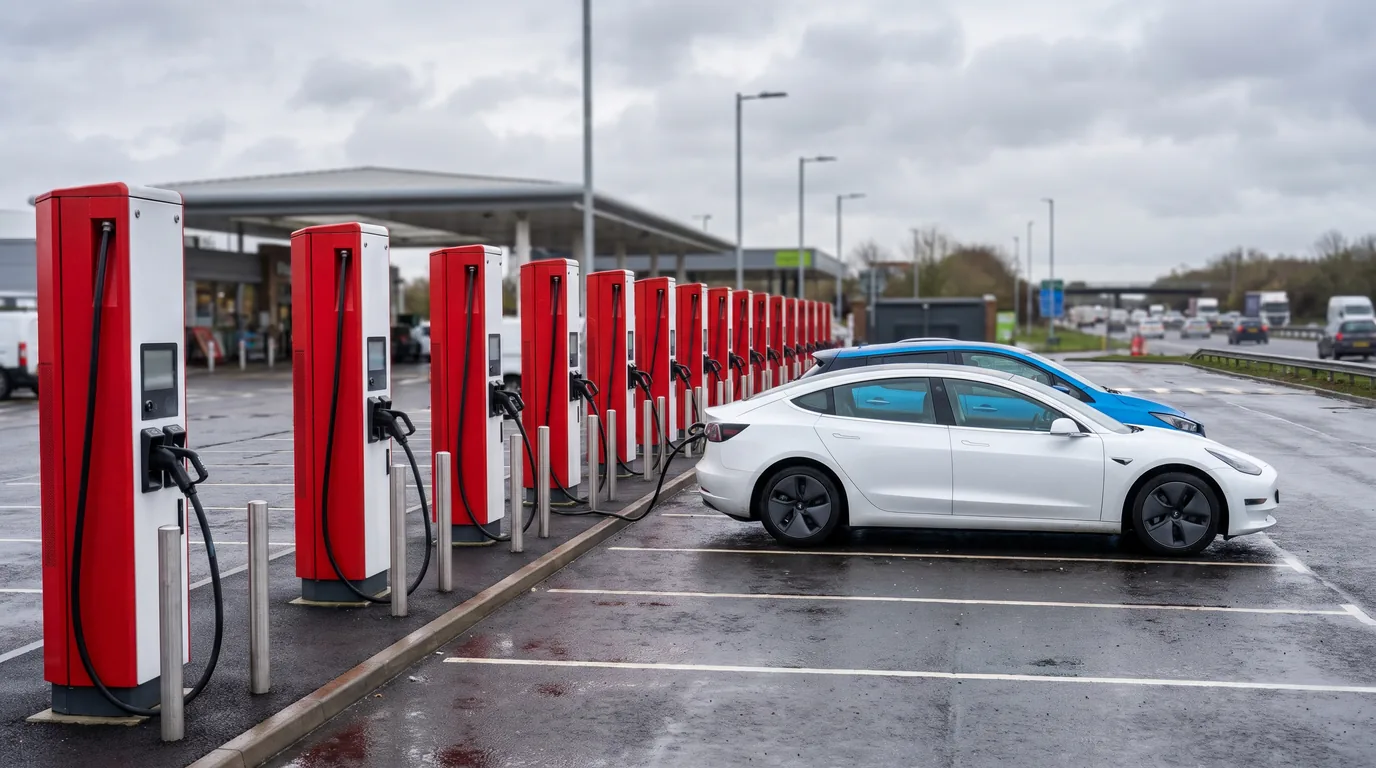
Quick answers
- Tesla drivers paid an average of 48p/kWh across the UK Supercharger network in September 2026, according to Zapmap's Charging Price Index.
- Drivers of other EVs paid an average of 69p/kWh at the Supercharger sites open to them in September 2026, which is 21p or 44% more than Tesla drivers paid.
- Zapmap named Tesla's open network the cheapest of the UK's top 10 rapid networks in October 2026, with prices from 51p/kWh against a top-10 range that reached 93p/kWh.
- A 10 to 80 per cent stop in a 79 kWh Tesla adds 55.3 kWh and costs £26.54 at the 48p Tesla driver average, against £43.69 at Zapmap's 79p/kWh public rapid average.
- Supercharger prices are higher from 4pm to 8pm; at Wokingham in April 2025 non-members paid 41p/kWh off-peak and 52p at peak, a 27% premium.
- The Supercharging membership for non-Tesla drivers was cut to £8.99 a month, or £90 a year, in April 2024, and pays for itself at about 45 to 90 kWh a month on monthly billing.
Tesla drivers paid an average of 48p/kWh on UK Superchargers in September 2026, and drivers of other EVs paid 69p/kWh at the sites open to them, according to Zapmap. Both are below the 79p/kWh average for public rapid charging, and both are cheaper outside the 4pm to 8pm peak.
Tesla does not publish one national price list for UK Superchargers. Each site has its own rate, which changes with the time of day and depends on whether you drive a Tesla or have a Supercharging membership. The Tesla app shows the rate before you plug in. To show what drivers actually pay, the figures below combine Zapmap’s monthly price data with dated examples from individual sites.
How much does a Tesla Supercharger cost per kWh?
Across the whole Supercharger network, Tesla drivers paid an average of 48p/kWh in September 2026. At Superchargers open to all drivers, the average was 69p/kWh (Zapmap Charging Price Index). In October 2026, Zapmap named Tesla’s open network the cheapest of the UK’s top 10 rapid networks, with prices from 51p/kWh (Zapmap rapid charging prices).
Here is the EV Compared snapshot. To show what each price means in pounds, we costed one typical stop: 10 to 80 per cent in a Tesla with a 79 kWh usable battery, which is the battery in every Model 3 and Model Y apart from the RWD models and the Model Y Premium Long Range RWD (EV Database).
Method: 79 kWh × 70% = 55.3 kWh added; 55.3 kWh × price per kWh = cost of the stop.
| Price point | p/kWh | Period | Cost of a 10 to 80% stop (55.3 kWh) |
|---|---|---|---|
| Tesla drivers, whole Supercharger network average | 48p | September 2026 | £26.54 |
| Lowest open-site Supercharger price | 51p | October 2026 | £28.20 |
| Non-Tesla drivers, open-site average | 69p | September 2026 | £38.16 |
| UK public rapid and ultra-rapid average | 79p | September 2026 | £43.69 |
| Home smart tariff (our methodology input) | 8p | November 2026 | £4.42 |
EV Database quotes about 28 minutes for that stop in a Model 3 Premium Long Range RWD, which charges at up to 250 kW. For costs by trim and battery, including full charges and pence per mile, see our guide to how much it costs to charge a Tesla.
What do non-Tesla drivers pay at a Supercharger?
Non-Tesla drivers paid an average of 69p/kWh at open sites in September 2026. That is 21p more than Tesla drivers paid, a premium of 44% on our sums (69 ÷ 48 = 1.44). On a 55.3 kWh stop the gap is £11.62.
Even so, an open Supercharger is usually cheaper than the rest of the rapid market. At 69p, a non-Tesla driver pays 10p/kWh less than the 79p public rapid average, so the same 55.3 kWh stop costs £5.53 less. Zapmap put InstaVolt, the most expensive of the top 10 networks, at 92p/kWh. Our round-up of public EV charging prices in October 2026 compares the main networks, and our Ionity vs Tesla Supercharger guide looks at which suits other EVs on long trips.
Zapmap counted 2,774 Tesla chargers at 447 UK locations at the end of September 2026 and says more than half the network is now open to any compatible EV (Zapmap). You need a car with a CCS connector, which rules out cars such as the Nissan Leaf (Electrifying.com). Older V3 stalls are started through the Tesla app, and Electrifying.com reported in April 2024 that the newer V4 units also accept contactless cards.
Are Superchargers cheaper off-peak?
Yes. Tesla has charged less outside a 4pm to 8pm peak since November 2022, and the off-peak rate applies at sites open to other EVs as well as Tesla-only sites (Electrifying.com). Zapmap does not publish separate peak and off-peak averages, so the table uses the two dated examples we could source.
Method: peak price minus off-peak price = gap; gap ÷ off-peak price = peak premium.
| Example | Off-peak | Peak (4pm to 8pm) | Gap | Peak premium |
|---|---|---|---|---|
| UK averages when off-peak pricing launched, November 2022 | 54p | 67p | 13p | 24% |
| Wokingham, non-member, April 2025 | 41p | 52p | 11p | 27% |
At the Wokingham rates, moving a 55.3 kWh stop out of the 4pm to 8pm window saves £6.08 (55.3 × 11p). On a long weekday journey, stopping before 4pm or after 8pm is the simplest way to cut the cost.
The price is set by the site and the time you plug in, so two Superchargers on the same route can differ. In April 2025, Electrifying.com found non-members paying 52p/kWh at peak in Wokingham and 42p at nearby Uxbridge.
Is a Supercharging membership worth it?
Tesla cut the membership for non-Tesla drivers from £10.99 to £8.99 a month in April 2024 and added a £90 annual plan (Electrifying.com; Zapmap). Those are the most recent UK membership prices we could source. Tesla owners are put on member rates automatically, so the membership is aimed at drivers of other EVs.
Members save between 10p and 20p per kWh, according to Electrifying.com in April 2025. At Uxbridge, that meant 28p/kWh with membership against 42p without.
Method: membership fee ÷ saving per kWh = monthly kWh needed to break even.
| Plan | Cost per month | Break-even at 20p saving | Break-even at 10p saving |
|---|---|---|---|
| Monthly | £8.99 | 45 kWh | 90 kWh |
| Annual (£90) | £7.50 | 38 kWh | 75 kWh |
In practice, if you make one or two typical rapid stops a month on Superchargers, the monthly plan roughly pays for itself. The annual plan only pays off if you Supercharge regularly all year; a driver who Supercharges on two holiday trips a year will not reach 38 kWh in most months. Our guide to EV charging subscriptions compares Tesla’s membership with other networks’ plans.
Are there other Supercharger fees?
Yes, and they are avoidable. If you stay plugged in after charging finishes, Tesla can charge an idle fee of up to £1 a minute, according to Electrifying.com in April 2025. Zapmap also notes that connection or overstay fees can apply on top of the per-kWh price. Moving the car as soon as the session ends avoids them.
How does Supercharging compare with charging at home?
Home charging is far cheaper. At 8p/kWh on a smart EV tariff such as Intelligent Octopus Go, the 55.3 kWh that costs £26.54 at a Supercharger costs £4.42 at home, about a sixth of the price. Even on the October to December 2026 price cap rate of 26.32p/kWh, the same energy costs £14.55, still about £12 less than the Supercharger average.
So Superchargers make most financial sense on long journeys, while most of your charging is best done at home. If you are still choosing a car, our guide to which Tesla to buy compares range and charging speed across the Model 3 and Model Y.
How we test and where our numbers come from
Range figures are official WLTP combined values taken from manufacturer UK specification pages, with real-world estimates drawn from independent comparative testing. Prices are UK list prices at the time of the latest update. Tax, grant and charging-scheme figures come from GOV.UK and HMRC publications. We re-check every guide when pricing, specification or policy changes. Last checked 1 November 2026. How we work out our own figures.
Frequently asked questions
How much does a Tesla Supercharger cost per kWh in the UK?
Tesla drivers paid an average of 48p/kWh across the UK Supercharger network in September 2026, according to Zapmap. Drivers of other EVs paid an average of 69p/kWh at sites open to them. Each site sets its own price, which the Tesla app shows before you plug in.
How much does a Supercharger cost for a non-Tesla car?
Non-Tesla drivers paid an average of 69p/kWh at open Supercharger sites in September 2026, and Zapmap listed open-site prices from 51p/kWh in October 2026. A Supercharging membership, which Tesla cut to £8.99 a month in April 2024, lowers the per-kWh rate by 10p to 20p, according to Electrifying.com.
Are Tesla Superchargers cheaper at night?
Yes, Superchargers charge less outside the 4pm to 8pm peak. When Tesla introduced off-peak pricing in November 2022, the UK averages were 54p/kWh off-peak and 67p at peak. At Wokingham in April 2025, non-members paid 41p/kWh off-peak and 52p at peak.
Is a Tesla Supercharging membership worth it for a non-Tesla driver?
It is worth it if you charge about 45 to 90 kWh a month on Superchargers, which is roughly one or two typical rapid stops. That is our calculation from the £8.99 monthly fee and Electrifying.com's 10p to 20p per kWh saving. The £90 annual plan works out at £7.50 a month and breaks even at about 38 to 75 kWh a month.
How much does it cost to charge a Tesla at a Supercharger from 10 to 80 per cent?
A 10 to 80 per cent stop costs £26.54 in a Tesla with a 79 kWh battery at the 48p/kWh average Tesla drivers paid in September 2026. The same 55.3 kWh would cost £38.16 at the 69p non-Tesla average and £4.42 at home on an 8p/kWh smart tariff.
Are Tesla Superchargers cheaper than other rapid chargers?
Yes, for both Tesla and non-Tesla drivers on average. Zapmap's September 2026 public rapid average was 79p/kWh, against 48p for Tesla drivers on Superchargers and 69p for other EVs at open sites. In October 2026 Zapmap named Tesla's open network the cheapest of the top 10 rapid networks.
Can any electric car use a Tesla Supercharger?
Any car with a CCS connector can use a Supercharger site that Tesla has opened to other EVs, and Zapmap says more than half of the UK network is now open. Cars without CCS, such as the Nissan Leaf, cannot use them. Most sessions are started in the Tesla app.
Sources and further reading
- zapmap.comCharging Price IndexSeptember 2026 averages: 48p/kWh paid by Tesla drivers across the Supercharger network, 69p/kWh at Superchargers open to all drivers, 79p/kWh for public rapid and ultra-rapid charging and 54p/kWh for slow and fast charging.
- zapmap.comRapid charging pricesOctober 2026: Tesla Public is the cheapest of the top 10 rapid networks with prices from 51p/kWh; top-10 prices ranged from 51p to 93p/kWh.
- zapmap.comTesla network2,774 Tesla chargers at 447 UK locations at the end of September 2026, with more than half of the network open to any compatible EV; connection or overstay fees may apply.
- electrifying.comHow to charge a non-Tesla at a Tesla SuperchargerApril 2025: membership at £8.99 a month saves 10p to 20p per kWh; Wokingham non-member prices of 41p off-peak and 52p from 4pm to 8pm; Uxbridge 42p, or 28p with membership; idle fees of up to £1 a minute; CCS connector required; sessions started in the Tesla app.
- electrifying.comTesla lowers Supercharger prices across UK and IrelandApril 2024: membership cut by £2 to £8.99 a month, new £90 annual plan, Tesla owners automatically on member rates, V4 units accept contactless cards while V3 units need the Tesla app.
- electrifying.comTesla brings off-peak charge rates to UK Supercharger networkNovember 2022: off-peak pricing introduced at all UK Supercharger sites including those open to other EVs, with a 4pm to 8pm peak; UK averages of 67p/kWh peak and 54p off-peak at launch.
- zapmap.comTesla opens more of its Supercharger sites to non-Tesla driversMay 2024: membership fee fell from £10.99 to £8.99 a month with a £90 annual option.
- ev-database.orgTesla Model 3 Premium RWD (Highland)79 kWh usable battery, 250 kW peak DC charging and about 28 minutes for 10 to 80 per cent.
- octopus.energyIntelligent Octopus GoSmart EV tariff with an 11:30pm to 5:30am off-peak window, now listed from 6.5p/kWh; EV Compared's methodology uses 8p/kWh as its home off-peak input.

EV Compared
The EV Compared editorial team tracks the UK electric vehicle market full time: new model launches, list prices, WLTP and real-world range, public charging tariffs and the tax rules that decide what an EV actually costs to run. Every guide is checked against manufacturer specifications and official GOV.UK figures, and updated whenever the numbers move.
Related reading
View all
Tesla Supercharger membership: when does it pay for itself?
Non-Tesla drivers can pay a monthly or annual fee to get Tesla owner prices at Superchargers. We worked out how much charging you need to do before the fee is covered.
Tesla Superchargers join bp's roaming network: what fleets get
bp's Fuel & Charge card now works at eligible Tesla Superchargers, more than 2,000 of them in the UK, with sessions billed straight to the employer. bp has not published the per-kWh rate fleets will pay.
Best home energy tariffs for Tesla owners
We worked out what 8,000 miles a year in a Tesla Model Y costs on each of the main UK EV tariffs, which ones connect to a Tesla directly, and where Tesla's own electricity licence stands.

Tesla Q3 2026 results: what they mean for UK buyers
Tesla delivered 10,567 fewer cars than a year earlier and earned less on each one, but ended the quarter with its largest order backlog in four years. That points to firm UK prices and longer waits rather than discounts.
Tesla referral codes and discounts: what UK buyers can get
A referral link earns a new Model 3 or Model Y buyer 650 miles of free Supercharging, not money off. We work out what those miles are worth and set them against the bigger Tesla discounts running to 31 December 2026.
Tesla software update: what the latest version adds (November 2026)
Tesla began pushing 2026.38.6 to UK cars on 29 October. It brings Halloween Mode, sharper car graphics and Set Arrival Energy, while the headline FSD and Supercharger features stay in North America for now.