Best EV Charging Subscriptions UK 2026: Which Plans Save Money
Which monthly plans actually save money, and who should not bother with one
Quick answers
- The best EV charging subscription in the UK depends on where you charge: IONITY Power 365 suits motorway drivers, Be.EV suits the North of England, Shell Recharge suits city drivers without a driveway, and Fastned Gold suits drivers on Fastned routes.
- An EV charging subscription is a monthly or annual fee that buys a lower per-kWh rate on one or more networks. At 50 kWh of rapid charging a month, the gross saving is roughly £10 to £20 a month before the fee comes off.
- IONITY's Power 365 plan costs £104.99 a year and charges 49p per kWh, against a 79p pay-as-you-go app rate used in our comparison; IONITY says its monthly Power plan pays for itself after two sessions a month.
- bp pulse's subscription costs £7.85 a month and cuts rapid (DC 150 kW) charging to 69p per kWh, a 20p per kWh saving against an 89p pay-as-you-go rate.
- Fastned Gold takes 30% off the standard 79p per kWh UK price, bringing it to 55p per kWh; the free Fastned app already gives 10% off without a subscription.
- Be.EV's Flexi Pass charges 39p per kWh for £13.99 a month, but Be.EV is concentrated in the North of England, so it has little use for drivers elsewhere.
- Skip a subscription if you charge publicly fewer than once or twice a month, mostly charge at home, or spread your charging across several networks; pay-as-you-go contactless or a roaming app such as Electroverse is usually cheaper.
The best EV charging subscription in the UK depends on where you charge: IONITY Power 365 for motorway drivers, Be.EV in the North of England, Shell Recharge for city drivers without a driveway. An EV charging subscription is a monthly or annual fee that buys you a lower per-kWh rate on one or more charging networks. Done right, a subscription saves money on every public charge. Done wrong, you pay a fee and charge publicly so infrequently that the fee wipes out any saving. The key is matching the subscription to your actual charging behaviour.
The PAYG contactless rate is always the most expensive option on any network. Subscriptions exist because operators want loyal customers and recurring revenue, but the savings they offer are real. This guide shows you which plan wins for your situation, and our Zapmap price index report shows what the average rapid charge costs right now.
Quick comparison: the main subscriptions in 2026
Of the six plans below, IONITY Power 365 and Be.EV’s Flexi Pass save the most after fees at 50 kWh a month, while Shell Recharge, Fastned Gold and bp pulse save much less.
| Network | Fee | Rapid PAYG rate | Subscriber rate | Net annual saving (50 kWh/month)* |
|---|---|---|---|---|
| IONITY Power 365 | £104.99 a year (about £8.75 a month) | 79p/kWh | 49p/kWh | ~£180 gross, ~£75 after fee |
| Be.EV Flexi Pass | £13.99 | ~80p/kWh | 39p/kWh | ~£246 gross, ~£78 after fees |
| Shell Recharge | £9.99 | 79p/kWh | ~56p/kWh | ~£138 gross, ~£18 after fees |
| Fastned Gold | £9.99 | 79p/kWh | 55p/kWh | ~£144 gross, ~£24 after fees |
| bp pulse | £7.85 | 89p/kWh | 69p/kWh | ~£120 gross, ~£26 after fees |
| IONITY Motion | £5.49 | 79p/kWh | 59p/kWh | ~£120 gross, ~£54 after fees |
*Calculation assumes 50 kWh rapid charging per month at the subscriber rate vs the PAYG rate, minus a full year of fees. Indicative only; prices change, so check the operator’s app before you sign up.
Drivers who charge more will save more; drivers who charge less will save less or may not break even.
1. IONITY Power: best for frequent long-distance drivers
IONITY Power 365 is among the best-value plans here for drivers who regularly use motorway ultra-rapid chargers, at 49p per kWh for £104.99 a year.
Cost: £104.99 for the 12-month Power 365 plan, paid once with no auto-renewal. A monthly Power plan is available at about £10.50 a month and charges 47p per kWh.
Rate: 49p per kWh on the annual plan (47p on the monthly plan), on all IONITY ultra-rapid chargers (150 kW to 350 kW).
PAYG alternative: 79p per kWh in the app (83p by contactless).
Saving per 40 kWh session: £12.00.
IONITY’s Power plan is one of the deepest discounts of any mainstream UK charging subscription. At 49p per kWh, it approaches the lower end of home EV tariff pricing. The cheaper IONITY Motion plan costs £5.49 a month at 59p per kWh (or £54.99 for the annual Motion 365 at 62p per kWh), a sensible entry point if you only make a few long journeys. Osprey drivers can also skip the app entirely, as our Osprey Go Autocharge report explains.
The limitation is network coverage: IONITY has 860 chargers in the UK, concentrated at Extra motorway services and village hotels. IONITY says its monthly Power plan pays for itself after two charging sessions a month. If you rarely encounter IONITY stations, it offers no value. Our comparison of IONITY and Tesla Superchargers for non-Tesla drivers shows how it stacks up on motorway routes.
Best for: Drivers who regularly travel on IONITY-served motorway routes (M25, M4, M5, M6 corridors via Extra services).
2. Be.EV: best for North of England drivers
Be.EV’s Flexi Pass gives a 39p per kWh rate for £13.99 a month, the lowest subscriber rate in this comparison, but only if you charge in the North.
Cost: £13.99 per month for the Flexi Pass, cancel anytime. Be.EV also sells bundled passes: £49 a month for 120 kWh (the Go Pass) and £89 a month for 250 kWh (the Go Further Pass).
Rate: 39p per kWh on the Flexi Pass.
PAYG alternative: standard ultra-rapid pricing runs from 59p to 89p per kWh depending on the site, and Be.EV compares its passes with an 80p UK average.
Be.EV is concentrated in the North of England, particularly Manchester, Leeds, Sheffield and surrounding areas. Its 39p rate is the cheapest on any mainstream UK subscription we have checked, and the pass gives access to Be.EV’s growing network of rapid and ultra-rapid chargers. Our report on Be.EV’s monthly charging passes covers the allowance plans in more detail.
For drivers in the North who charge publicly several times a month, Be.EV’s pricing advantage is substantial. The geographic concentration limits its usefulness for drivers in the South, Midlands or Scotland.
Best for: Frequent public chargers in the North of England.
3. Shell Recharge: best for urban drivers without a driveway
Shell Recharge costs £9.99 a month and takes 30% off app pricing, which makes it the most practical large-network membership for city drivers who rely on on-street charging.
Cost: £9.99 per month.
Rate: 30% off app pricing (up to 1,000 kWh per month).
Shell Recharge operates the UK’s largest on-street charging network (absorbed from Ubitricity), with more than 11,000 chargepoints nationwide, including the densest on-street coverage in London and other major cities. For drivers without a driveway who depend on on-street or public charging as their primary energy source, Shell Recharge’s combination of footprint and the 30% subscription discount makes it the most practical large-network membership. If that is you, see our list of the best electric cars for drivers without a driveway.
Rapid Shell Recharge PAYG is 79p per kWh; on-street slow charging is 52p to 85p per kWh depending on location. The subscription applies across both, so savings stack up quickly for high-mileage urban users.
Best for: London drivers, urban dwellers without off-street parking.
4. Fastned Gold: best for reliability-focused drivers
Fastned Gold takes 30% off Fastned’s standard price, bringing a rapid charge from 79p to 55p per kWh for £9.99 a month.
Cost: £9.99 per month.
Rate: 30% discount on PAYG.
Fastned’s Gold membership is straightforward: pay £9.99 per month and get 30% off every charge at any Fastned station. With PAYG at 79p per kWh, the subscriber effective rate is 55p per kWh. Fastned also allows you to save 10% through its free app without any subscription, making it worth downloading even if you do not go for Gold.
Fastned was third in Zapmap’s 2025 medium rapid/ultra-rapid network rankings, having topped that category in 2024. If Fastned stations appear on your regular routes, the combination of reliability and Gold membership pricing is compelling.
Best for: Drivers on Fastned-served routes who prioritise reliability over pure price minimisation.
5. BP Pulse: best for flexible multi-charger access
bp pulse has the second-cheapest fee in this comparison at £7.85 a month, but its 69p per kWh subscriber rate is the highest here.
Cost: £7.85 per month (first month sometimes free).
Rate: 69p per kWh on rapid chargers (versus 89p PAYG) and lower on slower AC chargers.
BP Pulse is the cheapest subscription fee of the major general-purpose networks. The subscriber rate of 69p per kWh versus 89p PAYG represents a 20p per kWh saving, because BP Pulse’s PAYG rate is the highest of the main networks. Its published subscriber rate is lower on slower chargers: 63p per kWh on 43 kW AC and 50 kW DC points, and 44p per kWh on 7 kW AC. For a head-to-head view, read our BP Pulse vs Shell Recharge comparison.
Reliability is the caveat. BP Pulse’s network is large but mixed in quality. The subscription saves money on sessions that complete; it does not compensate you for broken chargers. For drivers with a regular BP Pulse location that works reliably, the subscription is good value. For those who have had reliability problems, it is worth checking recent Zap-Map user reviews of your intended site before committing.
Best for: Drivers who specifically use BP Pulse locations regularly and have found them reliable.
Who should not pay for a subscription?
You should skip a subscription if you charge publicly fewer than once or twice a month, mostly charge at home, split your charging across networks, or have free workplace charging.
- Charge publicly fewer than once or twice a month
- Primarily charge at home and use public chargers only on occasional long trips
- Use multiple different networks rather than concentrating on one
- Have access to free workplace charging for most of your energy needs
If most of your top-ups come from a home charger, a paid plan delivers less value, and your electricity costs sit outside the subscription. For occasional or multi-network users, PAYG contactless or a free roaming platform like Electroverse is simpler and usually cheaper than paying a monthly fee.
Roaming platforms as an alternative
A roaming platform gives you access to many networks through one account and one invoice, so you do not need a subscription for each network. Electroverse, Bonnet and ChargePass are the best-known examples; our Electroverse vs Bonnet comparison explains the differences. Some provide network-rate pricing (the same as if you had that network’s app); others add a small fee. For drivers who regularly use GRIDSERVE, Pod Point, BP Pulse and Osprey on different journeys, a roaming platform can eliminate the need for four separate apps and sometimes reduce the total cost. Rates vary by network and location, so check current in-app prices before starting a session.
The subscription checklist
Before signing up, ask these five questions:
- How often do I charge publicly? (Less than 2x per month? Probably not worth it.)
- Which network’s chargers do I actually use most? (Match the subscription to your real behaviour and the price you usually pay.)
- Is there a free trial? (BP Pulse and others sometimes offer first month free.)
- Can I cancel easily? (Most monthly plans let you cancel anytime; IONITY’s annual plans are paid once for 12 months and are less flexible.)
- Are there off-peak rates that might save more? (InstaVolt’s free app off-peak discount may beat a paid subscription, and some networks offer cheaper charging in-app with no monthly fees, so compare PAYG before you sign.)
Where to find more
For a guide to the cheapest public charging options overall, see Best Cheap Public EV Charging Options.
For a full comparison of UK charging networks, see Best Public EV Charging Networks in the UK.
For the complete overview of how public charging works, visit our Public Charging guide.
How we test and where our numbers come from
Range figures are official WLTP combined values taken from manufacturer UK specification pages, with real-world estimates drawn from independent comparative testing. Prices are UK list prices at the time of the latest update. Tax, grant and charging-scheme figures come from GOV.UK and HMRC publications. We re-check every guide when pricing, specification or policy changes. Last checked 23 October 2026. How we work out our own figures.
Frequently asked questions
What is the best EV charging subscription in the UK?
For frequent long-distance drivers, IONITY Power 365 (£104.99 a year, 49p per kWh) is among the strongest value on this list. Drivers in the North of England should look at Be.EV, and urban drivers without a driveway at Shell Recharge. A subscription only pays if you rapid charge often enough for the lower rate to beat the fee.
How much does an EV charging subscription cost in the UK?
Fees run from about £5.49 a month for IONITY Motion to £13.99 a month for Be.EV's Flexi Pass. bp pulse costs £7.85 a month, while Shell Recharge and Fastned Gold are £9.99 a month. IONITY Power 365 is a single £104.99 payment for the year.
Is an EV charging subscription worth it?
Yes, but only if you charge on the network often. At 50 kWh of rapid charging a month, IONITY Power 365 saves roughly £75 a year after fees and Be.EV's Flexi Pass roughly £80, while Shell Recharge and Fastned Gold save only about £20 a year. Below that level of use, the fee can cancel the saving.
Which EV charging subscription gives the cheapest per-kWh rate?
Be.EV's Flexi Pass at 39p per kWh and IONITY Power at 47p per kWh on the monthly plan (49p on Power 365) give the lowest rates of the plans compared here. Both depend on location, though: Be.EV is concentrated in the North of England and IONITY sites are mostly at motorway services.
Can I cancel an EV charging subscription?
Most monthly plans can be cancelled at any time, and Be.EV and IONITY's monthly plans are set up that way, while Fastned Gold can be cancelled after the first 30 days. IONITY's annual Power 365 and Motion 365 plans are paid once for 12 months, so they are less flexible.
Do I need a subscription if I charge at home?
Usually not. If most of your charging is at home and you only use public chargers on occasional long trips, pay-as-you-go contactless or a roaming platform such as Electroverse is simpler and usually cheaper than a monthly fee.
Sources and further reading
- zapmap.comZap-MapPrimary source referenced in this article.
- ionity.euIONITY: lowers ultra-rapid EV charging fees with new annual plansSupports the standard annual fees of £104.99 for Power 365 and £54.99 for Motion 365; the 43p and 53p per kWh rates in the release were the October 2025 launch rates, and IONITY now lists Power from 47p per kWh.
- ionity.euIONITY: flexible EV charging subscriptionsSupports IONITY's UK prices (79p app and 83p contactless pay as you go; Power £10.50 a month at 47p; Power 365 at 49p; Motion £5.49 a month at 59p; Motion 365 at 62p) and its statements that Power pays off after two sessions a month and Motion after the first.
- shell.co.ukShell UK: Shell Recharge pricingSupports the £9.99 a month Shell Recharge subscription and 30% off app pricing (up to 1,000 kWh a month).
- zapmap.comZapmap: Best EV charging networks UK 2025Supports Fastned's third place in the 2025 medium network rankings.
- zapmap.comZapmap: IONITY chargers UKSupports IONITY's 860 UK chargers at the end of September 2026.
- bppulse.combp pulse UK: how much does it cost to charge an electric car?Supports the £7.85 a month subscription and the 69p per kWh subscriber rate on DC 150 kW chargers.
- be-ev.co.ukBe.EV: Levenshulme Station pricing and charging passesSupports the Flexi Pass (39p per kWh, £13.99 a month), Go Pass and Go Further Pass prices.
- fastnedcharging.comFastned UK: prices, discounts and subscriptionsSupports the 79p standard price, 55p Gold Member price, 30% Gold discount and 10% app discount.

EV Compared
The EV Compared editorial team tracks the UK electric vehicle market full time: new model launches, list prices, WLTP and real-world range, public charging tariffs and the tax rules that decide what an EV actually costs to run. Every guide is checked against manufacturer specifications and official GOV.UK figures, and updated whenever the numbers move.
Related reading
View all
Be.EV Charging Pass: £49 a month for 120kWh, or £89 for 250kWh
Be.EV has launched two monthly charging passes with a kWh allowance included. We work out the real cost per kWh, compare them with its 39p Flexi Pass and show who comes out ahead.
BP Pulse vs Shell Recharge: Which UK Network Wins?
Two of the UK's biggest charging networks compared on price, reliability and which type of driver each suits
Best Cheap Public EV Charging Options in the UK
How to charge in public for the least money, the networks, tricks and times that cut your bill
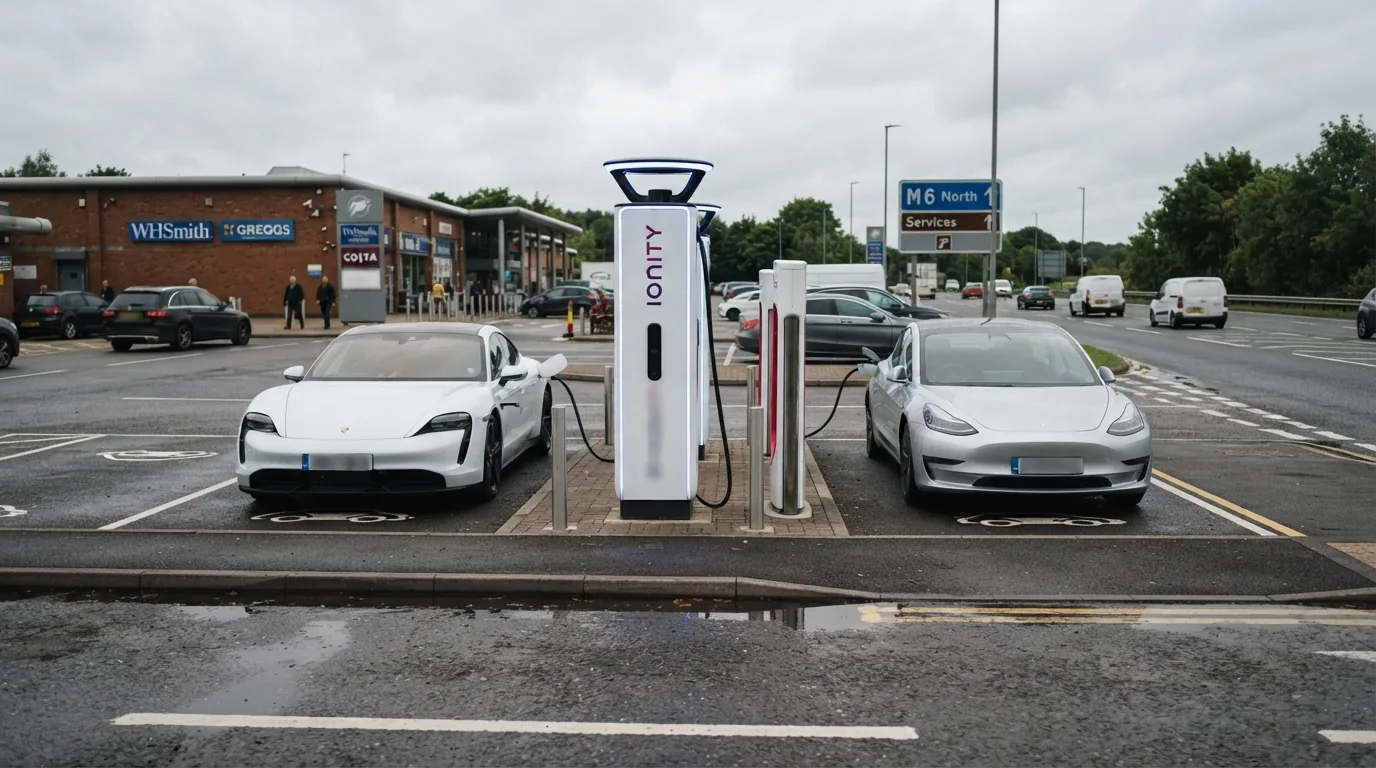
Ionity vs Tesla Supercharger: Best for Non-Tesla EVs in the UK?
Two ultra-rapid networks compared on price, speed, coverage and real-world experience for CCS drivers
Octopus Electroverse vs Bonnet: Best Charging App Compared
Octopus Electroverse and Bonnet (now OVO Charge) are the two leading multi-network EV charging apps in the UK. We compare coverage, price and who each one suits.
Public EV Charging in the UK: Networks, Costs and How It Works
Everything you need to know about charging your electric car away from home