How to Use a Tesla Supercharger with a Non-Tesla EV
Which sites are open, what you need on your phone, how to park when your charging port is in the wrong place, and when a Supercharging Membership pays for itself.
Quick answers
- By EV Compared's calculation, about 65% of UK Tesla Supercharger sites are open to non-Tesla cars, based on two independent counts of Tesla's map in autumn 2026: 149 of 230 sites and 152 of 233 sites.
- That leaves roughly 80 UK Supercharger sites that are still Tesla-only, so a non-Tesla driver must confirm a site is open in the Tesla app before relying on it.
- Any electric car with a CCS charging socket can use an open Supercharger; you need a free Tesla account, the Tesla app and a payment card, and the newest V4 stalls also have contactless readers.
- Zapmap lists Tesla's pay-as-you-go price at about 69p per kWh in October 2026, against a UK rapid and ultra-rapid average of 79p per kWh in September 2026.
- A 40 kWh top-up costs about £27.60 at 69p per kWh, around £4 less than the same charge at the 79p national rapid average (£31.60).
- A Supercharging Membership costs £8.99 a month or £90 a year, and pays for itself once you add roughly 45 to 90 kWh a month on the monthly plan, depending on whether it saves you 20p or 10p per kWh.
- Idle fees of up to £1 a minute can apply if you leave your car plugged in after it finishes charging.
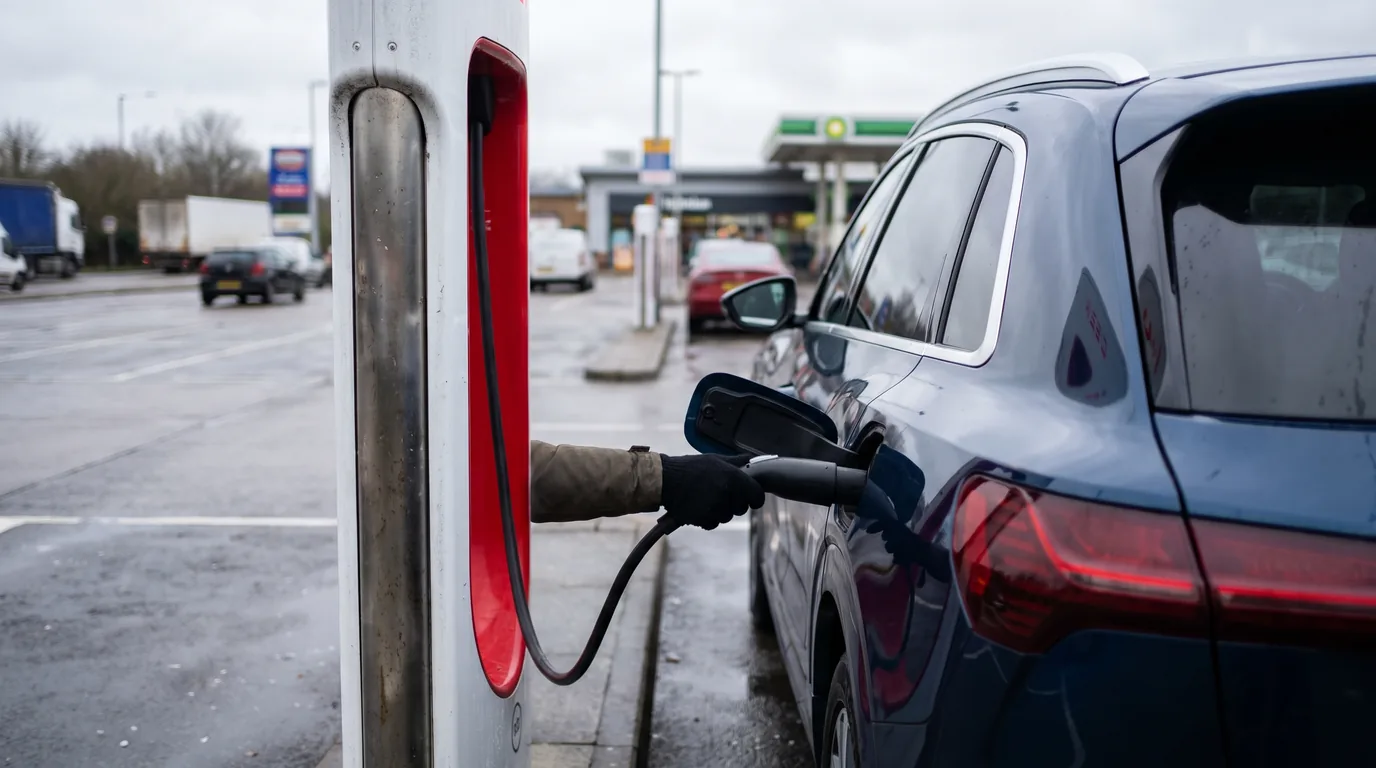
Yes, you can charge a non-Tesla electric car at a Tesla Supercharger, as long as it has a CCS socket and the site is open to other makes. By our count about 65% of UK Supercharger sites now are; you start the session in the free Tesla app (or by contactless at the newest stalls) and pay about 69p per kWh.
Tesla opened 15 of its 98 UK Supercharger sites to other cars in a pilot in May 2022, according to Which?. Four years on, opening a site to everyone is the norm rather than the exception. This guide covers which sites you can use, the exact steps, what it costs, and the practical problems that catch out first-timers.
How many UK Supercharger sites can non-Tesla cars use?
About two in three. Tesla does not publish a UK percentage, so we worked it out from two independent counts of Tesla’s own map taken in autumn 2026.
EV Compared calculation: open sites divided by all UK Supercharger sites: 149 ÷ 230 = 64.8% (tesla-chargers.com) and 152 ÷ 233 = 65.2% (myteslajourney.co.uk count of 7 October 2026), so about 65%.
| Count | UK Supercharger sites | Open to non-Tesla EVs | Tesla-only | Share open |
|---|---|---|---|---|
| tesla-chargers.com (autumn 2026) | 230 | 149 | 81 | 64.8% |
| myteslajourney.co.uk (7 October 2026) | 233 | 152 | 81 | 65.2% |
| Which? (May 2022 pilot) | 98 | 15 | 83 | 15.3% |
Zapmap, which counts chargers across Tesla’s whole UK network, says more than 50% was open to other makes by the end of September 2026, out of 2,774 Tesla chargers. The two measures are not the same, since Zapmap counts chargers and we count sites, but both point the same way: most of the network is now open. Major routes still have gaps; the five M1 sites listed in the 7 October count were all Tesla-only.
The practical upshot is that roughly 80 UK sites remain off limits. Never plan a long trip around a Supercharger without first confirming that it appears in the non-Tesla section of the Tesla app.
Which cars can use a Tesla Supercharger?
Any electric car with a CCS rapid charging socket. That covers almost every EV sold new in the UK in recent years, including the Kia EV6, Hyundai Kona Electric, Skoda Enyaq, Nissan Ariya, BYD Dolphin and Volvo EX30, which Carwow lists as examples. Zapmap notes that only CCS cars can use the open sites, and where a stall has two cables, other makes must use the CCS one.
Older cars with a CHAdeMO socket, such as early Nissan Leafs, cannot use Superchargers at all.
Charging speed is set by your car as much as by the charger. Every UK Supercharger site currently tops out at 250 kW, so a car that accepts 150 kW will simply charge at its own maximum.
How do you charge a non-Tesla car at a Supercharger?
You need a smartphone, a payment card and about five minutes the first time. The process below follows the steps described by Electrifying.com and Carwow.
- Download the Tesla app and create a free account. You do not need to own a Tesla. Add a payment card in the app before you set off.
- Find an open site. In the app, choose “Charge Your Non-Tesla”. The map only shows sites you can use, with prices and facilities. Zapmap users can also filter for the Tesla public Supercharger network.
- Park so the cable reaches. See the section on charging port position below.
- Plug in, then enter the stall number. Each stall has a number, usually printed at the base. Select it in the app and press to start. Electrifying.com notes that the connection can take up to two minutes, so wait before assuming there is a fault.
- Stop the session in the app and return the connector to its holder. Move the car promptly, because idle fees of up to £1 a minute can apply once charging has finished.
At some of the newest V4 stalls there is a contactless card reader, so you can pay without the app. The first UK V4 site, at the Tesla Centre in Tottenham, opened in August 2023 with a contactless reader and a longer cable. The tesla-chargers.com tracker now lists 107 UK sites with V4 hardware, but not every one has a card reader, so keep the app installed as a backup.
How much does a Tesla Supercharger cost for a non-Tesla EV?
About 69p per kWh on pay-as-you-go, according to Zapmap’s October 2026 figure. Tesla prices each site separately and charges more at busy times; Carwow notes that the peak runs from 4pm to 8pm. The exact price for your chosen stall is shown in the app before you plug in.
That makes Tesla cheaper than the typical rapid charger. Zapmap’s price index puts the UK average for rapid and ultra-rapid pay-as-you-go charging at 79p per kWh in September 2026.
| Where you charge | Price per kWh | Cost of a 40 kWh top-up |
|---|---|---|
| Tesla Supercharger, pay-as-you-go | 69p | £27.60 |
| UK rapid and ultra-rapid average (Zapmap) | 79p | £31.60 |
| Home on Intelligent Octopus Go | 6.5p | £2.60 |
EV Compared calculation: 40 kWh × price per kWh. A Supercharger stop saves about £4 against the national rapid average, but home charging on a smart tariff is still more than ten times cheaper. Our guide to Supercharger prices in the UK covers how Tesla’s site-by-site pricing works.
Is the Supercharging Membership worth paying for?
Only if you rapid charge regularly. A Supercharging Membership lets a non-Tesla driver pay lower, Tesla-owner prices. Tesla cut the fee from £10.99 to £8.99 a month in April 2024 and added a £90 annual option, according to DrivingElectric and Zapmap. Electrifying.com estimates the saving at 10p to 20p per kWh.
EV Compared calculation: monthly fee ÷ saving per kWh: £8.99 ÷ 20p = 45 kWh, and £8.99 ÷ 10p = 90 kWh. On the annual plan (£90 ÷ 12 = £7.50 a month) the break-even falls to 37.5 to 75 kWh a month.
In plain terms, one or two long motorway charges a month covers the fee. If you mostly charge at home and use a Supercharger a few times a year, pay-as-you-go is cheaper. If you are weighing up subscriptions across several networks, our guide to EV charging subscriptions compares the options.
What if your charging port is in the wrong place?
Supercharger cables are short because they were designed for Teslas, which have the charging port at the rear on the left. Electrifying.com points out that cars with ports at the front, or on the right, may need to park in an unusual way to reach.
- Port at the rear left: reverse in as a Tesla would.
- Port at the front: drive in nose first.
- Port on the right: an end bay often gives you room to position the car without blocking the next stall.
Tesla asks drivers not to park across bay lines, and Zapmap notes Tesla’s warning that some site layouts will not suit every car. If you would have to block a second stall to reach, move to a different bay or a different site. V4 stalls have longer cables, which solves most of these problems.
How do Superchargers compare with other networks?
For a CCS car, an open Supercharger is one of the cheaper ultra-rapid options on pay-as-you-go, and Tesla’s network has a strong reputation for reliability. The trade-off is the app and the parking. We compare Tesla directly with two rivals in IONITY vs Tesla Supercharger and Tesla Supercharger vs InstaVolt.
If you would rather not juggle several accounts, see our guide to charging any EV at any public charger, and our round-up of the best EV charging apps for route planning and payment.
Quick checklist before your first Supercharger stop
- Your car has a CCS socket.
- The Tesla app is installed, signed in and has a payment card saved.
- The site appears under “Charge Your Non-Tesla” in the app.
- You know where your charging port is and which bay will suit it.
- You will be back before the car finishes, to avoid idle fees of up to £1 a minute.
How we test and where our numbers come from
Range figures are official WLTP combined values taken from manufacturer UK specification pages, with real-world estimates drawn from independent comparative testing. Prices are UK list prices at the time of the latest update. Tax, grant and charging-scheme figures come from GOV.UK and HMRC publications. We re-check every guide when pricing, specification or policy changes. Last checked 1 November 2026. How we work out our own figures.
Frequently asked questions
Can a non-Tesla EV use a Tesla Supercharger in the UK?
Yes, at Supercharger sites Tesla has opened to other makes, which EV Compared estimates at about 65% of UK sites in autumn 2026. Your car needs a CCS charging socket, and you start and pay for the session in the Tesla app, or by contactless at the newest V4 stalls.
How much does it cost to use a Tesla Supercharger with a non-Tesla car?
Zapmap lists Tesla's pay-as-you-go price at about 69p per kWh in October 2026, though Tesla sets prices per site and by time of day. At 69p, a 40 kWh charge costs about £27.60, compared with about £31.60 at the UK rapid average of 79p per kWh.
Do I need a Tesla account to charge a non-Tesla car at a Supercharger?
Yes, at most stalls you need a free Tesla account and the Tesla app, where you choose 'Charge Your Non-Tesla', pick the site and enter the stall number. Some newer V4 Superchargers have a contactless card reader, so the app is not needed there.
Is the Tesla Supercharging Membership worth it?
It is worth it if you charge at Superchargers regularly. The membership costs £8.99 a month or £90 a year, and if it cuts your price by 10p to 20p per kWh, the monthly plan breaks even at about 45 to 90 kWh a month, or roughly one to two long-distance charges.
Why can't I find some Superchargers in the Tesla app?
Those sites are still reserved for Tesla cars. By the two autumn 2026 counts we used, roughly 80 UK Supercharger sites remain Tesla-only, and the app only shows non-Tesla drivers the sites they can use.
Will the Supercharger cable reach my car's charging port?
It depends on where your charging port is. Superchargers are designed for Teslas, which have the port at the rear on the left, so cars with ports elsewhere may need to reverse in, drive in nose first or take an end bay. Newer V4 stalls have longer cables, which helps.
Sources and further reading
- zapmap.comTesla Supercharger network: UK locations and prices2,774 Tesla chargers at 447 UK locations at the end of September 2026, with more than 50% of the network open to other makes, and a 69p/kWh price (October 2026).
- zapmap.comZapmap charging price indexUK average pay-as-you-go price of 79p/kWh for rapid and ultra-rapid charging in September 2026.
- tesla-chargers.comSuperchargers in the United KingdomTracker listing 230 UK Supercharger sites, 149 of them open to non-Tesla EVs, 2,479 stalls and 107 V4 sites (newest site opened September 2026).
- myteslajourney.co.ukTesla Superchargers in the UK: costs, V4 and road tripsIndependent count of Tesla's Find Us map on 7 October 2026: 152 of 233 UK sites open to other EVs, every UK site topping out at 250 kW, five listed M1 sites all Tesla-only, and the first UK V4 site at Tottenham in August 2023 with a contactless reader and longer cable.
- zapmap.comTesla opens more of its Supercharger sites to non-Tesla driversOnly CCS cars can use open sites, Tesla asks drivers not to park across bay lines, and the membership fee was cut from £10.99 to £8.99 a month with a £90 annual option.
- drivingelectric.comTesla Supercharger membership fee cut with 42 charging sites open to all EVsMembership at £8.99 a month or £90 a year from April 2024, and V4 Superchargers with contactless payment pads.
- electrifying.comHow to charge a non-Tesla at a Tesla SuperchargerStep-by-step app process, connection taking up to two minutes, port position advice, membership saving of 10p to 20p per kWh, and idle fees of up to £1 a minute.
- carwow.co.ukCan non-Tesla cars use Tesla Superchargers?Examples of CCS cars that can use open sites, finding open sites in the Tesla app, and higher prices at the 4pm to 8pm peak.
- which.co.ukTesla opens its Supercharger network to other car brandsThe May 2022 UK pilot opened 15 of Tesla's 98 UK Supercharger sites to other makes through the Tesla app.
- octopus.energyIntelligent Octopus GoSmart charging rate of 6.5p/kWh, with a 23:30 to 05:30 off-peak window for the home.

EV Compared
The EV Compared editorial team tracks the UK electric vehicle market full time: new model launches, list prices, WLTP and real-world range, public charging tariffs and the tax rules that decide what an EV actually costs to run. Every guide is checked against manufacturer specifications and official GOV.UK figures, and updated whenever the numbers move.
Related reading
View all
Tesla Supercharger prices UK: what Tesla and non-Tesla drivers pay
Tesla drivers paid an average of 48p/kWh on Superchargers in September 2026, while other EVs paid 69p at open sites. We set out what each group pays, how peak and off-peak pricing works and when a membership is worth it.
Tesla Model Y vs BYD Sealion 7: UK family SUV compared
The Model Y starts at £44,990 and the Sealion 7 at £47,025 in November 2026. We compare price, range, space, charging and tax, and work out what each costs per mile.
Tesla Model Y vs Kia EV5: Price, Range and Cost per Mile Compared
The Kia EV5 undercuts the Tesla Model Y on price and matches it on range, but the Tesla uses less electricity per mile and has a much bigger boot. We worked out what that efficiency gap is worth.
Tesla Model Y vs Xpeng G6: Price, Range and Cost per Mile Compared
The Xpeng G6 undercuts the Model Y by £5,000 at entry level and charges faster on paper, but the Tesla goes further on each kWh. We work out what that means per mile.
Tesla Supercharger vs InstaVolt: Cost, Speed and Coverage Compared (2026)
Tesla Superchargers are cheaper overall, especially for Tesla owners, while InstaVolt offers wider geographic coverage and tap-and-go contactless simplicity. Here is how to choose.
Tesla Supercharger membership: when does it pay for itself?
Non-Tesla drivers can pay a monthly or annual fee to get Tesla owner prices at Superchargers. We worked out how much charging you need to do before the fee is covered.