Tesla Powerwall 2 Fire-Risk Warning: Who Is Affected
The UK product safety regulator says some Powerwall 2 home batteries contain cells that can crack and overheat. Tesla is discharging affected units remotely and replacing them free of charge. Here is how to tell if yours is one of them.
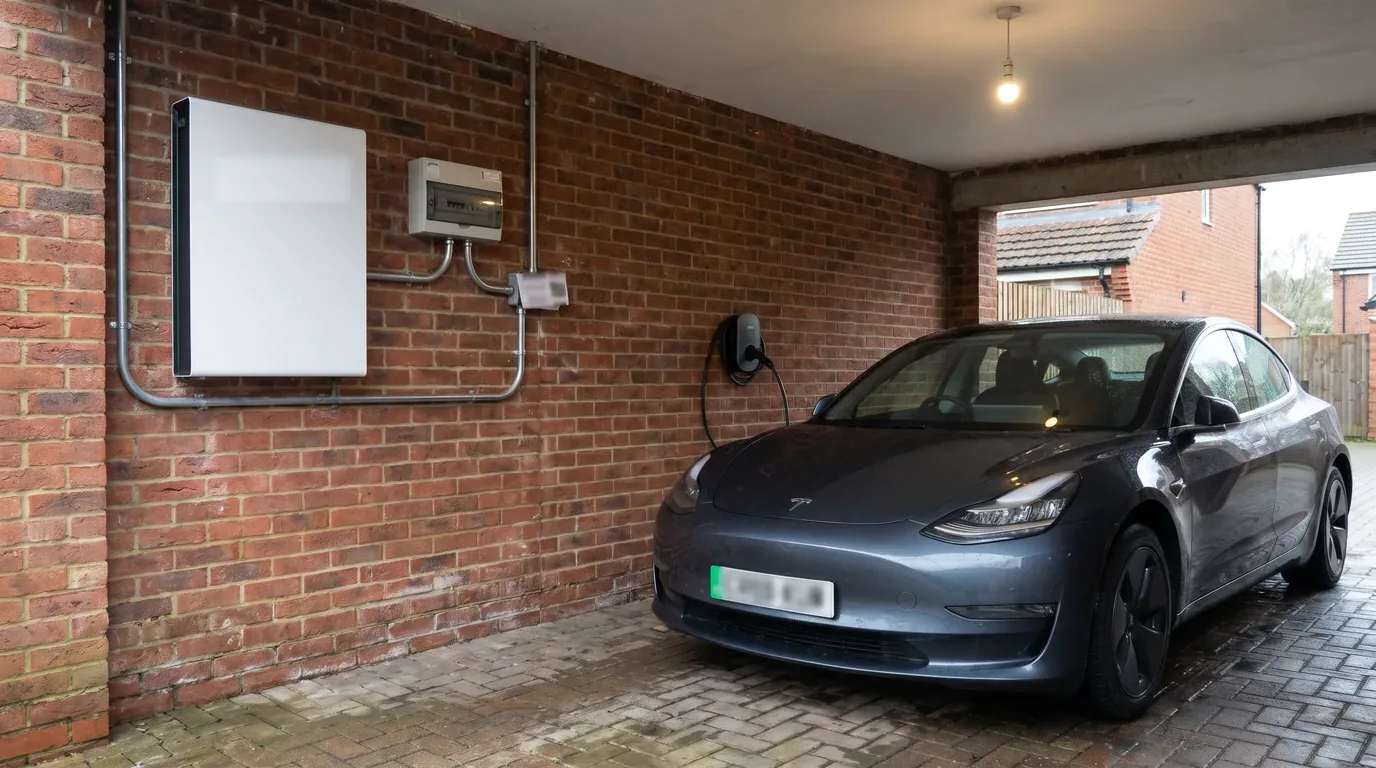
Quick answers
- The Office for Product Safety and Standards published a fire-risk report on the Tesla Powerwall 2 on 28 September 2026, under notification number 2609-0219.
- The cause is third-party battery cells that may contain excessive lithium plating, which can crack the cell casing and lead to an internal short circuit and thermal runaway.
- The UK action is classed as a modification programme rather than a recall, and Tesla replaces affected units free of charge.
- Tesla has not said how many UK units are affected; the only way to know is a notification in the Tesla app, so owners should keep their Powerwall 2 online.
- In the US, the same fault led to a recall of about 10,500 Powerwall 2 units sold from November 2020 to December 2022, after 22 reports of overheating and 5 fires.
- EV Compared estimates that a discharged 13.5 kWh Powerwall 2 costs an owner on Intelligent Octopus Go about £2.35 a day, or roughly £71 a month, in lost savings until it is replaced.
Some Tesla Powerwall 2 home batteries in the UK carry a fire risk from faulty cells, and Tesla is replacing affected units free of charge. You can only find out if yours is included through a notification in the Tesla app, so keep the battery online and check it now.
The warning came from the Office for Product Safety and Standards (OPSS) on 28 September 2026. It follows a recall of about 10,500 Powerwall 2 units in the US and an earlier action in Australia, both caused by the same cell problem.
What is wrong with the Powerwall 2?
According to the OPSS product safety report, certain battery cells inside affected units “may develop internal defects over time”. An investigation found that cells made by a third-party supplier may contain excessive lithium plating, which can crack the cell casing. That can cause an internal short circuit and thermal runaway, where the cell heats faster than it can shed heat, leading to overheating and fire.
The regulator says the product does not meet the Electrical Equipment (Safety) Regulations 2016. Tesla has not named the cell supplier.
The US figures give a sense of scale. The Consumer Product Safety Commission recorded 22 reports of overheating, including 6 involving smoke and 5 fires that caused minor property damage. No injuries were reported. For context on how rare battery fires are in cars, see our look at EV battery fire risk in UK data.
Is it a recall?
Not formally. OPSS lists the measure as a “modification programme”, because the batteries stay on the wall until Tesla swaps them, rather than being returned. In practice the outcome is the same as a recall: affected units are taken out of service and replaced at no cost.
Which Powerwall 2 units are affected?
Tesla has not published serial number ranges or a UK unit count, and it had not told Batteries International how many UK systems are involved. The OPSS report gives the country of origin as the United States. Abroad, the affected units had narrower sale dates:
| Market | Date of action | Units | Sold between | Regulator |
|---|---|---|---|---|
| Australia | September 2025 | Not disclosed | November 2020 to June 2022 | ACCC |
| United States | 13 November 2025 | About 10,500 | November 2020 to December 2022 | CPSC |
| United Kingdom | 28 September 2026 | Not disclosed | Not stated | OPSS |
If your Powerwall 2 was installed outside those windows, do not assume you are clear. The UK report names no dates, and Tesla says the app notification is the deciding test. The Powerwall 3, which replaced the Powerwall 2 when Tesla stopped selling it in 2025, is not named in the OPSS report.
What should UK owners do?
- Keep the Powerwall 2 online. Tesla discharges affected units remotely and sends notices through the app; an offline unit misses both.
- Check the Tesla app for a notification confirming whether your unit is affected.
- Contact your original Tesla Certified Installer to book the replacement. If that installer has closed or will not respond, call Tesla Support on +44 1628 450630.
- Do not try to recharge or reset a discharged unit. Tesla says discharged units do not pose an operational risk, and they cannot charge until replaced.
The replacement is free. The UK report says nothing about compensation for lost savings. In Australia, Tesla said it would consider compensation case by case, so UK owners waiting for a swap can reasonably ask.
How much does a discharged Powerwall cost you?
A Powerwall 2 stores 13.5 kWh of usable energy, according to Tesla’s datasheet. Owners on a smart tariff typically fill it overnight at the cheap rate and run the house from it during the day. While it sits discharged, everything comes from the grid at the full rate.
EV Compared estimate: about £2.35 a day, or roughly £71 a month. Method: 13.5 kWh used at the 26.32p/kWh price cap (£3.55), minus 15 kWh bought at 8p/kWh on Intelligent Octopus Go to cover 90% round-trip efficiency (£1.20), for one full cycle a day over 30 days.
Your real figure will be lower if you do not cycle the battery fully every day, and different if you rely on solar rather than tariff shifting. For tariff options that work with or without a home battery, see our guide to the best energy tariffs for Tesla owners.
Does it affect charging an electric car?
No. The warning covers the home battery only, not Tesla cars, Wall Connectors or any other charger. With the Powerwall discharged, your car simply charges from the grid. If you charge overnight on a smart tariff, that costs the same 8p/kWh it would have cost to fill the battery, so the cost to charge a Tesla at home barely changes. The loss is in daytime household use, not the car.
If your replacement unit arrives and you want to set it up to work alongside EV charging and a smart tariff, Best Chargers has a guide to using a Tesla Powerwall with EV charging in the UK. For the solar side, our explainer on how solar panel EV charging works covers the basics.
How we test and where our numbers come from
Range figures are official WLTP combined values taken from manufacturer UK specification pages, with real-world estimates drawn from independent comparative testing. Prices are UK list prices at the time of the latest update. Tax, grant and charging-scheme figures come from GOV.UK and HMRC publications. We re-check every guide when pricing, specification or policy changes. Last checked 1 November 2026. How we work out our own figures.
Frequently asked questions
Is there a Tesla Powerwall 2 recall in the UK?
Yes, in effect, though the UK regulator classes it as a modification programme rather than a formal recall. The Office for Product Safety and Standards published its report on 28 September 2026, and Tesla is replacing affected units free of charge.
How do I know if my Powerwall 2 is affected?
Check the Tesla app, which shows a notification if your unit is part of the replacement programme. Tesla has not published serial number ranges for the UK, so the app is the only confirmed route, and your Powerwall 2 must stay online for the notice to reach you.
Is my Powerwall 2 safe to keep using?
Tesla says affected units it has discharged do not pose an operational risk. It has discharged most affected units remotely and is sending technicians to discharge the rest, so keep the unit online and follow any instruction in the app.
Who pays for the Powerwall 2 replacement?
Tesla does, as the OPSS report says affected units are replaced free of charge. You arrange the work through your original Tesla Certified Installer, or through Tesla Support on +44 1628 450630 if that installer is no longer available.
Will Tesla compensate me for lost savings while my Powerwall is discharged?
The UK report does not mention compensation for lost savings. In Australia, Tesla said it would consider compensation case by case, so UK owners can ask, but there is no published UK policy.
Does the warning affect charging my Tesla at home?
No, your car and wall charger are not part of the warning. A discharged Powerwall 2 simply means your car charges from the grid instead of the battery, which on an 8p/kWh smart tariff overnight makes little difference to the cost of charging the car itself.
Sources and further reading
- gov.ukProduct Safety Report: Tesla Powerwall 2 (2609-0219)OPSS report of 28 September 2026: fire risk from lithium plating in third-party cells, failure to meet the Electrical Equipment (Safety) Regulations 2016, modification programme, remote discharge, free replacement and the Tesla Support number.
- cpsc.govTesla Recalls Powerwall 2 AC Battery Power Systems Due to Fire and Burn HazardsUS recall 26-092 of 13 November 2025: about 10,500 units sold November 2020 to December 2022, 22 overheating reports including 6 of smoke and 5 fires, no injuries.
- techcrunch.comTesla is recalling Powerwall 2 batteries over fire riskAustralian recall of September 2025 covering units sold November 2020 to June 2022, with compensation for lost energy savings considered case by case.
- batteriesinternational.comUK issues Tesla Powerwall 2 ESS fire risk alertTesla stopped offering Powerwall 2 in 2025, says discharged units do not pose an operational risk, and had not said how many UK systems are affected.
- irishtimes.comSafety warning issued over Tesla battery system which presents a risk of fireReport of 28 September 2026 confirming the OPSS warning and the advice to keep units online and check the Tesla app.
- driveteslacanada.caTesla Powerwall 2 recall expands to the U.S. with 10,500 units affectedLinks the US recall to the Australian action and confirms discharged units cannot charge until replaced.
- tesla.comPowerwall 2 AC datasheetPowerwall 2 specifications: 13.5 kWh usable energy, 5 kW continuous power and 90% round-trip efficiency, used in our lost-savings estimate.
- bestchargers.co.ukTesla Powerwall and EV Charging UKGuide to using a Tesla Powerwall with home EV charging and smart tariffs in the UK.

EV Compared
The EV Compared editorial team tracks the UK electric vehicle market full time: new model launches, list prices, WLTP and real-world range, public charging tariffs and the tax rules that decide what an EV actually costs to run. Every guide is checked against manufacturer specifications and official GOV.UK figures, and updated whenever the numbers move.
Related reading
View all
How much does it cost to charge a Tesla in the UK?
We worked out the cost of a full charge for every new Tesla Model 3 and Model Y on a smart home tariff, the standard price cap, Tesla's Superchargers and other public rapid chargers.
EV battery fire risk: what UK data says about cars, e-bikes and chargers
Most lithium-ion fire headlines involve e-bikes and e-scooters, not electric cars. Here is what UK fire service and insurer data shows, and how to charge safely at home.
How Does Solar Panel EV Charging Work in the UK?
The mechanics of diverting surplus solar electricity to your car, which chargers do it, and whether the numbers stack up
Best Tesla alternatives in the UK: nine rivals ranked by price per mile of range
We divided the November 2026 list price of nine Tesla rivals by their official range. Four cars beat the best-value Tesla, and the Model Y comes last.
Tesla Autopilot vs Enhanced Autopilot vs FSD in the UK: what you get
Tesla sells three tiers of driver assistance, and two have new names. Here is what each costs in November 2026, what it does on British roads and what the law allows.
Tesla battery degradation: how much range do they lose?
Independent tests and Tesla's own fleet data show most Model 3 and Model Y batteries lose 5 to 6 per cent early, then fade slowly. We turned the data into a range-by-mileage table.