How to charge an electric car: the complete beginner's guide
You charge an electric car by plugging it into a home wallbox, a public AC charger with your own Type 2 cable, or a rapid charger with a built-in CCS cable, then paying by app, card or contactless.
How to charge an electric car at a glance
| Standard and Standard Plus (3 kW to 49 kW), UK average pay as you go, Zapmap Price Index, October 2026 (checked 10 November 2026) | 54p/kWh |
|---|---|
| Rapid and ultra-rapid (50 kW and above), UK average pay as you go, Zapmap Price Index, October 2026 (checked 10 November 2026) | 82p/kWh |
| All public chargers, UK average pay as you go, Zapmap Price Index, October 2026 | 78p/kWh |
| Home electricity, Ofgem price cap average, Direct Debit, 1 October to 31 December 2026 | 26.32p/kWh |
| UK public charging devices | 98,899 at 48,815 locations (Zapmap, 31 October 2026) |
| Rapid and ultra-rapid devices | 21,285 at 7,202 locations (Zapmap, 31 October 2026) |
| AC connector | Type 2, with your own cable at most public AC chargers |
| DC rapid connector | CCS on most new cars; CHAdeMO on older Nissan Leafs |
| Three-pin plug | About 2.3 kW (Zapmap) |
| Contactless | Required on existing chargers of 50 kW and above, and new chargers of 8 kW and above, from 24 November 2024 |
| Rapid reliability standard | 99% availability across each operator's rapid network, measured over a calendar year |
Quick answers
- Most UK drivers charge an electric car in one of three ways: a home wallbox, a public AC charger with their own Type 2 cable, or a rapid DC charger with a tethered CCS cable.
- UK rapid and ultra-rapid chargers averaged 82p per kWh to pay as you go in October 2026, against 54p on slower public chargers, according to Zapmap.
- Home electricity under Ofgem's price cap costs 26.32p per kWh on average from 1 October to 31 December 2026, less than a third of the average rapid price.
- A 10 to 80% charge in an MG4 Long Range costs £11.37 at the home price cap rate and £35.42 at the average rapid price, on EV Compared's figures.
- A three-pin plug delivers about 2.3 kW, so a 10 to 80% charge in a BYD Atto 3 EVO takes around 23 hours, which is why Zapmap advises against it for regular use.
- Every existing UK charger of 50 kW and above has had to accept contactless bank cards since 24 November 2024, so you can rapid charge without an app.
- Zapmap counted 98,899 public charging devices at 48,815 UK locations on 31 October 2026, including 21,285 rapid and ultra-rapid devices.
To charge an electric car, plug it into a home wallbox, a public AC charger using your own Type 2 cable, or a rapid charger with its built-in CCS cable, then pay by app, RFID card or contactless. Home charging is the cheapest of the three at 26.32p per kWh under Ofgem’s price cap this quarter, against a UK average of 82p on rapid chargers in October 2026.
Charging is different from filling up: most of it happens while the car is parked anyway, overnight at home or during a few hours at work or the shops, and rapid chargers are for journeys. This guide covers the kinds of charger, what each costs, how to pay, whether a subscription pays, where to find chargers and how to use one, step by step.
What are the ways to charge an electric car?
There are three ways to charge an electric car in the UK: a home charge point, a slower public AC charger, and a rapid or ultra-rapid DC charger. A fourth, the three-pin plug, works in an emergency but is too slow for daily use.
Zapmap now groups public chargers into four bands by power:
| Charger | Power | Current and connector | Cable | Typical use |
|---|---|---|---|---|
| Home wallbox | Up to 7.4 kW on single-phase power | AC, Type 2 | Tethered or your own | Overnight |
| Standard | 3 kW to 7 kW | AC, Type 2 | Usually your own | Street and lamp-post charging, overnight |
| Standard Plus | 8 kW to 49 kW | AC, Type 2 | Usually your own | Car parks, shops, work |
| Rapid | 50 kW to 149 kW | DC, CCS (CHAdeMO on older Leafs) | Tethered | Journeys, quick top-ups |
| Ultra-rapid | 150 kW and above | DC, CCS | Tethered | Motorway hubs |
| Three-pin plug | About 2.3 kW | AC, portable cable | Your own | Occasional top-ups |
The car decides how much power it takes, not just the charger. An MG4 Premium Long Range accepts up to 6.6 kW on AC and 154 kW on DC, so a 22 kW public AC charger will not charge it faster than a 7 kW one. Most new cars use a Type 2 inlet for AC and CCS for DC; our guide to whether any EV works at any public charger covers the exceptions.
How do you charge an electric car at home?
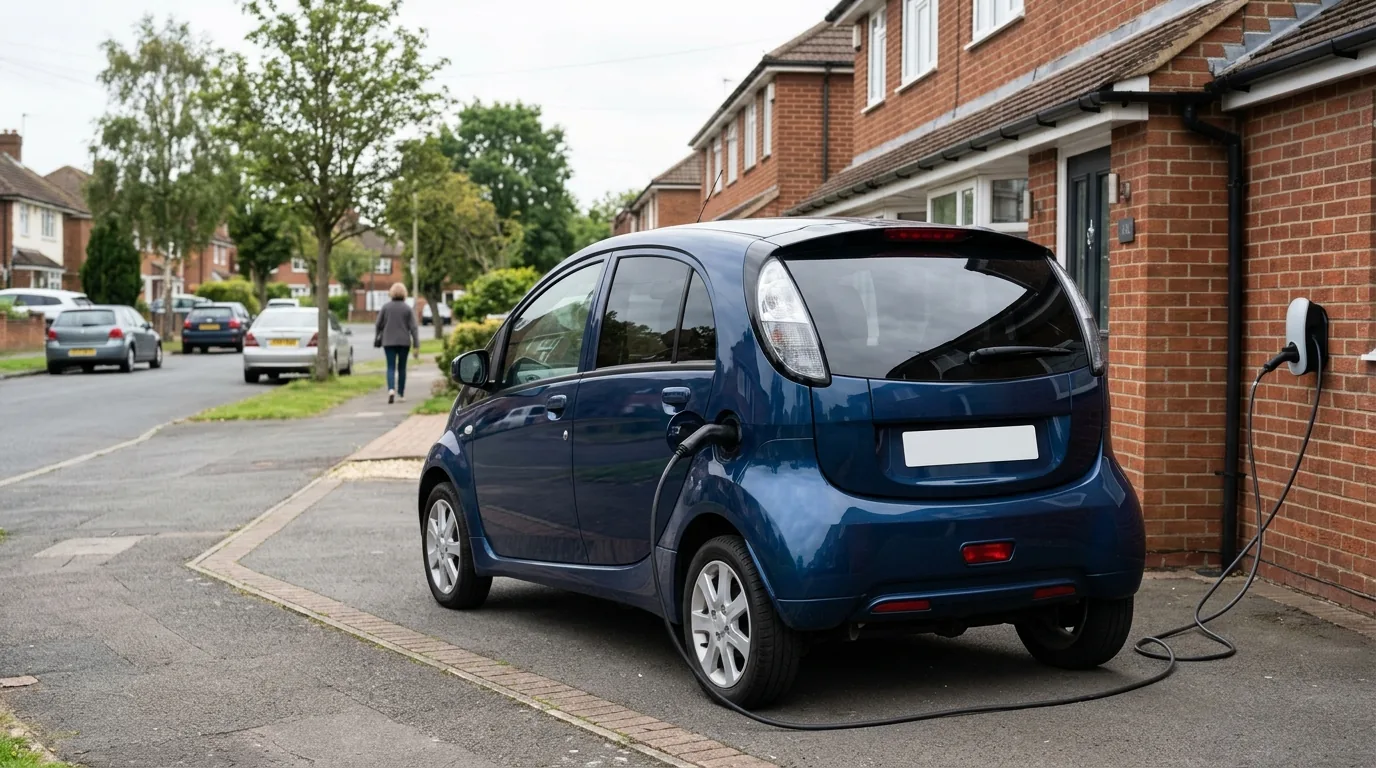
You charge at home by plugging the car into a wallbox fixed to the house or garage, which Zapmap describes as a weatherproof unit with either a tethered cable or a socket for your own. Zapmap puts typical home charging at up to 7.4 kW, because most homes have single-phase power. Our guide to charging an electric car at home covers tariffs and smart charging.
To choose a charger or find an installer, Best Chargers compares home charge points. If you have no driveway, cross-pavement channels are becoming easier to fit: our report on the new cross-pavement planning rules in England explains what changed in October.
Can you charge an electric car from a normal plug?
Yes, with a portable cable that has a three-pin plug at one end, but Zapmap puts the rate at about 2.3 kW and says a large battery can take more than 24 hours to fill. It also warns of overheating from sustained high current, so Zapmap does not recommend it for regular use. Our article on charging from a three-pin plug sets out when it makes sense.
How much does it cost to charge an electric car?
Charging costs 26.32p per kWh at home on Ofgem’s average price cap rate for 1 October to 31 December 2026, 54p on slower public chargers and 82p on rapid and ultra-rapid chargers, on Zapmap’s October 2026 averages. What Car? reported in May 2026 that EV tariffs offer overnight rates as low as 6.6p per kWh.
We costed a 10 to 80% charge for three cars from our spec data. Our method: 70% of each car’s usable battery multiplied by the price per kWh, ignoring charging losses; the full workings are on our methodology page.
| Car (usable battery, WLTP range) | Energy added, 10 to 80% | WLTP miles added | Home, 26.32p | EV tariff, 6.6p | Public AC, 54p | Rapid, 82p |
|---|---|---|---|---|---|---|
| MG4 Premium Long Range (61.7 kWh, 280 miles) | 43.2 kWh | 196 | £11.37 | £2.85 | £23.32 | £35.42 |
| Volkswagen ID.3 Neo Life (50 kWh, 258 miles) | 35.0 kWh | 181 | £9.21 | £2.31 | £18.90 | £28.70 |
| BYD Atto 3 EVO Design RWD (74.8 kWh, 316 miles) | 52.4 kWh | 221 | £13.78 | £3.46 | £28.27 | £42.94 |
Per mile on WLTP figures, the rapid average works out at 18.1p in the MG4, 15.9p in the ID.3 and 19.4p in the Atto 3. At the home price cap rate the same cars cost 5.8p, 5.1p and 6.2p a mile. Real-world range falls in winter and at motorway speeds, so the true cost per mile is higher than these.
How long does it take to charge an electric car?
A rapid charger takes a 10 to 80% charge in about 25 minutes in the MG4 Long Range and BYD Atto 3 EVO on our spec data; at home on a 7 kW wallbox the same charge takes several hours. Our own figures, dividing the energy added by the charging power, put it at 6.5 hours in the MG4 (limited to 6.6 kW on AC), 5.0 hours in the ID.3 and 7.5 hours in the Atto 3. On a three-pin plug at 2.3 kW the same charges take 18.8, 15.2 and 22.8 hours.
Stop at about 80% on a rapid charger. Zapmap notes that charging slows sharply above that point, and 80 to 100% can take as long as 20 to 80%. Cold batteries also charge more slowly, which our explainer on why EVs charge slower in cold weather covers.
How do you pay at a public charger?
You can pay at a public charger by contactless bank card, the network’s own app, an RFID card, or a third-party app or card that works across networks. The Public Charge Point Regulations 2023 have required contactless on existing chargers of 50 kW and above, and on new chargers of 8 kW and above, since 24 November 2024. Since 24 November 2025, every paid public charger has had to accept payment through at least one roaming provider.
- Contactless: no account needed, best for occasional rapid charging.
- Network app: the route to member prices on most networks.
- RFID card: tap to start, useful where mobile signal is weak.
- Roaming app or card: one account for many networks; our comparison of Octopus Electroverse and Bonnet looks at two of them.
The same regulations require the maximum price to be shown in pence per kWh before you start, with any fixed fee folded into it.
Is a charging subscription worth it?
A subscription pays only once your monthly rapid charging on that network saves more than the fee. Our break-even is the monthly fee divided by the saving per kWh, using the prices Fastned and Be.EV published on 10 November 2026, and converted to miles with each car’s WLTP efficiency.
| Plan | Fee a month | Pay as you go to member rate | Break-even | MG4 miles | ID.3 miles | Atto 3 miles |
|---|---|---|---|---|---|---|
| Fastned Gold | £4.99 (until early 2027) | 79p to 55p | 20.8 kWh | 94 | 107 | 88 |
| Be.EV Flexi Pass | £13.99 | 59p to 89p, down to 39p | 28.0 to 70.0 kWh | 127 to 317 | 144 to 361 | 118 to 296 |
Put simply, one 10 to 80% charge a month, between 35 and 52 kWh in these three cars, covers the Fastned Gold fee and clears Be.EV’s break-even where it charges 59p. Two such charges a month on Be.EV clear even its 89p break-even in all three cars. Our BP Pulse guide works through one network in detail.
Where are the chargers?
Zapmap counted 98,899 public charging devices at 48,815 UK locations on 31 October 2026, of which 21,285 devices at 7,202 locations were rapid or ultra-rapid. Slower chargers sit on streets, in car parks, at supermarkets and at workplaces; rapid hubs sit at motorway services, forecourts and retail parks.
A charging map or route planner that filters by connector, speed and network is the quickest way to find one. Zapmap suggests practising on chargers near home, on the networks you plan to use, before your first long trip.
Are public chargers reliable, and are there idle fees?
The law sets a 99% reliability standard for rapid chargers: each operator’s rapid network must be available 99% of the time, averaged over a calendar year, and the operator must publish its record. Every public charger must also display a free, staffed helpline open 24 hours a day. If a charger will not start, ring the number on the unit or move to another charger.
Idle fees are the other cost to know. Our guide to EV charger overstay fees and parking fines lists what networks and car parks charge when you stay plugged in too long.
How do you use a public charger, step by step?
Using a public charger takes a couple of minutes once you have done it once.
- Check on a map or app that the charger is working and has your connector: CCS for rapid charging on most new cars, Type 2 for AC.
- Park in the bay with the charging flap nearest the unit.
- Start the session: tap a contactless card, start it in the app or tap an RFID card. Some chargers ask you to plug in first.
- Plug in. On AC chargers use your own Type 2 to Type 2 cable; rapid chargers have their own.
- Check the car or screen shows the session has started.
- Stop the session at about 80% on a rapid charger, unplug, put the cable away and free the bay.
Our guide to charge point etiquette covers queueing and sharing bays.
What does this mean for choosing a car?
How you will charge matters as much as range. With a driveway, almost any electric car works, because home charging at the price cap costs about a third of the rapid average. Without one, look for an efficient car, since the gap between 15.9p and 19.4p a mile at rapid prices adds up, and a high DC peak if you rely on rapid hubs.
Our verdict, based on published prices and data rather than our own testing: charge at home if you can, use slower public chargers where you already park, and keep rapid charging for journeys. Carry a Type 2 cable and a contactless card, which the law requires every public charger of 50 kW and above to accept, and a roaming app for slower chargers, all of which must now offer roaming through at least one provider.
How we test and where our numbers come from
Prices are the operator's published pence-per-kWh rates on the date shown, checked against the operator's app and Zapmap's price index. Networks change prices without notice; if a figure here is out of date, tell us and we will correct it. Last checked 10 November 2026. How we work out our own figures.
Frequently asked questions
How do I charge an electric car at a charging station?
Park in the bay, start the session by tapping a contactless card, using the operator's app or tapping an RFID card, then plug in. Rapid chargers have their own CCS cable; most slower AC chargers need your own Type 2 cable. Stop the session, unplug and move the car when you are done.
Can you charge an electric car with a normal plug?
Yes, with a portable cable that has a UK three-pin plug at one end, but it is slow. Zapmap puts three-pin charging at about 2.3 kW, so a large battery can take over 24 hours to fill, and it warns of overheating risks from sustained high current. It suits occasional top-ups, not daily charging.
How long does it take to charge an electric car at a charging station?
On a rapid charger, a 10 to 80% charge takes about 25 minutes in cars such as the MG4 Long Range and BYD Atto 3 EVO, on our spec data. On a 7 kW AC charger the same charge takes 5 to 7.5 hours in the three cars we costed. Charging slows sharply above 80%.
How do you pay for public EV charging?
You pay by contactless bank card, the network's own app, an RFID card or a roaming app that works across several networks. Contactless has been required on existing chargers of 50 kW and above since 24 November 2024, and every paid public charger has had to offer roaming through at least one provider since 24 November 2025.
How do I charge an electric car if I live in a flat?
Without a driveway you rely on public chargers: street lamp-post and bollard chargers near home, supermarket and car park chargers while you shop, and rapid hubs on longer trips. Slower public chargers averaged 54p per kWh in October 2026, so pick ones near where you already park for hours.
Is it dangerous to charge an electric car at home?
Charging at home is not dangerous on a properly installed charge point, which Zapmap describes as a weatherproof unit fixed to the house or garage. The risk Zapmap flags is with three-pin plugs, where long sessions at high current can overheat a domestic socket, so it does not recommend them for regular charging.
Are EV charging subscriptions worth it?
A subscription is worth it only if you rapid charge enough each month on that network to cover the fee. On the operators' prices on 10 November 2026, Fastned's £4.99 Gold plan pays off after 20.8 kWh a month, about 94 miles of WLTP driving in an MG4 Long Range, and Be.EV's £13.99 Flexi Pass after 28.0 to 70.0 kWh, depending on the charger's pay as you go price.
Sources and further reading
- zapmap.comZapmap Price IndexUK weighted average pay as you go prices for October 2026: 54p per kWh on Standard and Standard Plus (3 kW to 49 kW) chargers, 82p per kWh on rapid and ultra-rapid (50 kW and above), 78p per kWh across all chargers.
- zapmap.comHow many EV charging points are there in the UK?98,899 public charging devices at 48,815 locations on 31 October 2026, including 21,285 rapid and ultra-rapid devices at 7,202 locations; renamed speed bands, Standard (3 kW to 7.9 kW) and Standard Plus (8 kW to 49 kW).
- zapmap.comEV connector typesSpeed bands (Standard 3 to 7 kW, Standard Plus 8 to 49 kW, Rapid 50 to 149 kW, Ultra-rapid 150 kW and above; home typically up to 7.4 kW); Type 2, CCS, CHAdeMO and Type 1 uses; most public AC chargers untethered; three-pin plug about 2.3 kW, over 24 hours for a large battery, overheating risk.
- zapmap.comComplete guide to EV charging for beginnersPayment by contactless, network app, RFID card and the Zapmap app or card; advice to end rapid sessions at about 80% because charging slows, with 80 to 100% sometimes taking as long as 20 to 80%; home charge points are weatherproof wall units; practise charging near home first (updated 4 November 2026).
- gov.ukPublic Charge Point Regulations 2023 guidanceContactless on existing chargers of 50 kW and above and new chargers of 8 kW and above from 24 November 2024; 99% rapid network reliability over a calendar year; free 24/7 staffed helpline; maximum price shown in pence per kWh; roaming at all paid public chargers by 24 November 2025.
- ofgem.gov.ukEnergy price cap: standing charges and unit rates by regionAverage electricity unit rate of 26.32p per kWh and 54.83p daily standing charge on Direct Debit, 1 October to 31 December 2026; no VAT on electricity from 1 October 2026 to 31 March 2027.
- fastnedcharging.comFastned UK tariffsUK standard price 79p per kWh; Gold membership £4.99 a month until early 2027 for 55p per kWh (checked 10 November 2026).
- be-ev.co.ukBe.EV pricingPay as you go 59p to 89p per kWh on ultra-rapid and 59p to 79p on rapid chargers; Flexi Pass £13.99 a month for 39p per kWh at any time (checked 10 November 2026).
- whatcar.comHow much does it cost to charge an electric car?EV tariffs with overnight off-peak rates as low as 6.6p per kWh (article updated 10 May 2026).

EV Compared
The EV Compared editorial team tracks the UK electric vehicle market full time: new model launches, list prices, WLTP and real-world range, public charging tariffs and the tax rules that decide what an EV actually costs to run. Every guide is checked against manufacturer specifications and official GOV.UK figures, and updated whenever the numbers move.