char.gy charging station guide: on-street prices, how to pay and where the chargers are
char.gy runs more than 6,000 slow on-street chargers mounted on lampposts, paid by app or browser at 39p/kWh on weekday nights and 59p/kWh by day.
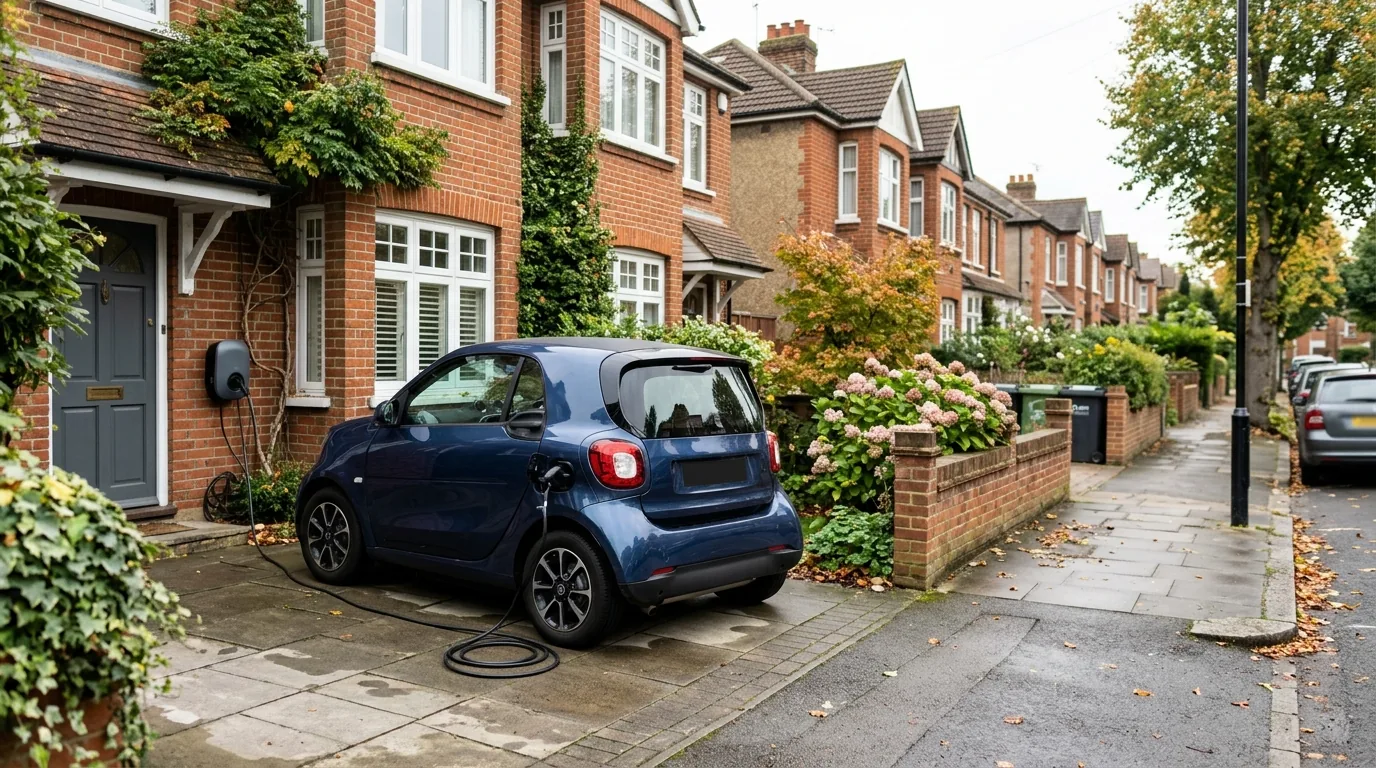
char.gy at a glance
| Operator | char.gy Limited |
|---|---|
| Weekday night, 00:00 to 06:59 (AC, up to 7.7 kW), checked 10 November 2026 | 39p/kWh |
| Weekday day, 07:00 to 23:59 (AC, up to 7.7 kW), checked 10 November 2026 | 59p/kWh |
| Weekend, all day Saturday and Sunday (AC, up to 7.7 kW), checked 10 November 2026 | 54p/kWh |
| Card pre-authorisation hold per session | £25, released after the charge |
| Chargers (Zapmap, end of October 2026) | 6,049 across 6,041 locations |
| Charger type | Untethered Type 2 AC, mounted on lampposts |
| Power | Up to 7.7 kW where the supply allows |
| Cable | Bring your own Type 2 to Type 2 cable |
| How to pay | char.gy app or web page by card, Apple Pay or Google Pay; Zap-Pay in the Zapmap app |
| Subscription | None; pay as you go only |
| Council and partner areas | 24 listed by char.gy |
| Driver support | 0800 086 9606 |
Quick answers
- A char.gy charging station costs 39p/kWh from midnight to 6:59am on weekdays, 59p/kWh from 7am to midnight on weekdays and 54p/kWh all weekend, according to char.gy's price page on 10 November 2026.
- Zapmap counted 6,049 char.gy chargers across 6,041 UK locations at the end of October 2026, mostly slow kerbside units mounted on lampposts.
- char.gy chargers are untethered Type 2 points delivering up to 7.7 kW, so you must bring your own Type 2 to Type 2 cable; a three-pin cable will not work.
- You pay through the char.gy app or the charge point's web page by card, Apple Pay or Google Pay, with a £25 pre-authorisation hold that is released after the session.
- char.gy has no subscription, so the saving comes from timing: charging at night instead of by day saves 20p/kWh, about £8.25 on a 10 to 80% charge in a Jaecoo E5 or Omoda E5.
- On EV Compared's sums, a 10 to 80% charge on the night rate costs £22.52 in a BYD Seal and £16.08 in a Jaecoo E5 or Omoda E5.
- char.gy is building more than 6,000 kerbside chargers for Brighton & Hove City Council under a £130m contract, with the first installed in Lawrence Road, Hove, in September 2025.
A char.gy charging station is a slow on-street charger mounted on a lamppost, and it costs 39p/kWh on weekday nights, 59p/kWh on weekday days and 54p/kWh at weekends (char.gy’s price page, 10 November 2026). You plug in your own Type 2 cable, scan the QR code and pay by card, Apple Pay or Google Pay.
What is char.gy and who runs it?
char.gy is a UK charge point operator that puts slow AC chargers on residential streets for drivers who have no driveway or off-street parking. The company, char.gy Limited, describes itself as a B Corporation and works under contracts with local councils: “Each char.gy network is tailored to the community it serves in partnership with your local council.”
Its chargers are mounted on lampposts and draw power from the lamppost feed, according to Zapmap. At slow AC speeds they suit long stays near home rather than a quick top-up on a journey. If you are weighing up whether a car can work for you without a drive, our guide to living with an electric car without a driveway covers the wider options.
How much does char.gy cost per kWh?
char.gy charges by the kWh at three time-of-day rates, with no connection fee listed on its price page or in its help centre.
| Time | Rate (checked 10 November 2026) |
|---|---|
| Weekday night, 00:00 to 06:59 | 39p/kWh |
| Weekday day, 07:00 to 23:59 | 59p/kWh |
| Weekend, all day Saturday and Sunday | 54p/kWh |
Two details matter. First, if a session crosses a tariff boundary, char.gy bills each part at the rate for that period, so plugging in at 10pm on a Tuesday means two hours at 59p before the 39p rate starts. Second, char.gy says there are “some exceptions” to these prices, and the charge point’s page in the app or browser shows the rate for that point before you start. That page is the price you pay.
These rates sit well above a typical home energy tariff, which is why on-street charging feels expensive to drivers who have charged on a drive. Our breakdown of the cost to charge an EV at home shows the gap.
What does a 10 to 80% charge cost at char.gy?
A 10 to 80% charge on the night rate costs from £16.08 to £22.52 for the three cars below, on EV Compared’s sums. Method: 70% of the car’s usable battery from our spec data, multiplied by the char.gy rate, ignoring charging losses (how we calculate).
| Car (usable battery) | Energy for 10 to 80% | Weekday night, 39p | Weekday day, 59p | Weekend, 54p | Time at 7.4 kW |
|---|---|---|---|---|---|
| BYD Seal Design (82.5 kWh) | 57.75 kWh | £22.52 | £34.07 | £31.19 | 7 h 48 min |
| Jaecoo E5 Pure (58.9 kWh) | 41.23 kWh | £16.08 | £24.33 | £22.26 | 5 h 34 min |
| Omoda E5 Knight (58.9 kWh) | 41.23 kWh | £16.08 | £24.33 | £22.26 | 5 h 34 min |
Per mile, using each car’s WLTP range and usable battery, the night rate works out at 9.1p a mile in the Seal, 9.3p in the Jaecoo E5 and 8.6p in the Omoda E5. On the day rate those become 13.8p, 14.0p and 13.0p.
The time column uses 7.4 kW, the charger speed char.gy uses in its own worked example. All three cars accept 10.3 kW or more on AC, so the charger, not the car, sets the pace.
A worked example: does a full night cover the charge?
The night rate runs for seven hours, from midnight to 6:59am. At 7.4 kW that delivers about 51.8 kWh, which covers a 10 to 80% charge in a Jaecoo E5 or Omoda E5 with time to spare.
A BYD Seal needs 57.75 kWh for the same charge, so if you plug in at midnight on a weekday, about 51.8 kWh comes at 39p (£20.20) and the last 5.95 kWh at 59p (£3.51), a total of £23.71. Starting from a higher state of charge, or charging over a weekend at 54p, avoids the day rate creeping in.
How do you pay at a char.gy charger?
You pay through the char.gy app or the charge point’s web page, using a saved credit or debit card, Apple Pay or Google Pay. You reach the page by scanning the QR code on the charger or typing its charge point ID into a browser, so there is no need to download anything for a one-off charge.
When the session starts, char.gy places a temporary £25 hold on your card. It says this “isn’t a charge”: you pay only for the energy used and the rest is released afterwards.
char.gy chargers also work with Zap-Pay, the payment system inside the Zapmap app, which lets you pay several networks from one account. char.gy’s own pages describe no contactless card reader or RFID card. The Public Charge Point Regulations 2023 require contactless payment on new public charge points of 8 kW or above and on rapid chargers; char.gy’s lamppost units deliver up to 7.7 kW. Our guide to contactless EV charging and where you can use it sets out which chargers must take a card tap.
Because you start a session from a QR code, check the code is printed on the unit and that the page it opens is on char.gy’s own web address. Fake stickers are a known trick, covered in our explainer on QR code scams at EV chargers.
Is there a char.gy membership or subscription, and does it pay?
There is no char.gy subscription: its price page lists pay as you go only, so there is no monthly fee and no break-even mileage to work out. The saving available to you comes from the clock.
Charging on the weekday night rate instead of the day rate saves 20p/kWh. On a 10 to 80% charge that is £11.55 in a BYD Seal and £8.25 in a Jaecoo E5 or Omoda E5. Over 10,000 miles a year at WLTP efficiency, choosing nights over days saves about £466 in the Seal, £475 in the Jaecoo E5 and £441 in the Omoda E5. If you can plug in after midnight on weeknights, do.
Where are the char.gy chargers?
Zapmap counted 6,049 char.gy chargers across 6,041 locations at the end of October 2026, almost one charger per location, as you would expect from single kerbside units. char.gy’s home page still says “more than 5,000”; Zapmap’s figure is the more recent count.
char.gy lists 24 council and partner areas:
- London: Barnet, Brent, Croydon, Enfield, Haringey, Harrow, Lambeth, Merton, Redbridge, Richmond, Southwark, Tower Hamlets and Wandsworth
- South and south east: Brighton and Hove, Buckinghamshire, Isle of Wight, Milton Keynes and Reading
- Midlands: Coventry, Leicester, West Northamptonshire and the University of Warwick
- Elsewhere: Devon and East Lothian
To find one near an address, use the live map on char.gy’s website or app, or filter by network on Zapmap.
The Brighton & Hove project
Brighton & Hove City Council (BHCC) gave char.gy a £130m contract to fit more than 6,000 kerbside chargers. The first, in Lawrence Road, Hove, was installed in September 2025, supported by the government’s £381m Local Electric Vehicle Infrastructure (LEVI) funding, which helps councils in England plan and deliver charging infrastructure for residents without off-street parking.
Trevor Muten, cabinet member for transport at BHCC, said the council was “leading the way in providing the infrastructure needed for the growing number of electric vehicle users in the city”. A Department for Transport spokesperson said the £381m would “install over 100,000 chargepoints across the country”. Zapmap reported char.gy’s 5,000th charger, also in Brighton & Hove, on 28 May 2026, with about 2,600 more planned in Reading and more than 1,500 on the Isle of Wight.
How reliable is char.gy, and are there idle fees?
char.gy claims 99% network uptime on its home page; that is the operator’s own figure, and we have found no independent reliability data for its network to set against it.
char.gy’s price page and help centre list no idle or overstay fee as of 10 November 2026. The parking rules still apply: char.gy tells drivers to follow the restrictions posted on or near the lamppost, warns that the online listing may not match the signs, and says it is not responsible for parking penalties.
How do you use a char.gy charger, step by step?
- Find a free charger on the char.gy map or Zapmap, and check the parking signs.
- Plug your Type 2 to Type 2 cable into your car and into the charger, and make sure both ends are secure. A three-pin cable will not fit.
- Scan the QR code on the charger, or type its charge point ID into your browser or the app.
- Tap Charge, choose your card, Apple Pay or Google Pay, and confirm. The £25 hold is placed.
- Tap Start Charging. A blue light on the charger means the car is charging, and the page shows the kWh delivered.
- To finish, tap Finish charging, release the cable and confirm. If the cable stays locked, char.gy’s help centre has a guide, or call 0800 086 9606.
Who does char.gy suit?
char.gy suits drivers who park on the street in one of its 24 areas, can leave the car plugged in overnight, and can time most sessions after midnight on weekdays. A car with a battery around 60 kWh, like the Jaecoo E5 or Omoda E5, fits a 10 to 80% charge inside the night window at 7.4 kW.
It suits drivers less well if they need a fast top-up, park somewhere different each night, or would charge mostly in the day at 59p/kWh. Those drivers should look at rapid hubs in our guide to public EV charging in the UK. If a home charger is possible after all, the new cross-pavement charging planning rules in England may open that route; Best Chargers covers home charger options.
Our verdict, based on published prices and data rather than our own use: char.gy is a sensible overnight option for street parkers, priced fairly on the night rate and expensive by day.
How we test and where our numbers come from
Prices are the operator's published pence-per-kWh rates on the date shown, checked against the operator's app and Zapmap's price index. Networks change prices without notice; if a figure here is out of date, tell us and we will correct it. Last checked 10 November 2026. How we work out our own figures.
Frequently asked questions
How much does a char.gy charging station cost?
A char.gy charger costs 39p/kWh on weekday nights from midnight to 6:59am, 59p/kWh on weekdays from 7am to midnight and 54p/kWh all day at weekends. char.gy says a few charge points are exceptions, so the price shown on the charge point's page in the app or browser before you start is the one you pay.
Do I need my own cable to use char.gy?
Yes, you need your own Type 2 to Type 2 cable, because char.gy chargers have no cable attached. char.gy's help centre says the cable must have a Type 2 connector at both ends, so the three-pin granny cable supplied with many cars will not work at a char.gy charge point.
How fast are char.gy chargers?
char.gy chargers are slow AC points delivering up to 7.7 kW where the local supply allows, according to Zapmap. char.gy says output depends on the location and type of charger. At 7.4 kW, a 10 to 80% charge takes about 5 hours 34 minutes in a car with a 58.9 kWh battery.
Can you pay for char.gy with contactless?
No contactless card reader is described on char.gy's pages; you pay through the char.gy app or the web page you reach by scanning the QR code, using a saved card, Apple Pay or Google Pay. char.gy chargers can also be started and paid for through Zap-Pay in the Zapmap app.
Where can I find a char.gy charging station near me?
Use the live map on char.gy's website or app, or filter by network in the Zapmap app. char.gy lists 24 council and partner areas, including Brighton and Hove, Barnet, Brent, Coventry, Croydon, Leicester, Milton Keynes, Reading, Southwark, Wandsworth, the Isle of Wight and Devon.
Does char.gy charge an idle or overstay fee?
char.gy's price page and help centre list no idle or overstay fee as of 10 November 2026. You must still follow the parking restrictions posted on or near the lamppost, and char.gy says it is not responsible for parking penalties at its charge points.
Is there a char.gy subscription?
No, char.gy is pay as you go only, so there is no monthly fee to break even on. The way to cut costs is to charge on the weekday night rate of 39p/kWh rather than the 59p/kWh day rate, which saves 20p on every kWh.
Sources and further reading
- char.gychar.gy pricingNight rate 39p/kWh (00:00 to 06:59 weekdays), day rate 59p/kWh (07:00 to 23:59 weekdays), weekend 54p/kWh, £25 pre-authorisation, pay as you go via app or website; checked 10 November 2026.
- help.char.gyHow much does it cost to use char.gy?Confirms the three rates, that sessions crossing a tariff boundary are billed at each period's rate, and that a few charge points are exceptions.
- char.gychar.gy drivers: getting startedStep-by-step start: plug in, scan the QR code or type the charge point ID, choose payment, start; card, Apple Pay and Google Pay accepted; blue light means charging; support line 0800 086 9606.
- help.char.gyStarting and finishing a charge using the char.gy appApp prompts for starting a session and the Finish charging and release cable steps to end it.
- help.char.gyDo I need a special cable to use char.gy?A Type 2 cable with a Type 2 connector at both ends is needed; char.gy units do not include a cable and a three-pin cable will not work.
- help.char.gyCharger power output and charging durationOutput depends on location and charger type; worked example uses a 7.4 kW charger and battery size divided by charger speed.
- help.char.gyDo I need to check local parking restrictions?Drivers must follow parking restrictions posted on or near the charge point; char.gy is not responsible for parking penalties.
- char.gychar.gy home pagechar.gy's own claims of more than 5,000 charge points and 99% network uptime; char.gy Limited is a B Corporation.
- char.gychar.gy network locationsLists 24 council and partner areas where char.gy operates.
- zapmap.comchar.gy on-street charge point network6,049 char.gy chargers across 6,041 locations at the end of October 2026; lamppost-mounted; Type 2 inlet; up to 7.7 kW; payment via the Zapmap app or char.gy's app.
- zapmap.comchar.gy hits 5,000th EV charger milestone5,000th charger installed in Brighton & Hove, published 28 May 2026; about 2,600 charge points planned with Reading Borough Council and more than 1,500 on the Isle of Wight.
- zapmap.comchar.gy signs up to become new Zap-Pay partnerchar.gy joined Zap-Pay, the single-app card payment system inside the Zapmap app.
- char.gyFirst char.gy on-street EV charger installed in Brighton and Hove15 September 2025: first charger in Lawrence Road, Hove; £130m contract for more than 6,000 kerbside chargers; £381m LEVI funding; quotes from Trevor Muten and the DfT.
- legislation.gov.ukThe Public Charge Point Regulations 2023, regulation 5Contactless payment is required on new public charge points of 8 kW or above, and on rapid charge points.

EV Compared
The EV Compared editorial team tracks the UK electric vehicle market full time: new model launches, list prices, WLTP and real-world range, public charging tariffs and the tax rules that decide what an EV actually costs to run. Every guide is checked against manufacturer specifications and official GOV.UK figures, and updated whenever the numbers move.