Octopus Electroverse review: how the card and app work, prices and networks
Electroverse is a free Octopus Energy app and RFID card that starts and pays for charges on more than 1,300 networks at rates set by each operator, with discounts for Octopus EV tariff customers and optional network subscriptions.
Octopus Electroverse at a glance
| Operator | Octopus Energy |
|---|---|
| Standard and fast, 3 to 49 kW (Zapmap UK pay-as-you-go average for October 2026, checked 10 November 2026) | 54p/kWh |
| Rapid and ultra-rapid, 50 kW and above (Zapmap UK pay-as-you-go average for October 2026, checked 10 November 2026) | 82p/kWh |
| Top 10 UK rapid networks, October 2026 (Zapmap, checked 10 November 2026) | 51p to 93p/kWh |
| Electroverse subscription or transaction fees (checked 10 November 2026) | None |
| Run by | Octopus Energy |
| Chargers that work with it | 1,426,060 (Electroverse, November 2026) |
| Charging networks | More than 1,300 |
| UK drivers signed up | 1 million (Octopus Energy, July 2026) |
| Subscription, sign-up or transaction fees | None |
| Octopus Go discount | 5% on all public charging |
| Intelligent Octopus Go discount | 8% on all public charging |
| Electrocard delivery | Up to 14 working days |
Quick answers
- Octopus Electroverse is a free app and RFID card from Octopus Energy that works with 1,426,060 chargers on more than 1,300 networks across the UK, Europe and beyond.
- Electroverse adds no subscription, sign-up or transaction fee and its rates come from the charge point operators, so it saves money mainly through its discounts.
- Octopus Go customers get 5% off all public charging through Electroverse and Intelligent Octopus Go customers get 8% off.
- At Zapmap's October 2026 rapid average of 82p/kWh, a 10 to 80% charge costs £25.77 for a BYD Dolphin, £33.81 for an Omoda E5 and £47.36 for a BYD Sealion 7.
- Electroverse's optional Ionity subscription costs £10.50 a month for 40% off, which at 82p/kWh pays for itself after 32 kWh, or about 145 miles in an Omoda E5.
- Plunge Pricing events cut public charging by up to 50% when renewable generation is high, and Octopus ran 84 of them in the UK and France in 2026 up to July.
Octopus Electroverse is a free app and RFID card from Octopus Energy that lets you find, start and pay for public charges on more than 1,300 networks with one account. It uses the rates each network’s operator provides and charges no subscription or transaction fees, so it saves money through its discounts: 5% or 8% for Octopus EV tariff customers, Plunge Pricing events and optional network subscriptions.
Electroverse does not own any chargers. It is a roaming service, which means it sits between you and the charge point operator, uses the operator’s rates and bills you for every network in one place. That makes it a convenience first and a saving second. This review rests on Electroverse’s own published terms, Zapmap’s price data and gov.uk rules, not on a road trip by EV Compared; for its closest rival, see our Octopus Electroverse vs Bonnet comparison.
What is Octopus Electroverse and who runs it?
Electroverse is run by Octopus Energy, the UK electricity supplier, and you do not need to buy your electricity from Octopus to use it. Its FAQ answers that question with “everyone is welcome”. Electroverse says 1,426,060 chargers work with the service, from partners including Allego, Ionity, InstaVolt, Shell Recharge and Be.EV.
Octopus said on 30 July 2026 that one million UK drivers have signed up to Electroverse, which it put at half of the fully electric cars on UK roads, and that hundreds of thousands of charging sessions run through the app every week. In Europe it claims access to more than 1.5 million public charge points, about nine in 10, and it now also works in North America.
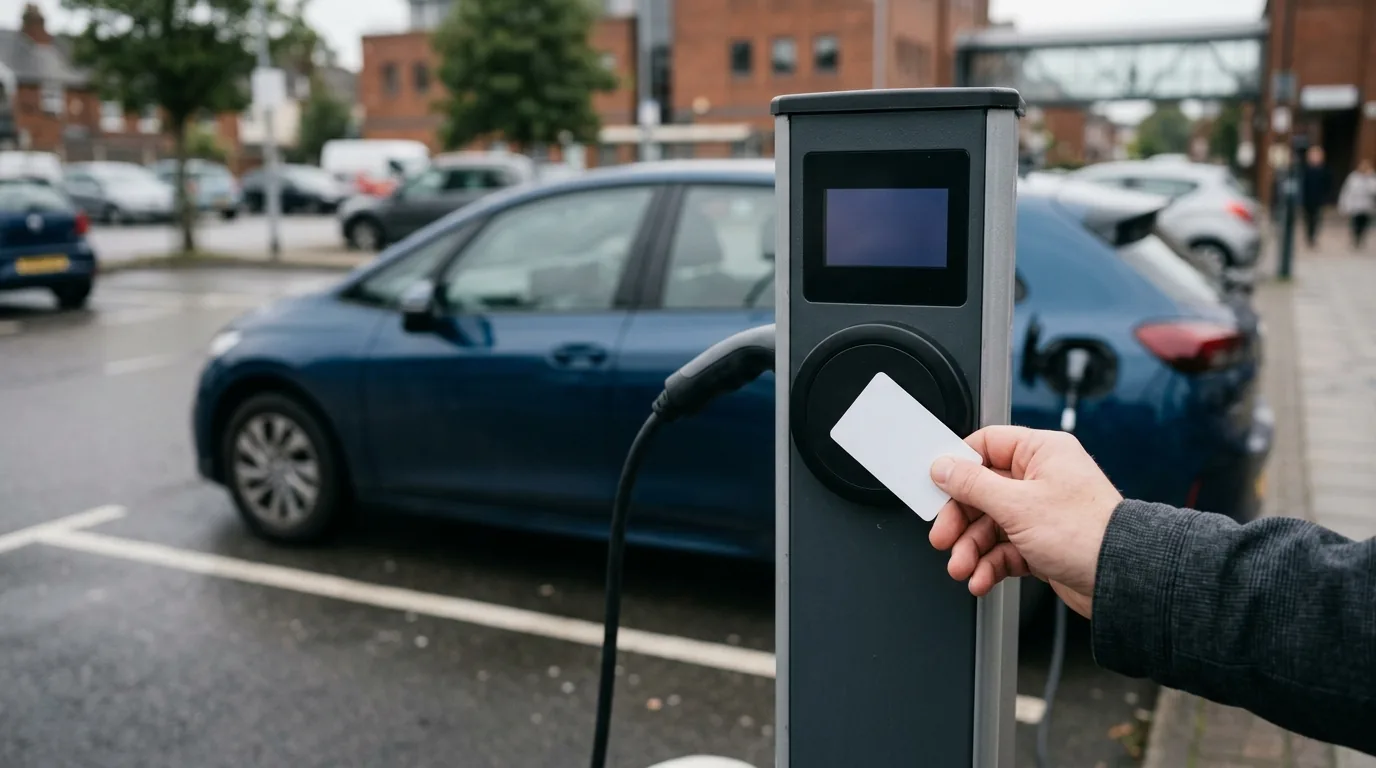
The service has two parts. The Electroverse app, on iOS and Android, shows chargers on a map with their speed, live availability and facilities, plans charging routes tailored to your car, and works through Apple CarPlay and Android Auto. The Electrocard is a free RFID card you tap on a compatible charger to start a session.
How much does Octopus Electroverse cost per kWh?
Electroverse charges the rate the charge point operator provides and adds no subscription, sign-up or transaction fee. The rate in the app is the rate you pay, though Electroverse warns it can occasionally differ from paying the operator directly. Its help pages list four parts a price can have: an energy price per kWh, a time price per minute, an operator idle fee per minute once the car has stopped drawing power, and a one-off connection fee.
Octopus does not publish one Electroverse price list by speed, so the table below uses Zapmap’s UK pay-as-you-go averages for the networks’ own prices.
| Charger speed | UK average price (October 2026) | With 5% Octopus Go discount | With 8% Intelligent Octopus Go discount |
|---|---|---|---|
| Standard and fast, 3 to 49 kW | 54p/kWh | 51.3p/kWh | 49.7p/kWh |
| Rapid and ultra-rapid, 50 kW and above | 82p/kWh | 77.9p/kWh | 75.4p/kWh |
Zapmap updated these averages on 5 November 2026, and we checked them on 10 November 2026. Across the 10 biggest rapid networks, Zapmap found prices from 51p to 93p/kWh in October 2026, with InstaVolt at 92p/kWh, so the network you pick matters more than the app you pay with. Our report on public charging prices this autumn covers the individual networks.
What does a 10 to 80% charge cost through Electroverse?
A 10 to 80% rapid charge at the 82p/kWh average costs between £25.77 and £47.36 for the three cars below. EV Compared worked these out by multiplying 70% of each car’s usable battery from our spec data by the price per kWh, ignoring charging losses; our methodology explains the inputs.
| Car | Usable battery | Energy for 10 to 80% | At 54p/kWh (fast) | At 82p/kWh (rapid) | At 82p less 8% (Intelligent Octopus Go) |
|---|---|---|---|---|---|
| BYD Dolphin Active | 44.9 kWh | 31.4 kWh | £16.97 | £25.77 | £23.71 |
| Omoda E5 Knight | 58.9 kWh | 41.2 kWh | £22.26 | £33.81 | £31.10 |
| BYD Sealion 7 Comfort RWD | 82.5 kWh | 57.8 kWh | £31.19 | £47.36 | £43.57 |
The 8% discount saves £2.06 on the Dolphin and £3.79 on the Sealion 7 per rapid charge. That is useful on a long trip, but it is small next to the gap between home and public prices: Zapmap puts the price cap at around 26p/kWh and an off-peak EV tariff at around 8.1p/kWh. If you are buying an Omoda E5 with a free Octopus charger or £1,000 of charging credit, the home charger will do more for your running costs than any public discount.
How do you pay with Electroverse: app, card or Octopus bill?
You pay with a debit or credit card saved in the app. The Electroverse FAQ lists a payment card as the supported method and says billing happens straight after each session. Octopus Energy customers can normally link their energy account instead, with the previous week’s sessions added to their energy statement each Monday; the link needs the same email address on both accounts, a healthy balance and an active Direct Debit. Electroverse’s help centre says paying through Octopus is temporarily switched off, so for now a card is the way to pay.
Contactless is the alternative. Under the Public Charge Point Regulations 2023, every charger of 50 kW and above, and every new charger of 8 kW and above, must take contactless. Slower and older chargers, such as many lamp-post and car park units, do not have to, which is where the Electrocard and app earn their place.
The same regulations require every operator to accept payment through at least one third-party roaming provider, which is the kind of service Electroverse is. Our guide to EV charging payment apps compares the alternatives.
Is an Electroverse subscription worth it?
An Electroverse subscription is worth it only if you charge on that single network often enough to cover the fee. Electroverse sells optional plans that cut the price on one network, and they can be cancelled at any time, though some have a one-month minimum term.
| Subscription (UK) | Monthly fee | Discount | Break-even at 82p/kWh | Break-even in an Omoda E5 |
|---|---|---|---|---|
| Ionity | £10.50 | 40% | 32.0 kWh | 145 miles |
| Be.EV | £9.99 | 51% | 23.9 kWh | 108 miles |
| Arnold Clark | £8.99 | 29% | 37.8 kWh | 171 miles |
| Shell Recharge | £9.99 | 25% | 48.7 kWh | 221 miles |
EV Compared worked out the break-even by dividing the monthly fee by the pence saved per kWh at Zapmap’s 82p/kWh rapid average, then converting kWh to miles with the Omoda E5’s WLTP figure of 267 miles from 58.9 kWh, or 4.53 miles per kWh. Real-world efficiency is lower than WLTP, especially in winter, so the true break-even mileage is lower; a network priced below 82p pushes the kWh figure up. Ionity’s plan applies in 24 countries, so it suits drivers who take the car to Europe. For Shell Recharge’s own prices and app, see our network guide.
Free discounts need no sign-up. Electroverse lists 15% off at Evyve chargers and 20% off across Source EV from 27 October, applied automatically, and a free hot drink at Arnold Clark Charge sites during opening hours. Referring a friend gives you each £5 of credit after their first charge.
What is Plunge Pricing?
Plunge Pricing is an Electroverse discount on partner chargers when renewable generation is high and wholesale prices fall. Electroverse says a Plunge Price can be 20% off one day and up to 50% off the following week, and it posts each event at least 24 hours ahead. Octopus ran 84 Plunge Pricing sessions in the UK and France in 2026 up to the end of July, and in France it launched in March 2026 on Powerdot’s network.
For Octopus EV tariff customers, the standing 5% or 8% discount is the more dependable saving. Our guide to Electroverse for Octopus EV tariff customers explains how to link the accounts.
Where are the chargers?
Electroverse reaches chargers across the UK’s public network because it roams onto existing operators rather than building its own. Zapmap counted 98,899 public charging devices at 48,815 UK locations at the end of October 2026, and Electroverse’s 1,426,060 figure covers the UK, Europe and the rest of the world combined. Octopus does not publish a UK-only count, so the map in the app is the place to check whether your regular chargers are included: each charger’s access information shows “Electroverse App” where it works.
How reliable is Electroverse, and are there idle fees?
Electroverse is as reliable as the charger you plug into, because the hardware and its uptime belong to the operator. The regulations require each operator’s rapid network to be available 99% of the time across a year, with compliance published on the operator’s website, and every charger must advertise a free, staffed helpline open 24 hours a day. The app’s live availability helps you avoid a busy or broken site before you arrive.
Idle fees are set by the operator, not Electroverse, and are passed on. They are charged per minute once your car is plugged in but has stopped drawing power, so move the car when the session ends. Our ranking of the most reliable charging networks shows which operators keep their chargers working.
How do you use Electroverse, step by step?
Once your account and card are set up, starting a charge takes a few taps.
- Download the Electroverse app and sign up; Electroverse says it takes under 30 seconds.
- Add a debit or credit card; paying through a linked Octopus Energy account is temporarily switched off.
- Order the free Electrocard from the app. It takes up to 14 working days to arrive and up to 24 hours to activate.
- Find a charger on the app’s map and check its speed, availability and live price.
- To use the app, open the charger, tap “Start Charge” before plugging in, then tap it again once connected. To use the card, tap it on the charger’s reader.
- To stop in the app, drag the “slide to stop” bar to the right, then unplug and move the car.
Who is Electroverse for?
Electroverse suits drivers without one favourite network: people who charge at a mix of rapid hubs on long trips, rely on lamp-post or car park chargers without contactless, or drive in Europe. It suits Octopus Go and Intelligent Octopus Go customers most, because the 5% or 8% discount applies on every network for nothing.
It suits less well a driver who charges mostly at one network, where that operator’s own app or a subscription can be cheaper, and anyone who expects it to beat the network’s price on its own: its rates come from the operators, so the savings come from discounts. For most UK drivers the bigger saving is a home charger on an off-peak tariff, and Best Chargers covers choosing one.
Our verdict, based on published prices and terms rather than our own testing: Electroverse is a sensible card and app to carry for occasional public charging, because it is free, charges no subscription or transaction fees and covers more than 1,300 networks. Treat its discounts as a bonus, and do the subscription sums before paying a monthly fee.
How we test and where our numbers come from
Prices are the operator's published pence-per-kWh rates on the date shown, checked against the operator's app and Zapmap's price index. Networks change prices without notice; if a figure here is out of date, tell us and we will correct it. Last checked 10 November 2026. How we work out our own figures.
Frequently asked questions
What is Octopus Electroverse?
Octopus Electroverse is a public charging app and RFID card run by Octopus Energy. One account starts and pays for charges on more than 1,300 networks, which Electroverse says covers 1,426,060 chargers. Joining and the Electrocard are free, and it adds no subscription or transaction fees.
Do you need to be an Octopus Energy customer to use Electroverse?
No. Electroverse is open to any driver with a payment card, and its FAQ answers the question with "everyone is welcome". Octopus Energy home customers do get extra: 5% off public charging on Octopus Go and 8% on Intelligent Octopus Go.
How much does Octopus Electroverse charge per kWh?
Electroverse charges the rate the charge point operator provides and adds no subscription or transaction fee, so the cost depends on the network. Zapmap's October 2026 averages were 54p/kWh on chargers from 3 to 49 kW and 82p/kWh on rapid and ultra-rapid chargers of 50 kW and above. The app shows the price before you start.
Is the Electroverse Electrocard free?
Yes. Electroverse recommends ordering the free Electrocard after you sign up. It takes up to 14 working days to arrive, and activation in the app can take up to 24 hours. You can order more cards from the Electrocards section of the app.
Are Electroverse subscriptions worth it?
A subscription pays only if you charge regularly on that one network. At Zapmap's 82p/kWh rapid average, the £10.50 Ionity plan with 40% off breaks even at 32 kWh a month, and the £9.99 Shell Recharge plan with 25% off needs about 49 kWh. Below that, pay as you go is cheaper.
Does Electroverse work in Europe?
Yes. Octopus Energy says Electroverse reaches more than 1.5 million public charge points across Europe, about nine in 10, and it also works in North America. Ionity's Electroverse subscription applies in 24 countries, including the UK, France and Germany.
Sources and further reading
- electroverse.comElectroverse: public charging made simple1,426,060 compatible chargers, more than 1,300 networks, rates provided by charge point operators, no subscription or transaction fees, free Electrocard, CarPlay and Android Auto, 5% Octopus Go and 8% Intelligent Octopus Go discounts.
- intercom.helpHow does pricing work?Prices come from charge point operators and can include energy, time, idle and connection fees.
- intercom.helpHow does Electroverse work with my Octopus Energy account?Linking needs the same email, a healthy balance and an active Direct Debit; sessions appear on energy statements weekly; paying through Octopus is temporarily switched off, cards still work.
- electroverse.comElectroverse subscriptions: what are they and how to sign upSubscription fees and discounts: Ionity £10.50 for 40% in the UK, Shell Recharge £9.99 for 25%, Be.EV £9.99 for 51%, Arnold Clark £8.99 for 29%; page updated October 2026.
- electroverse.comWhich charging discounts can EV drivers get with Octopus Electroverse?Evyve 15% off, Source EV 20% off, Plunge Pricing of 20% to 50% announced at least 24 hours ahead, referral credit; updated November 2026.
- octopus.energyPlugged in: one million Brits now charge their electric cars with one appOne million UK drivers signed up, more than 1.5 million charge points and nine in 10 public chargers in Europe, 84 Plunge Pricing sessions in 2026 (30 July 2026).
- octopus.energySalut savings: Octopus Energy takes its trailblazing EV charging scheme to FrancePlunge Pricing cuts prices by up to 50% when renewable generation is high and wholesale prices fall; launched in France on Powerdot's network (5 March 2026).
- electroverse.comElectroverse frequently asked questionsElectrocard delivery up to 14 working days, activation up to 24 hours, starting and stopping a charge in the app, payment by card, open to non-Octopus customers.
- zapmap.comZapmap Charging Price IndexOctober 2026 UK pay-as-you-go averages: 54p/kWh for 3 to 49 kW and 82p/kWh for 50 kW and above; price cap around 26p/kWh and off-peak around 8.1p/kWh (updated 5 November 2026).
- zapmap.comZapmap rapid charging pricesTop 10 UK rapid networks ranged from 51p to 93p/kWh in October 2026, with InstaVolt at 92p/kWh (updated 30 October 2026).
- zapmap.comEV charging statistics: how many charging points are there in the UK?98,899 public charging devices at 48,815 UK locations at the end of October 2026 (updated 4 November 2026).
- gov.ukPublic Charge Point Regulations 2023: guidanceContactless on new 8 kW and above and all 50 kW and above chargers, 99% rapid reliability, p/kWh price display, at least one roaming provider, free 24/7 helpline.

EV Compared
The EV Compared editorial team tracks the UK electric vehicle market full time: new model launches, list prices, WLTP and real-world range, public charging tariffs and the tax rules that decide what an EV actually costs to run. Every guide is checked against manufacturer specifications and official GOV.UK figures, and updated whenever the numbers move.
Related reading
View all
Omoda E5 and Jaecoo E5 buyers get a free Octopus charger or £1,000 of charging credit
Omoda & Jaecoo UK and Octopus Energy are offering E5 buyers a choice: an Octopus Charge wallbox with standard installation, worth up to £1,029, or £1,000 of public charging credit. We work out what the credit buys in miles, how it compares with charging at home, and why you should check the end date.
How Much Does It Cost to Charge an EV at Home in the UK?
A full 60kWh charge costs around £14.80 on the standard rate or about £4.80 on an overnight EV tariff. Here is the maths, plus how to get the cheapest possible home charging cost.
Best EV Charging Apps UK 2026: Find Chargers, Plan Routes and Pay
The UK public charging network has over 120,000 charge points. These are the apps that make it manageable, ranked by category and use case