Automated Vehicles Act: draft safety principles explained for UK drivers
The consultation on the ten principles that self-driving cars and robotaxis must meet closed on 9 September 2026. Here is what the draft says, what has not been decided and what it means for you.
Quick answers
- The Department for Transport consultation on the draft Statement of Safety Principles opened on 17 June 2026 and closed on 9 September 2026.
- The draft sets ten principles, and its core standard is a level of safety at least equivalent to that of careful and competent human drivers.
- The final statement has not yet been published, so the ten principles remain a draft.
- Under the Automated Vehicles Act 2024, legal responsibility for an incident moves from the person in the car to the authorised self-driving entity.
- Government intends to update Automated Vehicles Act regulations in the second half of 2026 so that driverless services can operate legally if they meet the standard.
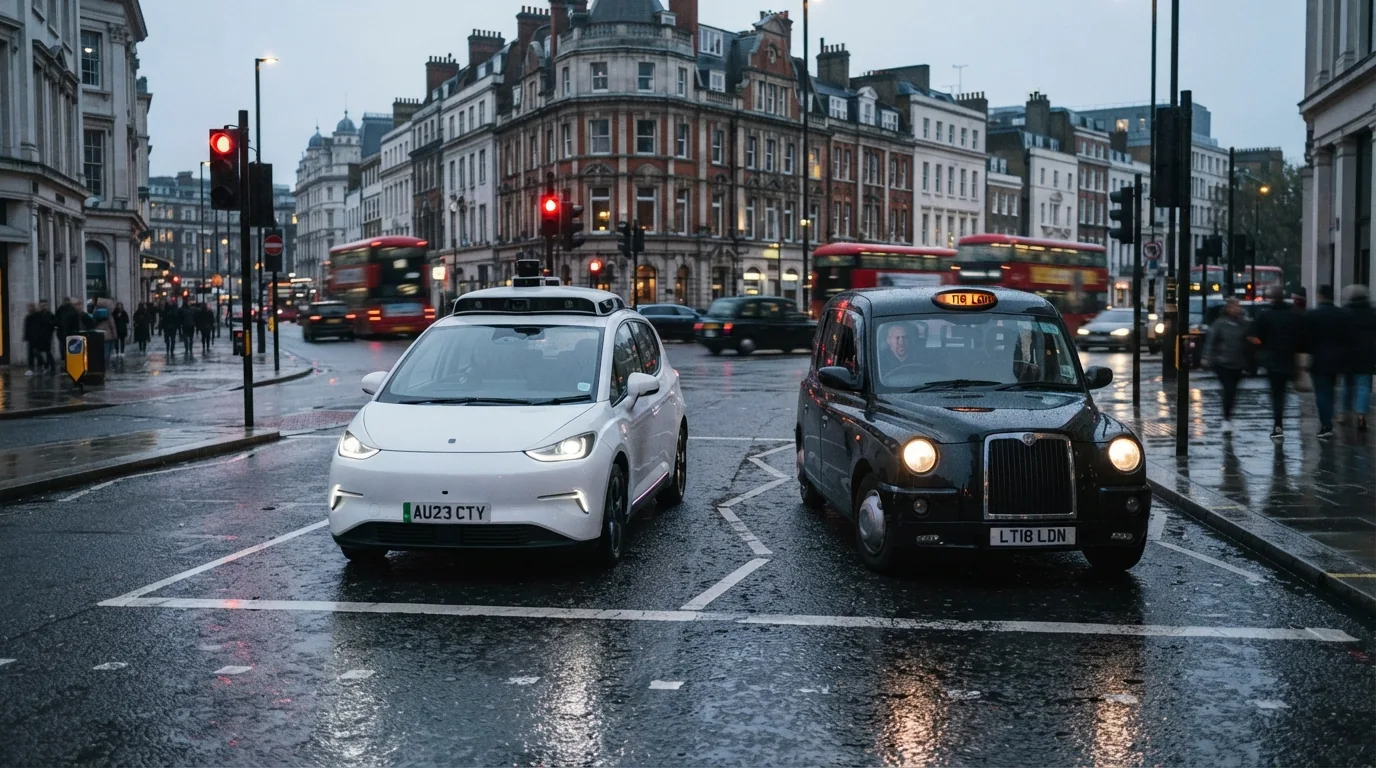
The Department for Transport’s consultation on the draft safety principles for self-driving vehicles closed on 9 September 2026, and the final statement has not yet been published. The draft sets ten principles, and its central test is that an authorised self-driving vehicle must be at least as safe as a careful and competent human driver. For UK drivers, this is the standard that every robotaxi and, in time, every privately owned self-driving car in Great Britain will be judged against. See also our report on the LEVC new black cab for 2027.
What has actually happened
The Department for Transport and the Centre for Connected and Autonomous Vehicles launched the consultation on 17 June 2026 (GOV.UK). It closed on 9 September 2026 (CMS). The statement is required under Section 2 of the Automated Vehicles Act 2024. September marked the end of the consultation, not the publication of a final document, so the principles below are proposals that could change. We found no sign of the final statement as of 6 October 2026.
| Date | Step |
|---|---|
| 17 June 2026 | Consultation on the draft statement opens |
| 9 September 2026 | Consultation closes |
| Second half of 2026 | Government intends to update Automated Vehicles Act regulations |
What do the ten draft principles say?
CMS reports that the Act requires the statement to ensure authorised self-driving vehicles reach a level of safety equal to or higher than careful and competent human drivers, and that road safety in Great Britain improves. The government describes careful and competent driving through five broad themes: vehicle control; hazard anticipation, perception and reaction; obeying traffic rules; interaction with other road users; and adaptability to road conditions. The ten draft principles say that self-driving vehicles should:
| No. | Draft principle |
|---|---|
| 1 | Use the road in accordance with traffic laws and the Highway Code |
| 2 | Maintain constant control over the vehicle |
| 3 | Predict, detect and respond to hazards proactively |
| 4 | Adapt driving to road and weather conditions |
| 5 | Behave in a predictable manner |
| 6 | Improve road safety in Great Britain for all |
| 7 | Interact safely with all road users, particularly those most at risk |
| 8 | Interact safely with emergency services |
| 9 | Operate autonomously only within the limits they are designed for |
| 10 | Be designed to take account of the specifics of the territory where they operate |
One principle requires vehicles to drive themselves only within the limits they were designed and authorised for (Weightmans). Those limits, known as the operational design domain, can cover road types, weather, locations, traffic and infrastructure.
What the “careful and competent driver” test means in practice
The benchmark is a human one. A self-driving system does not have to be perfect, but it has to match or beat a careful and competent driver, and the Act also requires road safety in Great Britain to improve. That is a higher bar than “no worse than the average driver”, because it refers to careful drivers rather than all of them. The principles turn it into behaviours such as keeping control, responding to hazards, obeying the Highway Code and adapting to the weather.
For insurers and lawyers, the operational design domain is the practical line. If a vehicle is driving itself inside the limits it was authorised for, responsibility sits with the authorised self-driving entity. Outside those limits, the vehicle should not be driving itself at all. Our guide to what the 2030 petrol and diesel ban means shows how other rule changes will shape the cars on sale, but the self-driving rules are a separate track from the ZEV mandate.
Who is liable when the car drives itself?
The Act moves legal responsibility away from the person in the car and onto the authorised self-driving entity, the company behind the vehicle. That matters for insurance and for any crash, and Weightmans, a law firm, set out why the principles matter to insurers. The statement itself guides the Transport Secretary’s decisions on authorising vehicles and on monitoring them once they are on the road.
How does this differ for private buyers and robotaxi passengers?
Robotaxi passengers are the nearest to the new rules. Uber and Wayve have been seeking customers for self-driving taxis in London, and our guide to how to book a London robotaxi covers the trials. A passenger in a robotaxi is not the driver, so the company carries the responsibility.
Private buyers are in a different position. Features sold today need you to stay in control, and you remain the driver. A car authorised as self-driving would be a separate category. For a sense of where driver assistance stands, see our report on Tesla FSD and the EU vote delay.
What happens next?
Government intends to update the Act’s regulations in the second half of 2026 so that driverless services can operate legally if they meet strict safety standards. The next visible steps are the publication of the final statement and the regulations. We have not found a published date for either, so we will report them when they appear.
What this means for you
Nothing changes for your car today. The safety principles will matter when a company applies to authorise a self-driving vehicle, and they will shape who is liable and how safety is judged once it is on the road. If you plan to use a robotaxi, the company is responsible for its driving. If you are buying a car with driver assistance, you remain the driver and need to stay alert. Watch for the final statement, which will show which of the ten principles survive consultation.
How we test and where our numbers come from
Range figures are official WLTP combined values taken from manufacturer UK specification pages, with real-world estimates drawn from independent comparative testing. Prices are UK list prices at the time of the latest update. Tax, grant and charging-scheme figures come from GOV.UK and HMRC publications. We re-check every guide when pricing, specification or policy changes. Last checked 6 October 2026.
Frequently asked questions
Have the self-driving safety principles been published?
Only as a draft. The consultation on the draft Statement of Safety Principles closed on 9 September 2026. The final statement, which the Transport Secretary must publish under the Automated Vehicles Act 2024, has not yet appeared.
What safety standard must self-driving cars meet in Britain?
A level of safety at least equivalent to that of careful and competent human drivers, with road safety in Great Britain improving overall. That is the test set by the Automated Vehicles Act 2024 for authorised self-driving vehicles.
Who is responsible if a self-driving car crashes?
Under the Act, responsibility shifts from the person in the car to the authorised self-driving entity, which is the company that has put the vehicle forward for authorisation.
Does this affect my current car's driver assistance?
The Act covers vehicles authorised as self-driving, where the system drives without you supervising. Driver assistance features that need you to stay in control are a different category, and you remain the driver.
Sources and further reading
- gov.ukGOV.UK (Department for Transport)Primary source referenced in this article.
- cms.lawUK government consults on safety principles for automated vehiclesLaunch date, ten principles and the 9 September 2026 closing date.
- weightmans.comAutomated vehicles: why the UK's new safety principles matter for insurersOperational design domain and the insurance angle.
- burges-salmon.comAutomated Vehicles Act 2024: driverless but not directionlessLegal analysis of the DfT consultation.
- dacbeachcroft.comAutomated vehicles: the next step, Statement of Safety PrinciplesOverview of the Statement of Safety Principles.
- transportxtra.comUber and Wayve seek customers for self-driving taxis in LondonRobotaxi plans for London.

EV Compared
The EV Compared editorial team tracks the UK electric vehicle market full time: new model launches, list prices, WLTP and real-world range, public charging tariffs and the tax rules that decide what an EV actually costs to run. Every guide is checked against manufacturer specifications and official GOV.UK figures, and updated whenever the numbers move.
Related reading
View all
Tesla FSD EU vote slips to December: what it means for the UK
The EU-wide decision on Tesla's FSD (Supervised) will not come on 6 October after all, and even when it does, Britain runs its own approval. Here is where each route stands.
Wayve and Uber robotaxis in London: how to get a ride
Uber and Wayve began supervised autonomous rides in London on 3 September 2026, using 15 electric Ford Mustang Mach-Es. Here is how to be matched with one, what it costs and where Waymo and Tesla stand.
LEVC new black cab confirmed for 2027 as TX production ends
LEVC will launch an all-new London black cab in the second half of 2027, but has not said what powers it or what it will cost. Here is what taxi drivers deciding now should weigh.
What Does the 2030 Petrol and Diesel Ban Actually Mean?
Separating the facts from the myths: what changes in 2030, what does not, and what it means for your next car
Leapmotor B05, Geely E2 (EX2) and Aion UT earn five Euro NCAP stars
Three Chinese EVs have passed Euro NCAP's tougher 2026 tests, with the Leapmotor B05 scoring 92% for crash protection. Here is how the scores break down, what Euro NCAP flagged, and which cars UK buyers can order.
EV battery fire risk: what UK data says about cars, e-bikes and chargers
Most lithium-ion fire headlines involve e-bikes and e-scooters, not electric cars. Here is what UK fire service and insurer data shows, and how to charge safely at home.