Do Electric Cars Need Oil? What EVs Use Instead and What Still Needs Servicing
Electric cars need no engine oil or oil changes, but most still carry reduction gear oil, coolant and brake fluid that the maker's schedule checks or replaces.
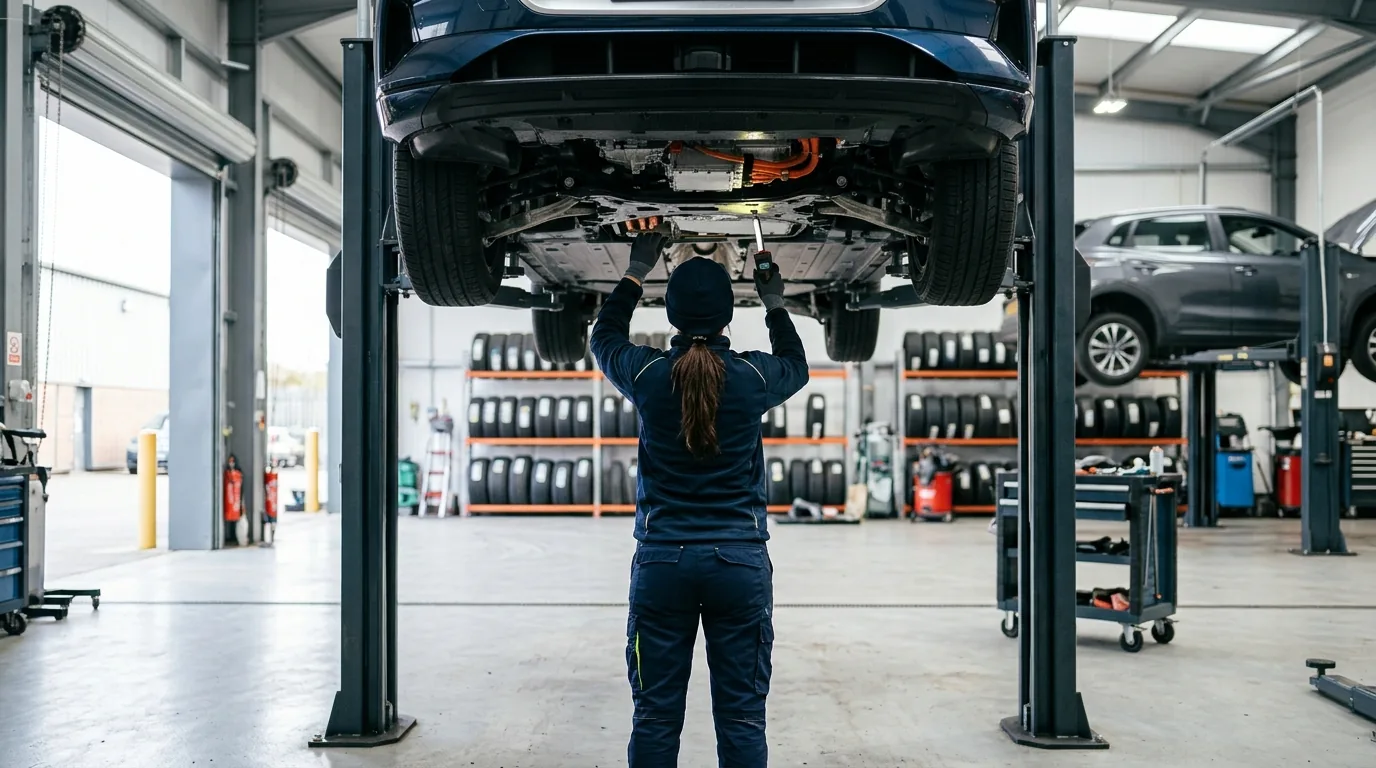
Quick answers
- Electric cars do not need engine oil or oil changes, because they have no combustion engine; the AA says an EV drivetrain has around 20 or fewer parts, against hundreds of moving parts in a combustion engine.
- Most electric cars still carry a small amount of oil in the reduction gearbox; Kia's European schedule only inspects the EV6's reduction gear fluid every 48 months and replaces it every 80,000 miles under severe use.
- Electric cars need coolant for the battery and motors, and Kia's EV6 schedule replaces it first at 140,000 miles or 120 months, then every 20,000 miles or 24 months.
- Brake fluid is the fluid an electric car is most likely to have changed: Kia replaces it every 24 months on the EV6, and Tesla checks it every 4 years on the Model 3.
- Hybrids still need oil changes, because they have a petrol engine; Toyota services its hybrid C-HR every 12 months or 10,000 miles, with an oil and filter change at the minor service.
- A BVRLA analysis of 47.4 million MOT tests found electric cars had roughly 1.8 times as many tyre defects as petrol cars, so tyres deserve more attention than oil in an EV maintenance budget.
- With no oil to change, a Range Rover Electric's main running consumable is electricity: EV Compared works out 8,000 miles at £166 on a 6.5p/kWh home rate.
Electric cars do not need engine oil or oil changes, because they have no engine. They do still use a few fluids: a small amount of oil in the reduction gearbox, coolant for the battery and motors, and brake fluid, which some makers replace every two years.
Why don’t electric cars need oil changes?
Electric cars don’t need oil changes because there is no combustion engine to lubricate. In a petrol or diesel car, engine oil keeps pistons, crankshaft, camshafts and valves from wearing against each other, and it breaks down with heat and use, which is why it is drained and replaced at service time. An electric motor has none of those parts, so there is nothing for engine oil to do.
The AA puts the difference in scale plainly: an EV drivetrain has around 20 or fewer parts, while a combustion engine has hundreds of moving parts. Fewer moving parts means less to lubricate and less to wear out. Honda UK’s own EV servicing guide says it directly: no oil changes are required.
That also answers the related question of whether electric cars need petrol or diesel: they need neither. The battery is the only energy store, and the electricity that fills it is the running cost that replaces fuel, as the worked example below shows.
Do electric cars use any oil at all?
Most electric cars do use a small amount of oil, but in the gearbox rather than an engine. An electric motor spins much faster than the wheels, so a single-speed reduction gear sits between them, and those gears run in sealed lubricant. Our guide to whether electric cars have gears explains how that gearbox works. The AA says this reduction gearbox oil may need changing over the car’s lifespan.
In practice it is rarely touched. Kia’s European maintenance schedule for the EV6 inspects the reduction gear fluid at 48, 96, 144 and 192 months, which is once every four years, and only schedules a replacement every 80,000 miles under severe use, or any time the car has been submerged in water. Tesla’s published service intervals for the Model 3 list no gear oil change at all.
So electric cars don’t need transmission fluid in the way a car with a multi-speed gearbox does. The reduction gear fluid is the only transmission lubricant, and for most owners it is a check, not a change.
Do electric cars need coolant?
Yes, electric cars need coolant. The battery, motors and power electronics all produce heat, and a liquid cooling loop keeps the battery in the temperature range where it charges quickly and ages slowly. The AA notes that EV cooling systems are sealed and should only be checked by a qualified high-voltage technician, so topping up is not a driveway job.
How often coolant is changed depends on the maker, and the official advice differs more than for any other fluid. Kia’s EV6 schedule replaces the coolant first at 140,000 miles or 120 months, then every 20,000 miles or 24 months after that. Honda UK’s guide says coolant only needs checking and topping up and never needs changing. Tesla’s Model 3 intervals list no coolant change, and warn that any damage caused by opening the battery coolant reservoir is excluded from the warranty. The owner’s manual for your car, not a general rule, decides this one.
Do electric cars need brake fluid?
Yes, electric cars need brake fluid, and it is the fluid most likely to be replaced on a fixed schedule. Every EV has hydraulic friction brakes alongside regenerative braking, so it carries brake fluid just as a petrol car does.
The schedules vary by maker:
- Kia replaces the EV6’s brake fluid every 24 months under its European schedule.
- Tesla runs a brake fluid health check every 4 years on the Model 3, replacing it if necessary, and says towing, long mountain descents or performance driving may call for more frequent checks.
- Volkswagen Financial Services’ two-year Essentials plan for the ID range includes one inspection and one brake fluid change if required.
Does regenerative braking mean the brakes never need work?
No, the brakes still need attention, though the pattern of wear is different. Regenerative braking uses the motor to slow the car and return energy to the battery, which takes load off the pads and discs. The AA says you will still need to replace pads and discs occasionally.
The bigger risk is the opposite of wear. A BVRLA-commissioned analysis of 47.4 million UK MOT tests by New AutoMotive, reported by Carwow on 22 September 2026, found brake defects were less common in high-mileage electric cars, but older low-mileage EVs had more friction brake defects, which the researchers linked to corrosion from infrequent use. Tesla’s intervals reflect this: clean and lubricate the brake calipers every year or 12,500 miles where roads are salted in winter, which covers UK drivers on gritted roads.
The same study found electric cars had roughly 1.8 times as many tyre defects as petrol cars, so tyres, not oil, are the item to watch. It also found EV MOT failure rates levelled off at 16% while petrol failures kept rising; above 120,000 miles, 16% of EVs failed against 23.5% of petrol cars. Our guide to MOT tests for electric cars covers what the examiner checks.
Do Teslas need oil changes?
No, Teslas do not need oil changes. Tesla’s published Model 3 service intervals are short:
- brake fluid health check every 4 years, replaced if necessary
- cabin air filter every 2 years
- wiper blades every year
- brake calipers cleaned and lubricated every year or 12,500 miles on salted roads
- tyres rotated every 6,250 miles
- A/C desiccant bag every 6 years, on cars built before about 2021
There is no engine oil, gear oil or coolant change on the list, and Tesla says its cars should generally be serviced on an as-needed basis. Our guide to Tesla servicing and maintenance costs puts prices on those jobs.
Do hybrid cars need oil changes?
Yes, hybrid cars need oil changes, because they still have a petrol engine. Toyota UK services its hybrid C-HR every 12 months or 10,000 miles, whichever comes first, and the minor service includes an oil and filter change. Plug-in hybrids carry a petrol engine too, so they keep the oil change alongside the electric parts.
If avoiding oil changes, filters and engine wear matters to you, only a fully electric car removes them. A plug-in hybrid adds a battery and motor to the engine’s servicing, rather than replacing it.
What does need maintaining on an electric car?
An electric car still needs a regular service, a set of fluid and filter changes, and close attention to tyres and brakes. The table sets two published European schedules side by side.
| Item | Kia EV6 (European schedule) | Tesla Model 3 (published intervals) |
|---|---|---|
| Engine oil and filter | None: no engine | None: no engine |
| Reduction gear fluid | Inspect every 48 months; replace every 80,000 miles under severe use | No interval listed |
| Coolant | Replace first at 140,000 miles or 120 months, then every 20,000 miles or 24 months | No interval listed |
| Brake fluid | Replace every 24 months | Health check every 4 years, replace if necessary |
| Cabin air filter | Replace every 24 months | Replace every 2 years |
| Brake discs and pads | Inspect every 24 months | Clean and lubricate calipers yearly or every 12,500 miles on salted roads |
| Tyres | Inspect every 24 months | Rotate every 6,250 miles |
| Main service | Every 24 months or 20,000 miles | Generally as needed |
Other makers set different rhythms. Honda says its EVs typically need a service every 12 months. Whatever the schedule, the MOT rules are the same as for a petrol car: gov.uk says the first test is due by the third anniversary of registration, then every year. Our breakdown of how much it costs to service an electric car compares typical bills.
Worked example: a Range Rover Electric with no oil to change
A Range Rover Electric shows where the money goes once there is no oil. JLR lists it from £154,070 in November 2026 for the EV550 Autobiography SWB, with a 118.5 kWh usable battery, a 372-mile WLTP range and two motors producing 550 PS. It has no engine oil to change; its main running consumable is electricity.
EV Compared worked out its energy costs from the official figures: efficiency is WLTP miles divided by usable battery, priced at a 6.5p/kWh off-peak home rate, the 26.32p/kWh price cap and an 82p/kWh public rapid average, ignoring charging losses (our methodology).
| Range Rover Electric (118.5 kWh, 372 miles WLTP) | Home off-peak, 6.5p/kWh | Price cap, 26.32p/kWh | Public rapid, 82p/kWh |
|---|---|---|---|
| Full charge | £7.70 | £31.19 | £97.17 |
| Pence per mile | 2.1p | 8.4p | 26.1p |
| 8,000 miles | £166 | £671 | £2,090 |
That works out at 3.14 miles per kWh. On a cheap overnight tariff, 8,000 miles costs £166 in electricity; charging the same miles on public rapid chargers costs £2,090. Our guide to the cost of charging an EV at home shows how the tariff changes the sum.
The fluids that remain still need watching on a car like this. Land Rover quotes a towing capacity of up to 2,500 kg, and towing loads the friction brakes; Tesla’s own guidance for its cars says towing can call for more frequent brake fluid checks. Owners who tow should ask the dealer what interval applies. JLR says its ThermAssist heat management system supports battery longevity and performance in extreme temperatures, and that each car has a Battery Digital Twin monitoring over 900 diagnostic data points to support proactive maintenance. The propulsion system carries an 8 year or 100,000 mile warranty.
What does this mean for choosing an electric car?
Servicing should not decide which electric car you buy, but three checks are worth making before you sign. First, look up the service interval: a car on a 24-month schedule, like the Kia EV6, needs half the visits of one serviced every 12 months. Second, check what a service plan includes, especially brake fluid, since that is the one fluid most EVs change regularly. Third, budget for tyres, because the MOT data shows electric cars carry more tyre defects. For other assumptions that trip up new owners, see the biggest myths about switching to an EV.
Low-mileage drivers should ask for the brakes to be checked at every service, since corrosion, not wear, is the brake problem the MOT data points to. High-mileage drivers gain most: the same study found EV failure rates stayed below petrol cars’ beyond 120,000 miles. Battery health and warranty cover are the bigger long-term questions; see how long electric car batteries last.
Our verdict, based on published manufacturer schedules rather than our own testing: the claim that electric cars need no maintenance is a myth, but the claim that they need no oil changes is true. An EV suits drivers who want fewer, simpler services and no oil, filters or exhaust to pay for. It suits less well anyone expecting no garage visits at all, or a driver whose car covers few miles and rarely uses its friction brakes. For the full picture of running costs, read what an electric car really costs to own.
How we test and where our numbers come from
Range figures are official WLTP combined values taken from manufacturer UK specification pages, with real-world estimates drawn from independent comparative testing. Prices are UK list prices at the time of the latest update. Tax, grant and charging-scheme figures come from GOV.UK and HMRC publications. We re-check every guide when pricing, specification or policy changes. Last checked 10 November 2026. How we work out our own figures.
Frequently asked questions
Do electric cars need oil changes?
No, electric cars do not need oil changes, because they have no engine oil to change. Most have a sealed reduction gearbox with a small amount of lubricant, but makers inspect it at long intervals; Kia checks the EV6's every 48 months and only replaces it every 80,000 miles under severe use.
Do electric cars need transmission fluid?
Electric cars have no multi-speed transmission, so there is no conventional gearbox oil service. The only transmission lubricant is the reduction gear fluid in the single-speed gearbox, which Kia's European schedule for the EV6 inspects every four years and Tesla's Model 3 service intervals do not list for replacement at all.
Do electric cars need coolant?
Yes, electric cars need coolant to keep the battery, motors and electronics at the right temperature. Intervals vary widely: Kia replaces EV6 coolant first at 140,000 miles or 120 months, while Honda UK says its EV coolant only needs checking and topping up. The AA says EV cooling systems should only be checked by a qualified high-voltage technician.
Do electric cars need brake fluid?
Yes, electric cars have hydraulic friction brakes alongside regenerative braking, so they need brake fluid. Kia replaces it every 24 months on the EV6, Tesla runs a brake fluid health check every 4 years on the Model 3, and Volkswagen's two-year ID service plan includes a brake fluid change if required.
Do Teslas need oil changes?
No, Teslas do not need oil changes. Tesla's published Model 3 service intervals cover a brake fluid health check every 4 years, a cabin air filter every 2 years, wiper blades every year and a tyre rotation every 6,250 miles, with no engine oil or gearbox oil change on the list.
Do hybrid cars need oil changes?
Yes, hybrid and plug-in hybrid cars need oil changes because they have a petrol engine. Toyota UK services its hybrid C-HR every 12 months or 10,000 miles, whichever comes first, and the minor service includes an oil and filter change.
Do electric cars need servicing?
Yes, electric cars still need servicing, though some makers space services further apart. Honda says EVs typically need a service every 12 months, while Kia's European schedule services the EV6 every 24 months or 20,000 miles. Like any car, an EV needs its first MOT by the third anniversary of registration.
Sources and further reading
- kia.comKia EV6 owner's manual: scheduled maintenance service (Europe)EV6 European schedule: service every 24 months or 20,000 miles; brake fluid and climate control filter replaced every 24 months; reduction gear fluid inspected at 48, 96, 144 and 192 months, replaced every 80,000 miles under severe use or after submersion; coolant replaced first at 140,000 miles or 120 months, then every 20,000 miles or 24 months.
- tesla.comTesla Model 3 vehicle service intervalsBrake fluid health check every 4 years, more often with towing or heavy braking; cabin air filter every 2 years; wipers yearly; calipers cleaned and lubricated yearly or every 12,500 miles on salted roads; tyre rotation every 6,250 miles; A/C desiccant bag every 6 years on cars built before about 2021; damage from opening the battery coolant reservoir excluded from warranty; servicing generally as needed; no oil interval listed.
- theaa.comElectric car maintenanceEVs use no engine oil but reduction gearbox oil may need changing over the car's life; sealed cooling systems to be checked by a qualified HV technician; brake fluid still replaced; pads and discs still need replacing; around 20 or fewer drivetrain parts against hundreds of moving parts in a combustion engine.
- honda.co.ukHow to service and maintain your electric carEVs typically need servicing every 12 months; no oil changes required; coolant only needs checking and topping up and never needs changing.
- toyota.co.ukToyota C-HR service: all you need to knowC-HR hybrid service intervals every 12 months or 10,000 miles; the minor service includes an oil and filter change.
- vwfs.co.ukVolkswagen service plans for fully electric vehiclesID range Essentials Plan covers 2 years of recommended servicing with one inspection, one brake fluid change if required and one pollen filter if required.
- carwow.co.ukShould you buy a used electric car? New MOT data suggests you shouldBVRLA-commissioned New AutoMotive analysis of 47.4 million MOT tests (22 September 2026): fewer brake defects in high-mileage EVs, more friction brake defects in older low-mileage EVs linked to corrosion, about 1.8 times as many tyre defects, EV failure rates levelling off at 16%, 16% EV failure rate above 120,000 miles against 23.5% for petrol.
- jlr.comRange Rover Electric: a new era for the original luxury SUVUK price from £154,070 (EV550 Autobiography SWB), 118.5 kWh usable battery, 372 miles WLTP, two motors with 550 PS, ThermAssist heat management for battery longevity and performance in extreme temperatures, Battery Digital Twin with over 900 diagnostic data points, 8 year or 100,000 mile propulsion warranty.
- rangerover.comRange Rover ElectricTowing capacity of up to 2,500 kg, 372 miles WLTP range and an eight-year or 100,000-mile battery warranty.
- gov.ukGetting an MOTA car's first MOT is due by the third anniversary of its registration, then every year.

EV Compared
The EV Compared editorial team tracks the UK electric vehicle market full time: new model launches, list prices, WLTP and real-world range, public charging tariffs and the tax rules that decide what an EV actually costs to run. Every guide is checked against manufacturer specifications and official GOV.UK figures, and updated whenever the numbers move.
Related reading
View all
Tesla servicing and maintenance costs in the UK
Tesla has no fixed annual service, and CAP HPI rates it the cheapest brand to service. Tyres are where the money goes. Here is what a Model 3 or Model Y costs to keep on the road for five years.
Are electric cars reliable? The latest reliability data by brand and model
Yes: electric cars break down less often than petrol and diesel cars, but reliability varies widely from one electric model to the next.
Do Electric Cars Have Gears? Are All EVs Automatic?
Almost every electric car has a single fixed gear and no clutch, so it drives as an automatic and the DVSA treats it as one.
Do Electric Cars Need an MOT? What the Test Covers for EVs
Yes: an electric car in Great Britain needs an MOT by its third registration anniversary and every year after, with the same checks as any car apart from the exhaust.

Tesla Model 3 price UK tracker: Model 3 and Model Y prices this month
A new Tesla Model 3 costs from £37,990 and a Model Y from £44,990 in November 2026, with no change to any of the eight UK trims since October.
Electric car battery capacity ranked: which EVs have the biggest battery?
The Range Rover Electric has the biggest usable battery in our UK data at 118.5 kWh, but efficiency, not capacity, decides how far a car goes on each kWh.