ChargePlace Scotland shuts in 2027: chargers must move by year end
Owners have under three months to move their chargers off ChargePlace Scotland. Here is who runs them next, which apps you will need and what Scottish councils charge per kWh.
Quick answers
- Charge point owners must remove their chargers from the ChargePlace Scotland network by the end of 2026, and the network itself closes later in 2027.
- ScottishPower is taking on about 123 chargers in Argyll and Bute, the Western Isles, Orkney and Shetland under a HITRANS contract.
- EasyGo holds a 20-year north of Scotland contract, estimated at £300m, covering Highland, Aberdeen City, Aberdeenshire and Moray. Dundee has already moved to Evolt.
- Chargers that are not migrated risk becoming standalone units with no payment system, no back office support and no visibility in driver apps.
- Published council tariffs range from 35p/kWh at Stirling park and ride sites to 70p/kWh on Glasgow rapids, against a UK rapid average of 77p in August 2026.
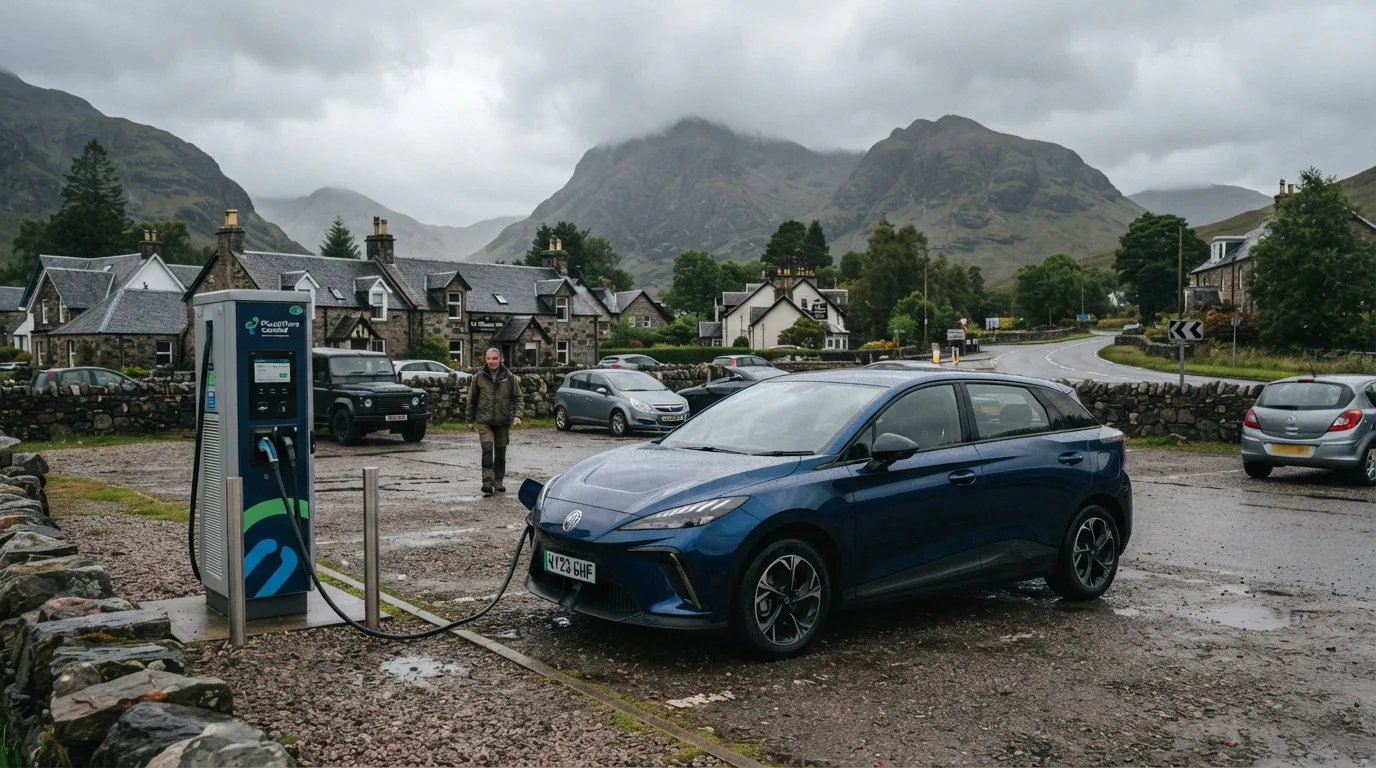
Charge point owners in Scotland have less than three months to move their chargers off ChargePlace Scotland, the publicly funded network, before the end of 2026, and the network itself closes in 2027. If you charge in public north of the border, the app you need, and possibly the price you pay, now depends on who takes over your local chargers. Some areas have already switched: Dundee’s chargers sit on the Evolt network, and ScottishPower has been taking on about 123 island and west coast chargers.
The Scottish Government is deliberately moving from a publicly funded charging network to one where more chargers are run by commercial operators. To ease the move, Energy Saving Trust runs a ChargePlace Scotland (CPS) Transition Fund for owners, which receives a share of the £17.8m EV package for 2026-27 that the Scottish Government confirmed in March, as electrive reported. Once a charger leaves CPS, access and payment move to the new provider.
When does ChargePlace Scotland close?
Two dates matter. Owners must remove their charge points from the CPS network by the end of 2026, and the network closes down its remaining operations later in 2027. The owners’ deadline was originally the end of 2025 and was pushed back a year to allow a more orderly transition. ChargePlace Scotland posts updates on its transition resource hub.
| When | What happened or happens |
|---|---|
| 2025 | EasyGo awarded a 20-year north of Scotland contract |
| October 2025 | ScottishPower named as HITRANS operator for island and Argyll chargers |
| Winter 2025 | First 60 HITRANS chargers due on ScottishPower’s platform |
| December 2025 | Dundee completes its move from CPS to Evolt |
| Early 2026 | Remaining HITRANS chargers were due to follow |
| March 2026 | £17.8m package confirmed, including the CPS Transition Fund |
| End of 2026 | Deadline for owners to remove chargers from CPS |
| 2027 | ChargePlace Scotland network closes |
Who runs your local chargers next?
There is no single replacement for ChargePlace Scotland. Councils and regional transport partnerships are choosing their own operators, so the answer depends on where you live and drive.
| Area | Councils covered | New operator | Status |
|---|---|---|---|
| Highlands and Islands (HITRANS) | Argyll and Bute, Western Isles, Orkney, Shetland | ScottishPower | About 123 chargers moving |
| North of Scotland | Highland, Aberdeen City, Aberdeenshire, Moray | EasyGo | 20-year contract, est. £300m |
| Dundee | Dundee City | Evolt | Migration complete |
| Elsewhere | Each owner decides | Varies | Deadline end of 2026 |
Highlands and Islands: ScottishPower
HITRANS, the Highlands and Islands Transport Partnership, appointed ScottishPower to manage public charge points across Argyll and Bute, the Western Isles, Orkney and Shetland as the CPS contract ends, electrive reported. Roughly 123 chargers were set to transfer to ScottishPower’s management platform over 18 months, with the first 60 due to move by winter 2025 and the rest in early 2026.
North of Scotland: EasyGo
EasyGo won a 20-year contract, estimated to be worth £300m, to provide charging infrastructure for the north of Scotland, with Highland Council as lead authority alongside Aberdeen City, Aberdeenshire and Moray, according to LocalGov. The project is part-funded through the Scottish Government’s £30m Electric Vehicle Infrastructure Fund, which earmarked more than £7m for the north of Scotland and Dundee, FutureScot reported.
Dundee: Evolt
Dundee became the first Scottish council to complete its migration from CPS, moving more than 190 public and fleet charge points to the Evolt network in December 2025, Fleet News reported. The chargers stayed put; the network and payment system behind them changed. Existing CPS cards were to keep working while the national network remains live.
Everywhere else
Other owners, whether councils, businesses or community groups, pick their own operator. CPS does not own the chargers, so leaving the network does not normally mean losing the hardware. The owner keeps it and decides how it is run after the transition.
What happens to chargers that are not moved?
This is the real risk for drivers. A charger that is not migrated could become a standalone unit, losing its payment system, back office support and visibility to drivers. In plain terms, that is a charger you may not see in your app and may not be able to pay at.
The Transition Fund exists to stop that happening by helping owners cover the cost of moving. We could not find a published count of how many CPS chargers have already moved, so it is not yet clear how many could go dark in 2027.
How much do council chargers cost now?
The end of CPS does not end cheap council charging, because that era had already finished. Councils set their own tariffs, and the latest rates published on council websites range from 35p to 70p per kWh. The last column shows the cost of adding 40kWh on a rapid.
| Council | Slow and fast (7 to 22kW) | Rapid | Tariff dated | 40kWh on a rapid |
|---|---|---|---|---|
| Glasgow | 40p | 70p | 1 March 2024 | £28.00 |
| Edinburgh | 51p (7kW), 56p (22kW), 48p on-street | 61p | Current council page | £24.40 |
| Stirling | 35p park and ride, 45p elsewhere | 59p | 8 January 2024 | £23.60 |
| Angus | 60p | 60p | 1 April 2025 | £24.00 |
| UK average (Zapmap) | 54p | 77p | August 2026 | £30.80 |
Even after the rises, every council rapid tariff in the table sits below Zapmap’s UK weighted average of 77p/kWh for rapid and ultra-rapid charging in August 2026, by between 7p (Glasgow) and 18p (Stirling). Slower chargers are a mixed picture: Glasgow’s 40p and Stirling’s 35p to 45p beat the UK standard average of 54p, while Angus at 60p and Edinburgh’s 22kW posts at 56p cost more.
Several councils have raised prices. Stirling’s current rates followed an increase on 8 January 2024 that the council put down to rising costs, and Angus moved to 60p on every council charger from 1 April 2025. Edinburgh’s on-street 7kW rate of 48p comes with a £30 overstay penalty after 12 hours, one of several overstay fees drivers now face. For the wider picture, see our guide to public EV charging costs and the latest rapid charging prices across the UK.
Will prices change after the switch?
They could. A new operator does not automatically mean a new tariff, but in our view it is an obvious moment to review one, and none of the operator announcements covered here set out prices.
Highland is the area to watch. Highland Council has previously proposed raising rapid charging from 30p to 70p per kWh, according to a 2024 trade press report, but we could not confirm whether or when that change took effect. Highland is also the lead authority on the EasyGo contract, so its drivers face a new operator and possibly different prices.
What this means for you
For most drivers in cities and larger council areas, this is an admin job rather than a crisis. Before the deadline:
- Check which network a charger is on before you set off. Map apps show the operator, and our guide to the best EV charging apps covers the main options.
- Get the right app for your area. That means ScottishPower across the HITRANS islands and Argyll and Bute, EasyGo in Highland, Aberdeen City, Aberdeenshire and Moray, and Evolt in Dundee.
- Look at the price per kWh in the new app before you plug in. Council tariffs already differ by up to 35p per kWh, and a new operator is a natural point for change.
- Plan a backup for rural and island trips. Our round-up of charging networks in Scotland lists the commercial alternatives on main routes and in towns.
- Report chargers that vanish. If a charger you rely on drops out of apps or stops taking payment in the new year, tell its owner, often the local council.
The bigger worry, in our view, is smaller owners without a council contract or regional partnership behind them. If they miss the end-of-2026 deadline, their chargers could drop out of apps entirely when CPS closes in 2027. Scotland’s EV grant schemes include the Transition Fund to help owners make the move, so there is little excuse for a working charger to go dark.
How we test and where our numbers come from
Range figures are official WLTP combined values taken from manufacturer UK specification pages, with real-world estimates drawn from independent comparative testing. Prices are UK list prices at the time of the latest update. Tax, grant and charging-scheme figures come from GOV.UK and HMRC publications. We re-check every guide when pricing, specification or policy changes. Last checked 6 October 2026.
Frequently asked questions
When does ChargePlace Scotland close?
Charge point owners have been told to remove their chargers from the ChargePlace Scotland network by the end of 2026. The network then closes later in 2027.
Will my ChargePlace Scotland account still work on migrated chargers?
Do not count on it. Once a charger leaves ChargePlace Scotland, access and payment are handled by the new provider. In Dundee, existing ChargePlace Scotland cards were to keep working on Evolt chargers while the national network remains live, but you should expect to need the new operator's app or payment method.
Who will run public chargers in the Highlands and Islands?
ScottishPower is taking on about 123 chargers across Argyll and Bute, the Western Isles, Orkney and Shetland for HITRANS. EasyGo holds a 20-year contract covering Highland, Aberdeen City, Aberdeenshire and Moray.
How much do council EV chargers cost in Scotland?
The latest published council tariffs run from 35p/kWh at Stirling park and ride sites to 70p/kWh on Glasgow rapid chargers. Edinburgh charges 48p to 61p and Angus charges 60p on all of its chargers.
What happens to a charger that is not moved off ChargePlace Scotland?
It risks becoming a standalone unit with no payment system, no back office support and no visibility to drivers. A Transition Fund run by Energy Saving Trust helps owners pay to migrate.
Sources and further reading
- energysavingtrust.org.ukEnergy Saving TrustPrimary source referenced in this article.
- electrive.comScottishPower to take over EV charging in Highlands and Islandsconfirms the HITRANS appointment and the transfer of about 123 chargers
- localgov.co.ukNorth of Scotland awards £300m infrastructure contractconfirms EasyGo's 20-year north of Scotland contract and its estimated £300m value
- fleetnews.co.ukDundee completes migration from ChargePlace Scotland to Evolt networkconfirms Dundee has finished moving its chargers to Evolt
- glasgow.gov.ukElectric Vehicle ChargingGlasgow City Council tariffs of 40p and 70p per kWh from 1 March 2024
- edinburgh.gov.ukElectric vehicle charging pointsCity of Edinburgh Council tariffs, on-street rate and £30 overstay penalty
- stirling.gov.ukElectric vehicle charging tariff to increase due to rising costsStirling Council tariffs from 8 January 2024
- zapmap.comZapmap Charging Price IndexUK weighted average prices of 54p and 77p per kWh in August 2026

EV Compared
The EV Compared editorial team tracks the UK electric vehicle market full time: new model launches, list prices, WLTP and real-world range, public charging tariffs and the tax rules that decide what an EV actually costs to run. Every guide is checked against manufacturer specifications and official GOV.UK figures, and updated whenever the numbers move.
Related reading
View all
Scotland EV charging grants 2026-27: £17.8m, what you can claim
Scotland funds its own EV charging grants on top of UK schemes: rural and island chargers, cross-pavement home charging, flats and microbusinesses. Here is who qualifies and how much each pays.
Best EV Charging Networks in Scotland for 2026
From Edinburgh and Glasgow to the NC500 and Western Isles, which networks to rely on
EV charger fines: overstay fees up to £1 a minute and £130 PCNs
Idle fees, council penalty notices and private camera tickets can all hit an EV driver at a public charger. Here is what each costs, why app-guided stops still get fined and how to appeal.
Zapmap: rapid charging averages 77p/kWh as MFG keeps 59p app price
Rapid public charging averaged 77p/kWh in August, and MFG has kept its 59p summer price for drivers who use its app. Here is what the big networks charge, and the off-peak and subscription deals that cut the bill.
Best EV Charging Apps UK 2026: Find Chargers, Plan Routes and Pay
The UK public charging network has over 120,000 charge points. These are the apps that make it manageable, ranked by category and use case
How Much Does Public EV Charging Cost in the UK in 2026?
Current prices by charger speed, network and payment method, with the real cost per mile