Could the Budget bring an 'SUV tax'? How a weight levy would hit electric cars
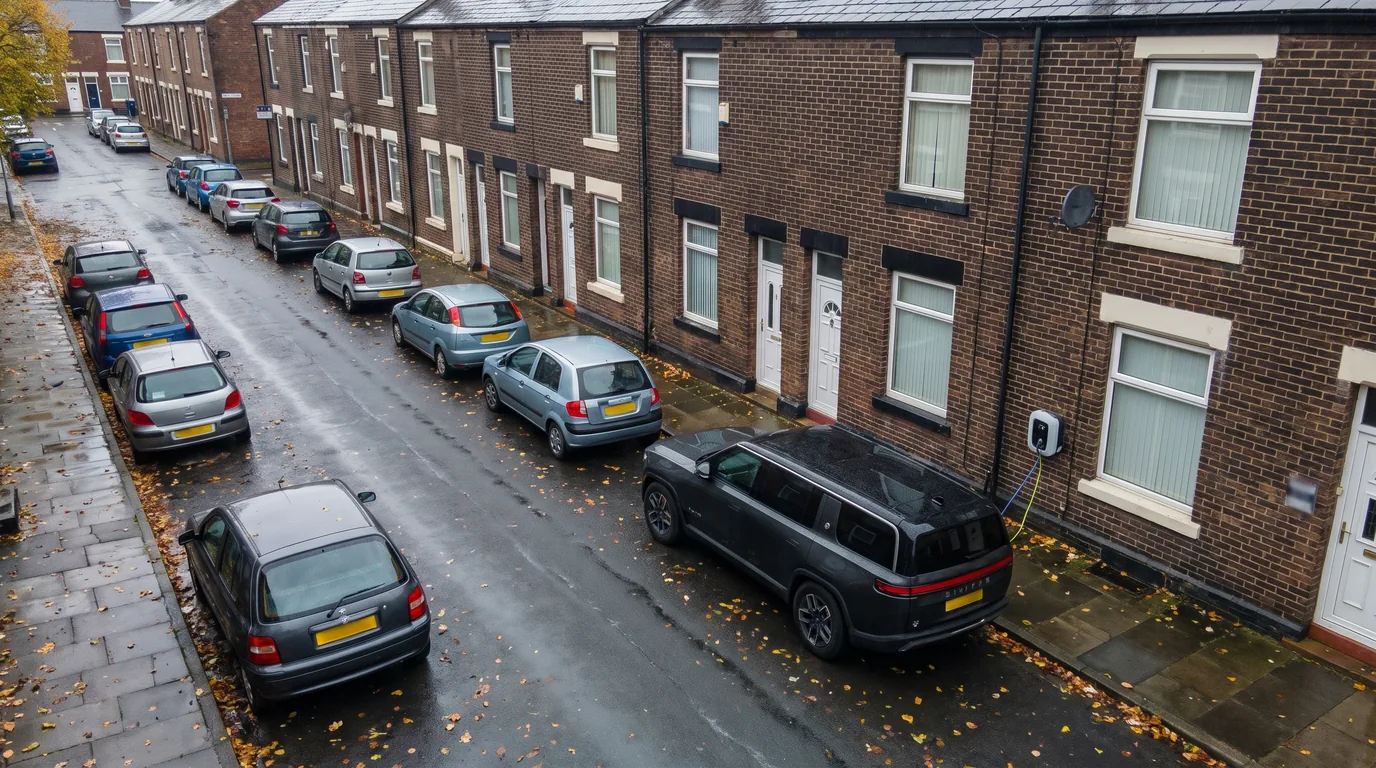
Ahead of the 28 October Budget, campaigners are pressing for a Large Vehicle Levy and councils from Cardiff to Bath are already charging more to park big cars. Here is how the proposals work and why heavy EVs are in the frame.
Quick answers
- Transport & Environment (T&E) has proposed a UK 'Large Vehicle Levy' of £10 for every kilogram of kerb weight above 1,600kg, which it says would raise almost £2bn a year.
- Under the proposal, new electric cars would get a 400kg buffer to reflect battery weight, so an EV would only pay above 2,000kg.
- The 1,600kg threshold matches France's 'weight malus' and is meant to exempt typical family cars such as the VW Golf and Ford Puma.
- SUVs account for more than half of UK new car sales; average UK bonnet heights rose from 76.9cm in 2010 to 83.8cm in 2024.
- Cardiff Council approved higher parking permit charges for vehicles over 2,400kg in October 2025, and Bath and North East Somerset introduced size-based resident permit charges from August 2026.
- No SUV tax has been announced; the Budget on 28 October 2026 is the next chance for the Chancellor to act, and the government has signalled no rises in the main rates of income tax, VAT or National Insurance.
Campaigners are pushing the Chancellor to use the Budget on 28 October 2026 to bring in an “SUV tax”, and heavy electric cars could be caught by it. The most detailed proposal, from the campaign group Transport & Environment (T&E), is a Large Vehicle Levy of £10 for every kilogram of kerb weight above 1,600kg, with a 400kg buffer for electric cars, according to the Express. T&E says it would raise almost £2bn a year.
No such tax has been announced, and the government has signalled that it does not plan to raise the main rates of income tax, VAT or National Insurance. But councils are already acting on their own, with Cardiff and Bath charging more to park bigger cars. Here is how the proposals work, which EVs would be affected and what to watch for on Budget day. For the wider EV picture, see our Autumn Budget 2026 preview.
What is the proposed SUV tax?
The main proposal is T&E’s Large Vehicle Levy, a one-off charge based on a car’s official kerb weight. Its key features are:
- £10 per kilogram above a 1,600kg threshold.
- A 400kg buffer for new electric cars, to reflect the weight of their batteries. That means an EV would only pay on weight above 2,000kg.
- Based on official kerb weight, already declared at registration, so no new testing or paperwork.
T&E says the 1,600kg cut-off is “a fair cut-off, already in use in France’s ‘weight malus’, ensuring typical family cars are protected while bulkier vehicles pay their way”. It says cars such as the VW Golf and Ford Puma would fall below the line.
“Heavily polluting SUVs are getting an unfair tax break,” T&E argues. “The current Vehicle Excise Duty doesn’t reflect the true impact of the biggest, heaviest vehicles on our roads.” It has suggested the money could fund a social leasing scheme offering electric cars to low-income households, such as nurses and carers, for £77 a month.
How much would it cost?
Under T&E’s design, the bill depends entirely on weight. Here are worked examples using the proposal’s own numbers. The weights are illustrative, not specific models.
| Car | Kerb weight | Threshold | Weight above threshold | Levy at £10/kg |
|---|---|---|---|---|
| Petrol family hatchback | 1,400kg | 1,600kg | None | £0 |
| Petrol SUV | 1,800kg | 1,600kg | 200kg | £2,000 |
| Compact electric SUV | 1,900kg | 2,000kg | None | £0 |
| Large electric SUV | 2,300kg | 2,000kg | 300kg | £3,000 |
| Very large luxury EV | 2,700kg | 2,000kg | 700kg | £7,000 |
The pattern is clear. Small and mid-size EVs would pay nothing, while the heaviest electric SUVs, which often weigh well over two and a half tonnes, would face bills in the thousands. The Express noted the proposals would target the “heaviest, most space-hungry models” from brands such as Range Rover, Mercedes-Benz and Porsche.
Why are campaigners targeting SUVs?
They argue that cars have grown bigger and heavier, a trend they call “carspreading”, and that the tax system has not kept up. The evidence they cite includes:
- Market share. SUVs account for more than half of UK new car sales; the Express put the figure at over 52%, while other estimates are higher.
- Size. WWF figures cited by Yahoo say SUVs are on average 26cm longer, 10cm wider and 205kg heavier than a regular car.
- Bonnet height. Average UK bonnet heights rose from 76.9cm in 2010 to 83.8cm in 2024, and nearly half of cars sold in 2024 had bonnets at least 85cm high.
- Safety. A London School of Hygiene and Tropical Medicine study of 359,000 police crash reports found young children are three times more likely to die when hit by an SUV.
- Parking. Clean Cities says almost half of all cars do not fit a typical urban parking space. A T&E and Clean Cities report warned cities could lose 8.5% to 14% of on-street spaces by 2040 if new cars keep growing.
- Road wear. T&E says heavy vehicles cause much more road damage than light ones.
“Regulators need to wake up and set maximum limits for the size of new cars,” said Barbara Stoll of Clean Cities. “Cities and governments can act now by structuring parking charges and taxes to reflect the risk that bigger cars impose.”
Are any councils already charging SUVs more?
Yes. Local councils have moved faster than the Treasury:
- Cardiff. In October 2025, Cardiff Council became the first UK local authority to approve higher resident parking permit charges for vehicles weighing more than 2,400kg fully laden, to be phased in over the following decade, as North Wales Live reported.
- Bath and North East Somerset. Size-based resident permit charges applied from August 2026. “By introducing size-based permit charges, we are encouraging the use of smaller, safer and cleaner vehicles,” said council cabinet member Joel Hirst.
- London boroughs. Newham, Hackney and Lambeth are among the councils that use emissions-based charges for permits and parking.
- Length limits. Wokingham, South Hams, Broadland and South Norfolk and West Devon have 5m limits in some council car parks, and Thurrock has a 5.35m limit.
Abroad, Paris trebled on-street parking charges for visiting heavy cars from 1.6 tonnes upwards in October 2024, from €6 to €18 for an hour, after a public vote.
Why would heavy EVs be caught?
Because batteries are heavy. A large electric SUV can weigh hundreds of kilograms more than a petrol equivalent. T&E’s 400kg buffer is designed to stop that penalising EVs as a category, but it does not protect the heaviest ones.
There is a reasonable argument either way. Supporters say a heavy EV still takes up the same space and wears roads in the same way as a heavy petrol car. Critics say taxing EVs on weight would undercut the government’s own push to get people out of petrol and diesel cars, especially families who need space. Clean Cities’ Oliver Lord has argued that the tax system should first “address the issue that it can be cheap to buy a polluting car” before adding charges to EVs.
EVs already face new costs. They pay Vehicle Excise Duty from April 2025, the expensive car supplement on cars over £40,000, and from April 2028 the 3p-a-mile pay-per-mile charge. Our guide to the expensive car supplement explains how that already falls on many big EVs.
Is it likely to happen in this Budget?
There is no sign it is being prepared. No minister has endorsed it, and the political risk is high: SUVs are Britain’s most popular type of car. When Cardiff approved its surcharge, opposition politicians called it “Labour’s latest crusade in their war on motorists”.
That said, the Chancellor needs money, and a weight levy can be framed as a tax on the biggest, most expensive cars rather than on ordinary families. Campaigners have also suggested it could replace part of the revenue lost as fuel duty declines. Watch for any change to first-year Vehicle Excise Duty or the expensive car supplement, which would be the simplest way to target heavy cars without creating a new tax.
What should you do if you are buying a big car?
Nothing drastic. No national SUV tax exists, and any new charge would need time to be designed and legislated. But if you are choosing between a large and a mid-size EV, size and weight are worth thinking about anyway:
- Running costs. Heavier EVs use more energy per mile, so they cost more to charge and wear tyres faster.
- Parking. Check your council’s permit rules and any car park length limits if you live in a city.
- Future-proofing. A car under 2,000kg would sit below T&E’s proposed EV threshold, if it ever happened.
Our guide to the cheapest electric cars to run shows how much efficiency matters to your bills.
What do drivers think?
Opinion is split. Clean Cities says most car owners agree that big cars take up too much space in towns, and few people think SUVs should face no extra charges at all. But SUVs are Britain’s most popular type of car, chosen by families for space, a higher driving position and practicality, and any new national charge would be politically contentious.
Any national weight charge would also need to decide how to treat vans, motorhomes and vehicles adapted for disabled drivers, which tend to be heavy.
We will report on any vehicle tax changes in the Budget on 28 October, including anything that affects heavy electric cars.
Our view
A weight-based tax has a logic, and councils are already showing appetite for size-based parking charges. But a national SUV tax in this Budget looks unlikely, and the bigger risks for EV drivers on 28 October are the ones already on the table: VAT on public charging, pay-per-mile road tax and the future of the Electric Car Grant. We will report what the Chancellor announces.
How we test and where our numbers come from
Range figures are official WLTP combined values taken from manufacturer UK specification pages, with real-world estimates drawn from independent comparative testing. Prices are UK list prices at the time of the latest update. Tax, grant and charging-scheme figures come from GOV.UK and HMRC publications. We re-check every guide when pricing, specification or policy changes. Last checked 23 October 2026. How we work out our own figures.
Frequently asked questions
Is there going to be an SUV tax in the UK?
No national SUV tax has been announced. Campaigners including Transport & Environment and Clean Cities are urging the Chancellor to introduce a weight-based levy in the Budget on 28 October 2026, but there is no confirmation it is being considered.
How would the proposed Large Vehicle Levy work?
T&E's proposal charges a flat £10 for every kilogram of a car's official kerb weight above 1,600kg. New electric cars would get a 400kg allowance, so they would only pay on weight above 2,000kg. T&E says it would raise almost £2bn a year.
Would an SUV tax affect electric cars?
It could affect heavy ones. Under T&E's proposal, an EV weighing 2,300kg would pay on 300kg above its 2,000kg threshold, or £3,000 at £10 a kilo. Smaller EVs such as superminis and many compact SUVs would fall below the threshold and pay nothing.
Which councils charge more to park an SUV?
Cardiff Council approved higher resident permit charges for vehicles weighing more than 2,400kg in October 2025, phased in over the following decade. Bath and North East Somerset Council introduced size-based resident permit charges from August 2026. Several London boroughs use emissions-based permit pricing.
Why do campaigners want an SUV tax?
They argue big, heavy cars take up more space, cause more road wear and are more dangerous to pedestrians. Research cited by campaigners found children are three times more likely to die when hit by an SUV, and almost half of cars do not fit a typical urban parking space.
Sources and further reading
- express.co.ukExpressPrimary source referenced in this article.
- express.co.ukAndy Burnham urged to introduce new 'SUV tax'T&E and Clean Cities' 'carspreading' report, Bath's size-based permits from August, Cardiff and Paris, and SUVs at over 52% of new car sales.
- uk.news.yahoo.comHow 'carspreading' is fuelling calls for higher taxes on driversBonnet height data, the LSHTM child fatality finding, council length limits and Clean Cities' comments.
- dailypost.co.ukFirst UK 'SUV' parking tax on all cars weighing over this amountCardiff Council's 2,400kg permit surcharge decision and reactions.

EV Compared
The EV Compared editorial team tracks the UK electric vehicle market full time: new model launches, list prices, WLTP and real-world range, public charging tariffs and the tax rules that decide what an EV actually costs to run. Every guide is checked against manufacturer specifications and official GOV.UK figures, and updated whenever the numbers move.
Related reading
View all
Autumn Budget 2026: what EV drivers want from John Healey on 28 October
The new Chancellor's first Budget lands as fuel prices bite, the ZEV mandate is under review and public charging still carries 20% VAT. Here is what the motor industry, charging firms and drivers are asking for, and what is already fixed.
Cheapest Electric Cars to Run in the UK for 2026
Ranked by real annual running costs -- fuel, tax, insurance and maintenance combined
How Does the Expensive Car Supplement Affect EV Owners?
The luxury car tax now applies to electric cars -- but the £50,000 threshold protects most family EVs
Leasing industry wants EV company car tax capped at 9% after 2030
Electric company car tax is set to more than double by 2029-30, and nothing has been set for the years after. Leasing firms say certainty is vital, because salary sacrifice drivers are four times as likely as private lessees to choose an EV.
A weaker ZEV mandate could cost the Treasury up to £16.7bn, industry warns
As ministers lean towards a 60% target for 2030, charging firms, energy groups and campaigners have put numbers on what a softer mandate would cost in lost tax, slower charger roll-out and air pollution.
Autumn Budget 2026 and electric cars: what to watch
The Budget is on 28 October. Nothing in it is known yet. This preview sets out the rules already in place for electric car drivers and the open questions on VAT, fuel duty and company cars.