BYD Blade Battery explained: safety, Blade 2.0 and 5-minute Flash Charging
The Blade battery is BYD's lithium iron phosphate battery, made of long cells built into the car's structure; the second generation adds megawatt Flash Charging, but no BYD-badged car on sale in the UK today can use it.
Quick answers
- The Blade battery is BYD's lithium iron phosphate (LFP) battery, launched on 29 March 2020, with long, thin cells that form part of the pack structure.
- In BYD's nail penetration test the Blade cell gave off no smoke or fire and reached 30 to 60°C, while a ternary lithium cell passed 500°C and burned.
- BYD unveiled Blade Battery 2.0 on 5 March 2026, claiming 10 to 70% in five minutes and 10 to 97% in nine minutes on its 1,500kW Flash chargers.
- BYD's UK electric cars use the Blade battery, and BYD warrants it for eight years or 155,000 miles against falling below 70% state of health.
- No BYD-badged car on sale in the UK today can use Flash Charging at full speed; the BYD Atto 3, with 220kW peak charging, charges 10 to 80% in 25 minutes and adds about 88 miles in 10 minutes.
- A 10 to 80% charge of a BYD Atto 3 costs about £3.40 on a 6.5p off-peak tariff, against about £42.94 at the 82p per kWh rapid charging average for October 2026.
The Blade battery is BYD’s lithium iron phosphate (LFP) battery, built from long, thin cells that sit side by side and form part of the pack’s structure, which BYD says makes it safer and more space efficient than conventional packs. Blade Battery 2.0, unveiled in March 2026, adds BYD’s claim of a 10 to 70% charge in five minutes on its own 1,500kW Flash chargers.
That second claim is what has pushed BYD’s 1,500kW chargers into UK headlines. The catch for UK buyers is that the BYDs you can order today use the first-generation Blade, and none of them can charge anywhere near megawatt speeds. This guide explains what the technology is, what Blade 2.0 changes, and what it means when you are choosing a car.
What is BYD’s Blade Battery?
The Blade battery is a pack of long, flat LFP cells that BYD arranges like a row of blades, so the cells themselves act as structural beams. BYD launched it at an online event on 29 March 2020 (BYD Europe), and named the BYD Han saloon in China as the first car to get it, according to InsideEVs.
Conventional packs put cells into modules and modules into a pack, which wastes space on casings. BYD’s cell-to-pack design skips the module. At launch BYD said cells filled about 60% of the pack’s volume against about 40% in a conventional pack, an improvement of over 50% in space utilisation.
BYD UK’s own e-Platform 3.0 page says the battery is built into the body structure, doubles the car’s rigidity and leaves a completely flat floor. BYD’s UK electric line-up, from the BYD Dolphin to the Seal, uses it.
Why is the Blade battery considered safer?
The Blade’s safety case rests on its chemistry and on BYD’s own nail penetration test. Driving a nail through a cell simulates an internal short circuit, the kind of fault that can start thermal runaway.
In the test BYD showed at launch, the Blade cell gave off no smoke or fire and its surface reached 30 to 60°C. A ternary lithium (nickel-based) cell passed 500°C and burned violently, and a conventional LFP block cell did not catch fire but reached 200 to 400°C (InsideEVs). BYD also said the Blade survived being crushed, bent, heated to 300°C in a furnace and overcharged by 260%.
These are BYD’s tests, not independent ones. The chemistry does support the claim: a 2026 trade guide from EV Infrastructure News puts thermal runaway onset at about 270°C for LFP against 150 to 210°C for NMC. For how often EVs catch fire in practice, see our look at what UK data says about EV battery fire risk.
Blade battery vs lithium-ion: what is the difference?
The Blade is a lithium-ion battery; the difference is its LFP cathode rather than the nickel manganese cobalt (NMC) chemistry many other electric cars use. That choice trades some energy density for durability, cost and thermal stability.
| LFP (including Blade) | NMC | |
|---|---|---|
| Cell energy density | 90 to 205 Wh/kg | 150 to 300 Wh/kg |
| Pack energy density | 125 to 145 Wh/kg | 140 to 180 Wh/kg |
| Cycle life | 2,000 to 6,000+ cycles | 1,000 to 2,500 cycles |
| Thermal runaway onset | About 270°C | 150 to 210°C |
| Range loss below 0°C | 30% or more | 15 to 25% |
Source: EV Infrastructure News, August 2026.
LFP also uses no cobalt or nickel, which helps keep its cost down. The same guide puts LFP cells at $80 to $90 per kWh against $100 to $120 for NMC.
What is the disadvantage of a BYD Blade battery?
The main disadvantage is weight: LFP stores less energy per kilogram, so a Blade pack for a given driving range is heavier than an NMC pack. The second is cold weather, where LFP loses more range than NMC below freezing.
The third is the gap between headline and showroom. The charging claims attached to the Blade name belong to Blade 2.0 and BYD’s own Flash chargers. The first-generation Blade in current UK BYDs charges at ordinary rapid speeds, from 65kW in the Dolphin to 220kW in the BYD Atto 3.
What is Blade Battery 2.0?
Blade Battery 2.0 is BYD’s second-generation Blade, unveiled on 5 March 2026 alongside its megawatt Flash Charging system (CarNewsChina). BYD claims 10 to 70% in five minutes and 10 to 97% in nine minutes, at up to 1,500kW through a 1,000V charging gun.
The key improvements over the first Blade, as BYD describes them:
- Faster charging: a 20 to 97% charge takes 12 minutes even at minus 20°C or minus 30°C, three minutes longer than at normal temperatures.
- More energy: CarNewsChina reports 5% higher energy density than the first generation.
- New chemistry: EV Infrastructure News reports a lithium manganese iron phosphate (LMFP) cathode, which runs at about 3.8V per cell against 3.2V for LFP.
- Safety under charge: EV Infrastructure News reports that a Blade 2.0 cell passed the nail test while Flash charging, after 500 Flash charging cycles, with no thermal runaway, smoke or fire.
- Faster on ordinary chargers: BYD claims 30 to 50% quicker charging than conventional batteries on standard chargers.
BYD tested ten Chinese models on Flash chargers for the launch, with 10 to 70% times between 4 minutes 54 seconds and 5 minutes 11 seconds. All are BYD’s figures.
Can you use BYD’s 1,500kW Flash chargers in the UK?
Only one car on sale in the UK can use them at full speed: the Denza Z9 GT, from BYD’s premium brand, which opened for UK orders on 27 July 2026 from £105,000 for the electric version (EV Powered). BYD demonstrated Flash Charging at its UK headquarters in Uxbridge on 11 June 2026, where it said a Denza Z9 GT adds 223 miles in five minutes and 323 miles in nine, and it planned 300 UK chargers by the end of 2026 (BYD UK Media).
Each charger draws from on-site battery storage, which delivers 100kW to 560kW depending on demand, so a site needs no more grid infrastructure than slower chargers do. Our report on the BYD Flash Charging UK rollout tracks locations and timing.
The chargers use the CCS connector, so other cars can plug in, but they charge only as fast as their own hardware allows. On price, BYD UK head Bono Ge has said he wants to be “sub-50 pence” per kWh, and drivers of other brands may pay more, according to EV Powered.
Which cars have Blade 2.0, and when do they reach the UK?
The first UK car able to use Flash Charging is the Denza Z9 GT from BYD’s premium brand, which BYD named at its Uxbridge demonstration. Our Denza Z9 GT UK prices and deliveries report has the latest on when it arrives.
The first BYD-badged model in Europe with the second-generation Blade is the Atto 8 seven-seat SUV, with a 115kWh battery and a European on-sale date in the first three months of 2027, according to The Car Expert. BYD has not said when its UK small and family cars will switch to Blade 2.0.
How fast do UK BYDs with the first Blade charge today?
Today’s UK BYD electric cars charge at 65kW to 220kW. The table uses the list prices and specifications in our spec dataset for November 2026.
| BYD model | Price | Usable battery | WLTP range | Peak DC | 10 to 80% | Miles in 10 min (EV Compared) |
|---|---|---|---|---|---|---|
| Dolphin Surf | £18,650 | 30kWh | 137 miles | 65kW | 30 min | 32 |
| Dolphin | £26,195 | 44.9kWh | 211 miles | 65kW | n/a | n/a |
| Atto 2 | £30,850 | 51.1kWh | 214 miles | 82kW | 38 min | 39 |
| Atto 3 | £38,990 | 74.8kWh | 316 miles | 220kW | 25 min | 88 |
| Seal | £45,730 | n/a | 354 miles | 150kW | 37 min | 67 |
| Sealion 7 | £46,990 | 82.5kWh | 300 miles | 150kW | 32 min | 66 |
Our miles in 10 minutes assume 70% of WLTP range is added in the 10 to 80% time; the full method is on our methodology page. Against the 223 miles BYD claims for the Z9 GT in five minutes, the Atto 3, quickest in the table, adds about 88 miles in ten.
Worked UK example: what a charge costs in a BYD Atto 3
A 10 to 80% charge of a BYD Atto 3 puts 52.36kWh into its 74.8kWh battery (70% of usable capacity), and the cost depends far more on where you plug in than on the battery inside. EV Compared’s figures ignore charging losses and use 6.5p per kWh off-peak (Intelligent Octopus Go), the 26.32p price cap for October to December 2026, and 82p per kWh for rapid charging, the Zapmap average for October 2026. Efficiency is WLTP miles divided by usable kWh.
| Where you charge | Price per kWh | 10 to 80% cost | Pence per mile |
|---|---|---|---|
| Home, off-peak tariff | 6.5p | £3.40 | 1.5p |
| Home, price cap | 26.32p | £13.78 | 6.2p |
| BYD Flash, at BYD’s 50p ceiling aim | 50p | £26.18 | 11.8p |
| Public rapid average | 82p | £42.94 | 19.4p |
The Atto 3 manages 4.22 miles per kWh on the WLTP figures. On a Flash charger it would still charge at its own 220kW peak, taking about 25 minutes, so the only gain would be the lower price, if BYD sets it there and offers it to Atto 3 drivers.
For the rest of the range, the same method gives 1.4p a mile at home in the Dolphin and Dolphin Surf, 1.6p in the Atto 2 and 1.8p in the BYD Sealion 7, and 17.5p, 18.0p, 19.6p and 22.6p a mile respectively on a public rapid charger. A full home charge costs £1.95 in the Dolphin Surf, £2.92 in the Dolphin and £5.36 in the Sealion 7.
How long does a Blade battery last, and what if it needs replacing?
BYD warrants the Blade battery for eight years or 155,000 miles and will repair it free if its state of health drops below 70% in that time, according to Motoring Research. The extension, announced in January 2026, also covers BYDs already on the road, and sits alongside a six-year, 93,000-mile new car warranty.
BYD does not publish a replacement price for a Blade pack. That makes the warranty the figure to compare, and our guide to what EV warranties actually cover shows how BYD’s terms stack up.
Does Tesla use a Blade battery?
Reportedly, in some cars. German media reported in May 2023 that Tesla’s Berlin factory had begun building the entry Model Y rear-wheel drive with BYD’s LFP Blade battery, and Tesla did not respond when CarNewsChina asked. Tesla also uses LFP cells from other suppliers, so you cannot assume a given Model Y has one.
What the Blade battery means for choosing a car
Buy a BYD for the Blade’s durability and safety record, not for Flash Charging. The first-generation Blade gives you an LFP battery with a long warranty and strong results in BYD’s own safety testing, in cars that charge at ordinary speeds. If you charge mostly at home on an off-peak tariff, charging speed matters little and the running costs above are what you will see.
The Blade suits drivers who charge at home, keep cars a long time and value a cobalt-free, thermally stable chemistry. It suits less well a driver who covers long motorway trips in winter, where LFP’s cold-weather range loss and the 65kW peak of the Dolphin would add time at chargers; the Atto 3’s 220kW peak narrows that gap.
Our verdict, based on published data rather than our own testing: Blade 2.0 is a genuine step if BYD’s claims hold, but it is a 2027 story for most UK buyers. Do not pay extra or wait for it unless you are buying a Denza or an Atto 8, and judge today’s BYDs on their price, range and the charging speeds in the table above.
How we test and where our numbers come from
Range figures are official WLTP combined values taken from manufacturer UK specification pages, with real-world estimates drawn from independent comparative testing. Prices are UK list prices at the time of the latest update. Tax, grant and charging-scheme figures come from GOV.UK and HMRC publications. We re-check every guide when pricing, specification or policy changes. Last checked 10 November 2026. How we work out our own figures.
Frequently asked questions
What is BYD's Blade Battery technology?
The Blade battery is a lithium iron phosphate (LFP) battery made of long, flat cells that BYD lays side by side so they form part of the pack's structure. BYD launched it on 29 March 2020, saying the design fits more battery into the same space and resists fire better than nickel-based cells.
Does Tesla use a Blade Battery?
Reportedly, in some cars. German media reported in May 2023 that Tesla's Berlin factory had started building the entry Model Y rear-wheel drive with BYD's LFP Blade battery. Tesla did not respond to CarNewsChina's request for comment, and it also buys LFP cells from other suppliers, so a given car may not have one.
What is the disadvantage of a BYD Blade Battery?
The main drawback is that LFP stores less energy per kilogram than nickel-based chemistry, so a pack for the same range is heavier. LFP cells also lose more range in cold weather. Current UK BYD electric cars charge at 65kW to 220kW, not at the megawatt speeds in Blade 2.0 headlines.
What is the Blade 2.0 BYD battery?
Blade Battery 2.0 is the second-generation Blade, unveiled on 5 March 2026. BYD claims 10 to 70% in five minutes and 10 to 97% in nine minutes on its 1,500kW Flash chargers, with 5% more energy density than the first Blade. The Denza Z9 GT is the first car coming to the UK able to use Flash Charging.
When will Blade 2.0 cars come to the UK?
The first is the Denza Z9 GT, from BYD's premium Denza brand, which BYD names as the first Flash Charging car coming to the UK; UK order books opened in July 2026. The BYD Atto 8 seven-seat SUV, the first BYD-badged model in Europe with the second-generation Blade, is expected on sale in Europe in the first three months of 2027.
How much is a BYD Blade battery replacement?
BYD does not publish a replacement price, and most owners should not need one inside the warranty. Since January 2026 BYD covers the Blade battery for eight years or 155,000 miles, repairing it free if its state of health falls below 70%, and the cover applies to cars already on the road.
Sources and further reading
- insideevs.comBYD Reveals Ultra-Safe Blade Battery: Pierces It With A NailOnline launch event, Han as first car, LFP cell-to-pack design, space utilisation, nail test temperatures for Blade, ternary and LFP block cells, and the crush, 300°C and 260% overcharge tests.
- bydeurope.comBYD's new Blade Battery set to redefine EV safety standardsBYD press release dated 29 March 2020 announcing the Blade battery launch, space utilisation over 50% higher, and nail test temperatures.
- carnewschina.comBYD unveils Blade Battery 2.0: 10-70% in 5 mins, 10-97% in 9 minsBlade 2.0 unveiled 5 March 2026, charge times for ten models, 12 minutes for 20 to 97% at minus 20°C and minus 30°C, 5% higher energy density, 30 to 50% faster on standard chargers, and 1,500kW at 1,000V.
- evinfrastructurenews.comBYD Blade Battery 2.0: how it delivers 1000+ km real-world rangeLMFP cathode in Blade 2.0 at 3.8V against 3.2V for LFP, and the nail test during Flash charging after 500 Flash cycles.
- bydukmedia.comReady in 5, Full in 9, Cold Add 3: FLASH Charging makes its UK debutUK demonstration at Uxbridge on 11 June 2026, 1,500kW single connector, 223 miles in five minutes and 323 miles in nine for the Denza Z9 GT, the first Flash Charging car for the UK, 300 UK chargers planned by the end of 2026, on-site storage output of 100kW to 560kW.
- byd.comBYD e-Platform 3.0BYD UK says the Blade battery is part of the body structure, doubles rigidity and allows a flat floor.
- motoringresearch.comBYD boosts EV battery warranty to 155,000 milesEight-year, 155,000-mile Blade battery warranty from January 2026 with a 70% state of health threshold, applying to cars already registered; six-year, 93,000-mile new car warranty; the UK Blade battery models.
- evinfrastructurenews.comLFP vs NMC battery technology: A buyer's guide for EV fleet infrastructureLFP and NMC energy density, cycle life, cell cost, thermal runaway onset and cold weather range loss.
- carnewschina.comTesla started production of Model Y with BYD battery in German gigafactory, according to a reportGerman media report from May 2023 that the Berlin-built entry Model Y RWD uses BYD's LFP Blade battery; Tesla did not respond to a request for comment; Tesla also uses CATL LFP cells.
- thecarexpert.co.ukNew BYD Atto 8 electric SUV unveiledAtto 8 is the first BYD model in Europe with the second-generation Blade, has a 115kWh battery and goes on sale in Europe in the first quarter of 2027.
- evpowered.co.ukBYD's 1,500kW Flash chargers are coming to the UK costing just 50p per kWhBYD UK head Bono Ge's aim of sub-50p per kWh; chargers usable by any EV with a CCS port, with other brands possibly paying more.
- evpowered.co.ukDenza Z9 GT UK pricing confirmed with order books now openDenza Z9 GT UK order books open on 27 July 2026, electric version from £105,000, 10 to 70% in about five minutes at up to 1,500kW.
- zapmap.comZapmap Charging Price IndexUK average of 82p per kWh for rapid and ultra-rapid pay-as-you-go charging in October 2026.

EV Compared
The EV Compared editorial team tracks the UK electric vehicle market full time: new model launches, list prices, WLTP and real-world range, public charging tariffs and the tax rules that decide what an EV actually costs to run. Every guide is checked against manufacturer specifications and official GOV.UK figures, and updated whenever the numbers move.
Related reading
View all
BYD Atto 8: seven-seat electric SUV charges 10-97% in nine minutes
BYD's new European flagship takes on the Kia EV9, Hyundai Ioniq 9 and Volvo EX90 with a huge battery, a 764hp top model and the fastest charging claim of any seven-seater. The catch is the chargers it needs.
Electric car battery capacity ranked: which EVs have the biggest battery?
The Range Rover Electric has the biggest usable battery in our UK data at 118.5 kWh, but efficiency, not capacity, decides how far a car goes on each kWh.
BYD Flash Charging UK: 300 chargers at 1,500kW, open to other EVs
BYD has promised 300 megawatt chargers for Britain, yet the first car able to use the full 1,500kW is only due to reach buyers this quarter. Here is where they go, what they should cost and who gains.
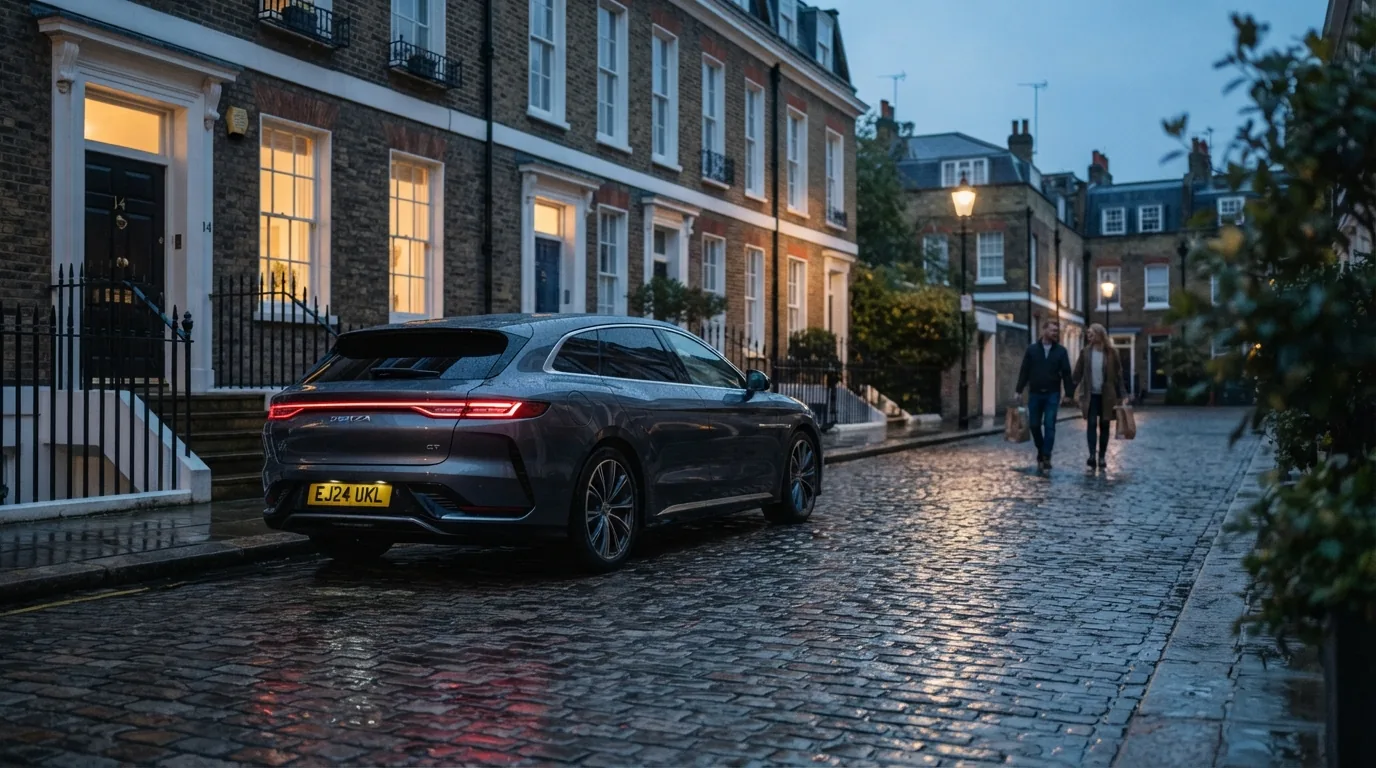
Denza Z9 GT UK prices: £95,000 plug-in hybrid, £105,000 EV
BYD's luxury brand has opened UK order books for the Z9 GT shooting brake, with first EV deliveries due this quarter, the plug-in hybrid to follow later, and Flash Charging of up to 1,500kW on both versions.
BiK Rates for Electric Cars 2026/27 to 2030/31: The Full Table
An electric company car is taxed at 4% of its list price in 2026/27, and the rate rises each April to 10% in 2030/31, still far below plug-in hybrids from 2028 and petrol cars.
Electric Car Leasing Explained: PCH, PCP, Salary Sacrifice and What a Good Deal Looks Like
Leasing an electric car means paying an initial rental and a fixed monthly fee to use a new car for a set term, then handing it back, and the only fair way to compare deals is the total cost over that term.