Euro 7 confirmed for Great Britain: EV battery durability rules from 29 November 2027
The Department for Transport has confirmed Euro 7 for new cars and vans registered in Great Britain from November 2027. For electric cars, it brings minimum battery durability standards and battery health monitors, which should make used EVs easier to judge in the 2030s. It does not change anything for cars already on the road.
Quick answers
- The Department for Transport published its response on 27 October 2026, confirming Euro 7 as the minimum emission standard for all new unlimited volume cars and vans registered in Great Britain from 29 November 2027.
- Small volume manufacturers have until 1 July 2030, and the government has dropped the proposed mandatory date of 29 November 2026 for new vehicle types.
- The DfT's consultation said Euro 7 introduces battery durability requirements for EVs and plug-in hybrids, including minimum capacity retention thresholds, and requires accurate, accessible and comparable battery health monitors.
- The 67 consultation responses welcomed the battery durability requirements, and some asked for battery durability checks at the MOT; the government has not committed to MOT battery checks.
- In the EU deal, a car battery must keep 80% of its capacity up to five years or 100,000 km and 72% up to eight years or 160,000 km; GB has not published its own figures.
- The rules apply to new registrations only, so cars already on the road and those registered before 29 November 2027 are not covered, and a battery health certificate remains the main check for used buyers.
- A statutory instrument under the Product Regulation and Metrology Act 2025 will make the change law; no date for it has been given.
Every new car and van registered in Great Britain from 29 November 2027 will have to meet the Euro 7 emission standard, the Department for Transport (DfT) confirmed on 27 October 2026. For electric cars, the important part is not the exhaust rules but the battery ones: Euro 7 brings minimum battery durability standards and battery health monitors. In practice, that means EVs registered from late 2027 should be easier to judge when they reach the used market in the 2030s. It changes nothing for the EVs on sale or on the road today.
The decision is set out in the government response to its consultation on updating the minimum emission standard for new road vehicles. Here is what has been decided, what is still open, and what it means if you plan to buy a used EV.
What has the government announced?
The DfT says it has “decided to proceed with updating the minimum emission standard for new road vehicles in Great Britain to Euro 7”. It will lay a statutory instrument under the Product Regulation and Metrology Act 2025 to apply Euro 7 to all new unlimited volume light duty registrations, which means cars and vans from mainstream manufacturers.
| What | Date | Status |
|---|---|---|
| Consultation opened | 13 April 2026 | Closed 25 May 2026, 67 responses |
| Government response published | 27 October 2026 | Statutory instrument to follow |
| New car and van types | Proposed 29 November 2026 | Dropped: no mandatory GB date |
| All new cars and vans registered (unlimited volume makers) | 29 November 2027 | Kept |
| All new cars and vans registered (small volume makers) | 1 July 2030 | Kept |
| Trucks, buses and coaches | Not set | Further consultation to follow |
The government will implement Euro 7 by accepting EU and equivalent UNECE type approvals as proof of compliance, rather than running a separate British test regime. Until the statutory instrument is in force, the response says the Vehicle Certification Agency “will not be able to accept EU Euro 7 type approvals”, so manufacturers are advised to use UN Regulation approvals in the meantime.
Of the 67 responses, 53 came from organisations and 14 from private individuals.
What does Euro 7 mean for electric cars?
Euro 7 is the first emission standard that deals directly with electric cars. The DfT’s April 2026 consultation document listed three changes that matter to EV drivers:
- Battery durability: “Battery durability requirements are introduced for EVs and PHEVs, including minimum capacity retention thresholds.” Plug-in hybrids are covered as well as pure electric cars.
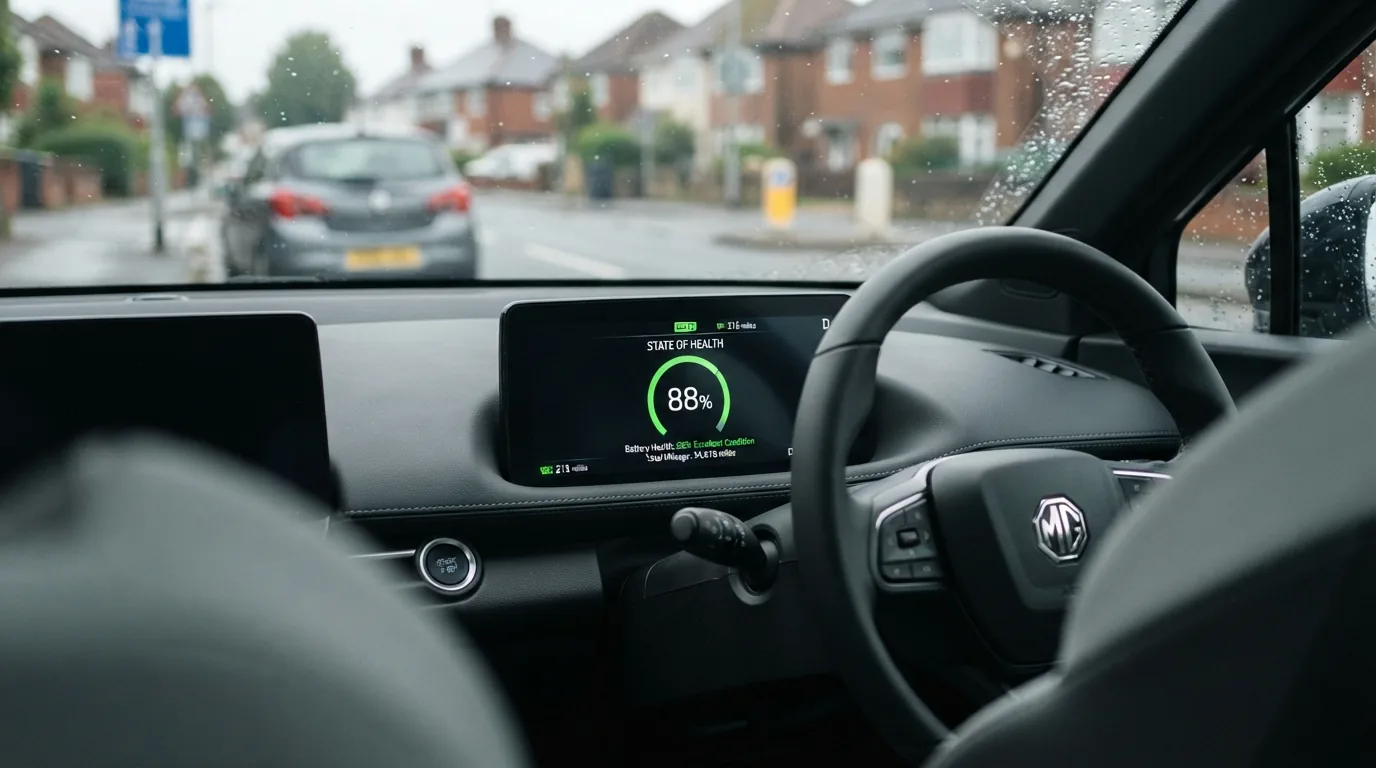
- Battery health monitors: “Euro 7 also requires vehicles to be fitted with accurate, accessible and comparable battery health monitors.”
- Brakes and tyres: Euro 7 “introduces new requirements to limit PM emissions from brake wear and tyre abrasion”. Electric cars produce no exhaust, but they do wear brakes and tyres.
The government response itself does not restate the battery measures in detail. It records that “respondents welcomed the proposed introduction of electric vehicle (EV) battery durability requirements”, and it confirms that Euro 7 is going ahead on the proposed registration dates.
EV Fleet World reports that the battery standards are aligned with the UN’s GTR 22 framework and that battery degradation data should be readable on the dashboard or through the on-board diagnostics (OBD) port. Those details come from the trade report rather than the GOV.UK pages we read.
What battery health will cars have to keep?
The GB documents do not give figures. They say only that there will be “minimum capacity retention thresholds”. Because the UK plans to accept EU approvals, the EU’s numbers are the best guide, but they are the EU’s figures and have not been published as GB law.
According to the European Parliament, the December 2023 Euro 7 deal set these minimums:
| Vehicle | Up to 5 years or 100,000 km (about 62,000 miles) | Up to 8 years or 160,000 km (about 99,000 miles) |
|---|---|---|
| Cars (electric and hybrid) | 80% | 72% |
| Vans | 75% | 67% |
The same deal set a brake particle limit of 3mg per km for pure electric vehicles, against 7mg per km for most petrol, diesel, hybrid and fuel cell vehicles.
These thresholds are a standard the car has to be approved against. They are not a warranty that a dealer or manufacturer owes you if your car falls short, and they do not replace the battery warranty that comes with the car. Our guide to EV warranties explains what those normally cover.
What would 80% and 72% mean in miles?
To put the EU figures into practical terms, here is an illustration. It is our own calculation from stated inputs, not a figure for any real car:
- Battery: 60kWh of usable capacity when new.
- Efficiency: 3.5 miles per kWh, a reasonable year-round figure for a mid-sized electric hatchback or small SUV.
- Assumption: range falls in line with capacity, which is a simplification, because the EU rules measure certified energy and real range also depends on weather and speed.
| Battery condition | Capacity | Estimated range |
|---|---|---|
| New | 60kWh | About 210 miles |
| EU minimum at 5 years or 100,000 km (80%) | 48kWh | About 168 miles |
| EU minimum at 8 years or 160,000 km (72%) | 43.2kWh | About 151 miles |
So at the eight-year floor, a car that did 210 miles when new would still manage about 150 miles on a charge. Most batteries do far better than that. Independent tests from Aviloo, which we covered in our Aviloo battery study report, found 16 of 20 popular models keeping a median 90% or more at 150,000km (about 93,000 miles). Our guide on how much battery degradation is normal has more detail. The value of Euro 7 is less about the floor and more about every car reporting its health in a comparable way.
Does this apply to EVs already on the road?
No. Euro 7 applies to new vehicles registered from 29 November 2027. According to the consultation document, cars approved to Euro 6d or Euro 6e can still be registered until 28 November 2027, or until 30 June 2030 for small volume manufacturers. Every EV on the road now, and every one registered before the cut-off, sits outside the new rules.
Some cars registered before November 2027 may already be built to Euro 7, because manufacturers selling in the EU will be approving models to it. But you cannot assume that, and there is no GB requirement for a pre-2027 car to have a standard battery health monitor.
What does it mean for buying a used EV in 2030 and beyond?
The benefit arrives slowly, because it only applies to new cars. A rough timeline for a car first registered in December 2027:
- 2029 to 2031: it starts appearing as a two to three year old used car, often from leasing and company fleets.
- December 2032: it reaches the five-year point, when the EU car threshold is 80%.
- December 2035: it reaches the eight-year point, when the EU car threshold is 72%.
For buyers in the early 2030s, the used market will be a mix. Cars registered from November 2027 should carry a battery health monitor that reads in a common way across brands. Older cars will still rely on each manufacturer’s own display, an OBD2 reader or an independent test.
Toby Poston, chief executive of the BVRLA, the leasing industry body, told EV Fleet World it means “one consistent benchmark for battery durability across manufacturers” and that buyers, dealers and leasing companies “can finally compare like with like”.
That matters because more used EVs are being financed and leased, not just bought outright. BVRLA figures quoted by Electrical Times show used EV personal contract hire up 484% and used EV salary sacrifice up 474% over the past year. Leasing companies set monthly prices on what they expect a car to be worth when it comes back, and uncertainty about the battery pushes those prices up. A common battery health reading should, over time, make used EV values more predictable for lenders, dealers and private buyers alike.
Until then, how do you check a used EV battery?
For any used EV you buy before the 2030s, nothing changes. There is still no legal requirement for a battery health certificate, for dealers or private sellers. The practical steps are:
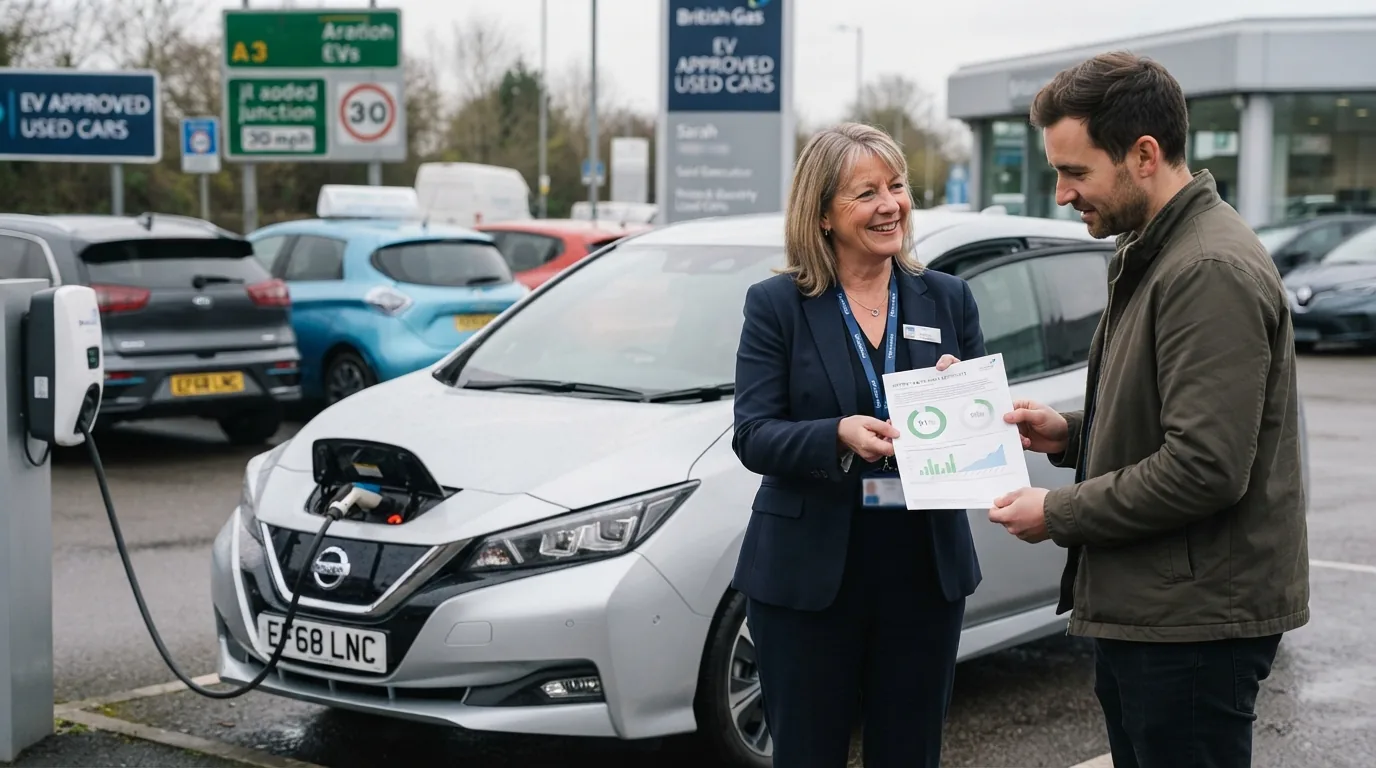
- Ask for a battery health certificate from the dealer, or pay for an independent one. Our guide to getting a battery health certificate explains who issues them and what they should include.
- Check it yourself if you can. Our guide to checking an electric car battery before buying used covers test drives and in-car displays, and our explainer on OBD2 adapters for electric cars covers the dongle and app route.
- Get it in writing. A battery health figure written into the sale paperwork is what counts if there is a dispute later, as we explain in our report on used EV battery disputes.
- Check the remaining battery warranty, including its mileage limit and the health percentage it guarantees.
Will the MOT check battery health?
Not yet. The government response notes that “a number of respondents called for further measures, including battery durability checks at the MOT and over-the-air access to battery durability data for third parties”. It does not commit to either.
Pressure for wider checks is building. In August 2026, Electrifying.com, New AutoMotive and BatteryIQ called for mandatory battery state of health certificates for all dealer-sold used EVs, according to Electrical Times. A survey of more than 13,000 UK drivers by Electrifying.com and the AA found only 3% felt confident buying a used EV, while 38% said an independent battery health certificate would increase their confidence.
What happens next?
Several things are still to come:
- The statutory instrument. The DfT will lay it to make Euro 7 law in Great Britain. No date has been given.
- Heavy vehicles. A further consultation will set dates for trucks, buses and coaches.
- Northern Ireland. The government’s aim is alignment with Northern Ireland and the EU from the date that applies to all new registrations. Respondents asked for early clarity on how on-board monitoring rules will apply to cars registered there.
- Replacement brakes. Replacement brakes fitted to Euro 7 cars will not initially have to meet the new brake wear limits, the response says.
Our view
This is a quiet but useful change for anyone who will buy a used electric car in the 2030s. A standard battery health readout on every new EV from November 2027, backed by minimum durability standards, should make used EVs far easier to compare and price. But it does nothing for the cars on sale now. If you are buying a used EV this year or next, a written battery health certificate is still the best protection you have, and it is worth insisting on one.
How we test and where our numbers come from
Range figures are official WLTP combined values taken from manufacturer UK specification pages, with real-world estimates drawn from independent comparative testing. Prices are UK list prices at the time of the latest update. Tax, grant and charging-scheme figures come from GOV.UK and HMRC publications. We re-check every guide when pricing, specification or policy changes. Last checked 30 October 2026. How we work out our own figures.
Frequently asked questions
When does Euro 7 start in the UK?
The Department for Transport says Euro 7 will apply to all new unlimited volume cars and vans registered in Great Britain from 29 November 2027, and from 1 July 2030 for small volume manufacturers. There is no mandatory date for new vehicle types. A statutory instrument still has to be laid to make it law.
Does Euro 7 apply to electric cars?
Yes. Euro 7 is not only about exhaust emissions. The DfT's consultation said it brings battery durability requirements for EVs and plug-in hybrids, battery health monitors, and limits on particle emissions from brakes and tyres, which affect electric cars as well as petrol and diesel ones.
Will my current EV have to meet Euro 7?
No. The rules apply to new vehicles registered from 29 November 2027. Cars already on the road, and cars approved to Euro 6d or Euro 6e and registered before that date, are not affected.
What battery health will Euro 7 cars have to keep?
Under the EU deal agreed in December 2023, car batteries must keep 80% of their capacity up to five years or 100,000 km and 72% up to eight years or 160,000 km. Vans have lower figures of 75% and 67%. The GB government has not published its own thresholds, but it plans to accept EU and UNECE approvals as proof of compliance.
Will the MOT check EV battery health?
Not as things stand. Some consultation respondents asked for battery durability checks at the MOT and for third parties to get over-the-air access to battery data, but the government response does not commit to either.
Sources and further reading
- gov.ukGOV.UK (Department for Transport)Primary source referenced in this article.
- gov.ukUpdating the minimum emission standard for new road vehicles: consultation documentWhat Euro 7 includes: battery durability requirements for EVs and PHEVs with minimum capacity retention thresholds, battery health monitors, brake and tyre particle limits, and the last registration dates for Euro 6d and 6e cars.
- europarl.europa.euEuro 7: Deal on new EU rules to reduce road transport emissionsThe EU battery durability figures for cars (80% and 72%) and vans (75% and 67%), and brake particle limits of 3mg/km for pure electric vehicles.
- evfleetworld.co.ukUK to mandate Euro 7 battery health rules to standardise used EV transparencyThe link to the UN GTR 22 framework, battery data on the dashboard or OBD port, and BVRLA chief executive Toby Poston's comments.
- electricaltimes.co.ukDrivers deserve to know the health of a used EV battery, say leading industry expertsThe August 2026 call by Electrifying.com, New AutoMotive and BatteryIQ for mandatory battery health certificates, and the survey of more than 13,000 drivers.

EV Compared
The EV Compared editorial team tracks the UK electric vehicle market full time: new model launches, list prices, WLTP and real-world range, public charging tariffs and the tax rules that decide what an EV actually costs to run. Every guide is checked against manufacturer specifications and official GOV.UK figures, and updated whenever the numbers move.
Related reading
View all
Aviloo battery study: EQA 94.0%, Zoe 87.3% at 93,000 miles
A 500,000-test study of 20 popular used EVs puts numbers on battery degradation. 16 of the 20 keep at least 90% at 150,000km, small-pack cars such as the Renault Zoe trail, and Aviloo now offers a UK used battery warranty.
How to Get a Battery Health Certificate for a Used EV
Battery health certificates are becoming standard in the UK used EV market. Here is what they cover, who issues them, what they cost, and whether you really need one
How Much Battery Degradation Is Normal on a Used EV?
The data on EV battery capacity loss is more reassuring than the headlines suggest. Here is what normal degradation actually looks like and when to be concerned
Used EV battery disputes: why written proof decides refunds
MotorCheck's analysis of 375,328 Financial Ombudsman decisions, reported by Honest John, found dealers won every battery case where they had written proof of disclosure and lost every one where they did not. Here is what to ask for and how to claim.
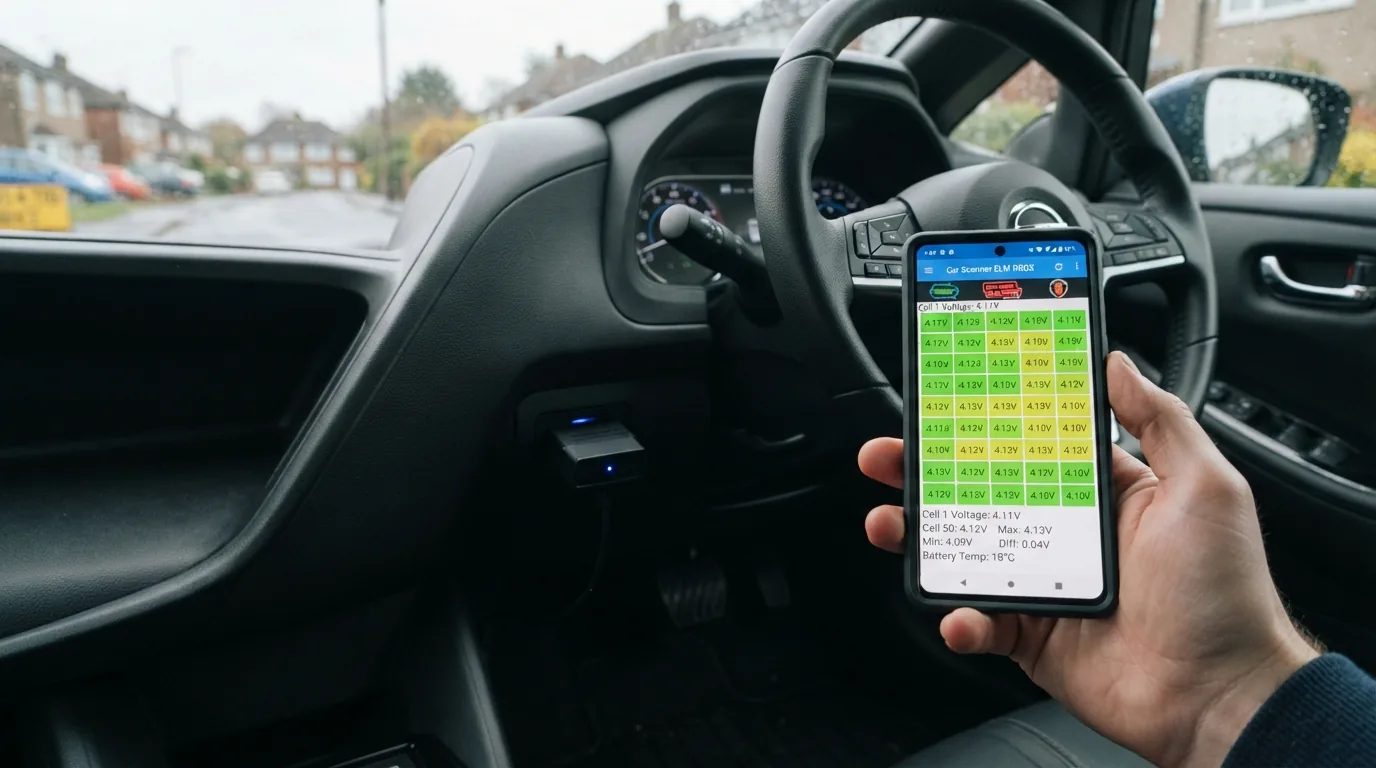
Do You Need an OBD2 Adapter for Your Electric Car?
OBD2 adapters unlock battery health data that most EV dashboards hide. Here is what they can read, the best options for UK drivers and which cars are compatible
Geotab: Rapid-Charging EVs Lose Battery Capacity Twice as Fast
Geotab's fleet data puts degradation at up to 3.0% a year for cars that rely on 100kW-plus DC chargers, against 1.5% for AC and lower-power use. The UK's largest used-EV study still finds 95% average health.