North Yorkshire replaces broken EV chargers after operator collapse, as £8m roll-out stalls
Thirty-two chargers in Bedale, Northallerton, Stokesley and Thirsk are being replaced after the firm that installed them went bust. Meanwhile the county's main £8m scheme is being re-tendered, and rural 'charging deserts' remain.
Quick answers
- North Yorkshire Council is replacing out-of-order EV chargers in the former Hambleton district under a £129,500 programme, part of a £204,611 countywide scheme.
- Thirty-two charge points were installed in Bedale, Northallerton, Stokesley and Thirsk in 2023, but the installer, EVS Energy Ltd, became insolvent and the council could not access user manuals to transfer the work.
- Faulty units will be replaced with AMP EV chargers run on a Fuuse back office, overseen by NY Highways; similar work will happen in Craven, and Ryedale and Selby chargers move to the new system.
- The Hambleton work is funded from a £175,000 York and North Yorkshire Combined Authority Gainshare grant.
- The council's separate £8m government-funded public charging roll-out has been paused and is being re-tendered after market changes since 2024.
- In Filey, all six 7kW chargers in a council car park were reported broken last year, forcing a visitor to drive 10 miles to charge.
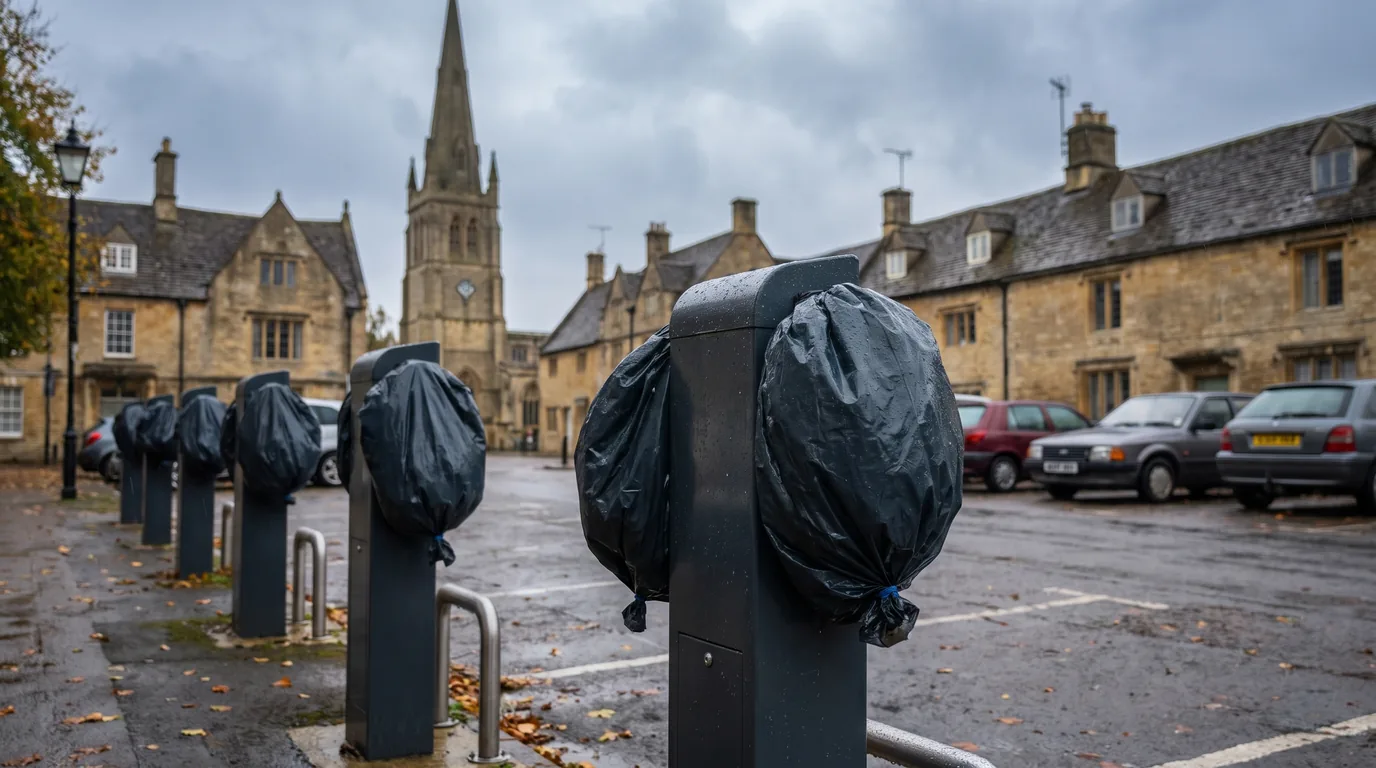
North Yorkshire Council is finally replacing broken electric car chargers left behind when the company that installed them went bust. Thirty-two charge points installed in 2023 in car parks in Bedale, Northallerton, Stokesley and Thirsk will be removed and replaced under a £129,500 programme, part of a £204,611 countywide scheme, according to the Yorkshire Post.
It is a small fix for a bigger problem. The council’s main £8m government-funded charging roll-out has been paused while it re-tenders, and councillors describe parts of England’s largest county as “charging deserts”. For drivers in rural areas, the story shows why reliable public charging matters as much as the number of chargers.
What went wrong in Hambleton?
The 32 chargers were installed under a deal struck by the former Hambleton District Council before it merged into North Yorkshire Council. Then the installer, EVS Energy Ltd, became insolvent. Without access to user manuals, the council could not transfer the work to another contractor.
The council’s report lists other failings with earlier schemes:
- Non-compliant equipment was installed in some places.
- Some equipment could not be transferred to other operators.
- Responsibility was split between multiple subcontractors for managing, operating and maintaining chargers.
“As a result of the failings of these systems, we are keen to avoid replicating those choices,” the report says.
What is the fix?
Faulty chargers in the former Hambleton area will be removed and replaced with new AMP EV chargers, managed through a Fuuse back-office system. NY Highways will oversee the work, AMP EV will supply the hardware, and Fuuse will provide back-office and customer support.
| Area | What happens |
|---|---|
| Former Hambleton (Bedale, Northallerton, Stokesley, Thirsk) | Faulty chargers replaced, £129,500 |
| Craven | Similar replacement work |
| Ryedale and Selby | Existing chargers move onto the new Fuuse system |
| Total countywide | £204,611.45 |
The Hambleton work is entirely funded from a £175,000 York and North Yorkshire Combined Authority Gainshare grant.
Fuuse is also taking on almost 1,000 former bp pulse workplace charging customers, as we report in our Fuuse and bp pulse story. Moving chargers onto a single, well-supported software platform is becoming a common way to rescue stranded equipment.
What about the £8m roll-out?
That is the bigger issue. North Yorkshire Council received more than £8m of government funding to build a network of “accessible and affordable” chargers for residents and visitors, and was due to appoint an operator in 2025. Instead, the scheme was paused, as The Northern Echo reported.
“The project has not been abandoned; it has been paused while we review the approach in the light of changes in the market since the process began in 2024,” said Karl Battersby, the council’s corporate director for environment. “The £8m funding remains in place and work is already underway to procure a new contractor.”
Not everyone is satisfied. “Our residents and businesses need action on car charging now,” said Green councillor David Noland. “We’re a huge area, mostly rural, and we have huge charging deserts. Until we’ve put in the infrastructure, we’re locking residents out of transition.” He also called for help for households in terraced houses and flats without driveways.
What does it look like on the ground?
At times, frustrating. Last year, a visitor to Filey found all six chargers in the council-run car park broken, Independent councillor Sam Cross told a full council meeting, according to York Press. Even if they had worked, they were 7kW chargers, which would have taken about 14 hours to charge his car. He drove 10 miles to a supermarket in Bridlington and charged there in two hours. “It’s just not good enough,” said Cllr Cross.
Is charging improving anywhere in Yorkshire?
Yes, especially on major routes and at private sites. Leeds Skelton Lake Services at junction 45 of the M1 added 10 more bays in mid-2026, taking it to 16 Ionity ultra-rapid chargers, according to the Yorkshire Post. Supermarkets including Morrisons have installed hundreds of chargers across their stores.
The gap is in council-run, local charging in market towns, villages and coastal resorts, which is exactly where the paused £8m scheme was meant to help.
Why does reliability matter so much?
A broken charger is worse than no charger, because drivers plan around it. In rural areas, the next working charger may be many miles away. Reliability depends on:
- Who maintains the chargers, and whether contracts survive if a supplier fails.
- Open, transferable systems, so another operator can take over.
- Live status data, so drivers know before they arrive.
Elsewhere, councils are increasingly signing long-term concessions with well-funded operators, such as Believ in Ayrshire and EZO in the Midlands, which we cover in our Ayrshire report and our EZO report. Those deals put the operator on the hook for maintenance over 15 or 20 years.
What should drivers in North Yorkshire do?
- Use a live charging map. Check status before you set off, and plan a backup on longer trips.
- Report broken chargers to the operator and the council.
- Charge at home where you can. It is far cheaper and more reliable. Our home charging cost calculator shows the savings.
- Use rapid hubs on main routes, such as motorway services and supermarkets, for longer journeys.
Why is rural charging so hard to get right?
Charging in rural areas faces problems that cities do not:
- Low usage. Fewer EVs and fewer passing drivers mean each charger earns less, so commercial operators are less interested.
- Long distances. If a charger is broken, the next one may be many miles away, as the Filey example showed.
- Grid capacity. Rural electricity networks often have less spare capacity, making high-powered chargers expensive to connect.
- Seasonal demand. Tourist areas such as the Yorkshire coast and Dales see big spikes in summer and quiet winters.
That is why public funding matters more in rural areas. The government’s Local EV Infrastructure (LEVI) funding was designed to help councils install chargers where the market alone would not, and North Yorkshire’s £8m is part of that kind of support.
What are the options for councils?
Councils broadly choose between:
- Owning chargers and paying contractors to install and run them. This gives control but exposes the council to the kind of supplier failure seen in Hambleton.
- Long-term concessions, where a private operator installs and runs chargers for 15 or 20 years, often sharing revenue with the council. Ayrshire’s deal with Believ and EZO’s contracts in the Midlands and northern Scotland follow this model, as we report in our Ayrshire story and our EZO story.
- Mixed approaches, using council land and funding to attract private investment.
North Yorkshire’s review of its £8m scheme reflects how quickly the market has changed since 2024: charger costs, energy prices and operator finances have all moved, and some operators have failed. A council choosing a partner now needs to look hard at that partner’s financial strength.
What should drivers expect next?
In the short term, drivers in Bedale, Northallerton, Stokesley and Thirsk should see faulty chargers replaced with new AMP EV units, managed through the Fuuse platform with proper customer support. In Craven, similar work is planned, and Ryedale and Selby chargers will move onto the same system.
The bigger change depends on the £8m scheme. Until a new contractor is appointed and chargers are installed, many parts of North Yorkshire will continue to rely on supermarkets, hotels, motorway services and home charging. Our guide to EV chargepoint grants for homeowners covers support for installing a charger at home, which remains by far the cheapest option.
How can you find working chargers?
Use a charging app that shows live status and user reports, check recent comments before you rely on a charger, and always plan a backup on longer rural trips. If you find a broken council charger, report it to the operator and the council; reports help prioritise repairs and show councils where reliability problems are worst.
How does North Yorkshire compare with the rest of the UK?
The UK passed about 120,000 public chargers in 2026, according to ChargeUK, but they are unevenly spread. MPs on the Public Accounts Committee warned earlier that too few had been installed outside London and the South East, which then hosted 43% of all charge points. Large rural counties like North Yorkshire, England’s biggest by area, are where the gap is most obvious.
The council’s own report says lessons have been learned. Choosing one proven supplier for hardware, and a single back office for all its chargers, should make future repairs and handovers far simpler.
Our view
North Yorkshire’s experience is a warning about cheap, fragmented charging contracts: when the installer went bust, drivers were left with broken chargers for years. The replacement programme is the right fix, and moving to a single supported platform should help. But the real test is the £8m roll-out. A huge, rural county needs reliable local charging most of all, and every month of delay keeps residents in charging deserts.
How we test and where our numbers come from
Range figures are official WLTP combined values taken from manufacturer UK specification pages, with real-world estimates drawn from independent comparative testing. Prices are UK list prices at the time of the latest update. Tax, grant and charging-scheme figures come from GOV.UK and HMRC publications. We re-check every guide when pricing, specification or policy changes. Last checked 24 October 2026. How we work out our own figures.
Frequently asked questions
Why are North Yorkshire's EV chargers being replaced?
Thirty-two chargers installed in 2023 in Bedale, Northallerton, Stokesley and Thirsk stopped working properly after the installer, EVS Energy Ltd, became insolvent. The council could not access manuals to hand the work to another contractor, and some equipment was non-compliant.
Who will run the new North Yorkshire chargers?
NY Highways will oversee the work, AMP EV will supply the chargers and Fuuse will provide the back-office system and customer support. Chargers in Ryedale and Selby will also move onto the new system.
What happened to North Yorkshire's £8m EV charger plan?
The council says the roll-out has been paused, not abandoned, while it reviews its approach in light of market changes since the process began in 2024. The £8m of government funding remains, and a new contractor is being procured.
Where can I find reliable rapid chargers in Yorkshire?
Motorway services and private hubs are expanding. Leeds Skelton Lake Services at junction 45 of the M1 now has 16 Ionity ultra-rapid chargers, and supermarkets such as Morrisons have added chargers at many stores.
What should I do if a council charger is broken?
Report it through the app or phone number on the charger and to the council. Use a charging map app with live status to check before you travel, and plan a backup charger on longer trips.
Sources and further reading
- yorkshirepost.co.ukYorkshire PostPrimary source referenced in this article.
- thenorthernecho.co.ukNorth Yorkshire EV charger roll-out 'paused' not 'abandoned'The £8m scheme's pause, Karl Battersby's and Cllr David Noland's comments.
- yorkpress.co.ukElectric vehicle charger problems on North Yorkshire's coastThe broken chargers in Filey and councillor comments.
- yorkshirepost.co.ukMore super-fast EV chargers installed at Leeds Skelton Lake ServicesSixteen Ionity ultra-rapid chargers at Skelton Lake Services.

EV Compared
The EV Compared editorial team tracks the UK electric vehicle market full time: new model launches, list prices, WLTP and real-world range, public charging tariffs and the tax rules that decide what an EV actually costs to run. Every guide is checked against manufacturer specifications and official GOV.UK figures, and updated whenever the numbers move.
Related reading
View all
Fuuse and Drax take on 1,000 ex-bp pulse fleet customers and 14,000 sockets
After bp pulse quit workplace charging in 2025, its depot customers were left looking for support. Now Fuuse will run the software and Drax the maintenance, with existing hardware warranties honoured.
Ayrshire to get 600 new EV chargers in a 15-year deal with Believ
Three councils have signed a 15-year deal backed by £2.8m of Scottish Government funding and more than £15m from Believ. It covers towns, rural areas and the Isle of Arran, and Believ will also take over existing ChargePlace Scotland chargers.
What Is the EV Chargepoint Grant for Homeowners?
Who can still claim the £500 home chargepoint grant in 2026, and who is no longer eligible
How to Calculate Home EV Charging Costs on UK Tariffs
See exactly what you will pay to charge at home, and which tariff saves you the most money
Half of UK councils still offer no on-street EV charging, FOI finds
More than 90% of councils now have public chargers, yet half offer nothing on-street. New LEVI deals in Hampshire, Peterborough and West Sussex show where help is arriving first.
Connected Kerb opens Aberdeen factory to build 25,000 on-street chargers by 2030
The on-street charging firm is moving manufacturing to Scotland after buying Trojan Energy and its flush kerbside chargers. For drivers without a driveway, it signals more residential chargers on the way.