EZO raises €150m to build 3,000 chargers under council contracts
The Irish operator's investment-grade loan is backed by future charging revenue and ring-fenced to repay the debt. It funds long-term council concessions in northern Scotland and four Midlands counties.
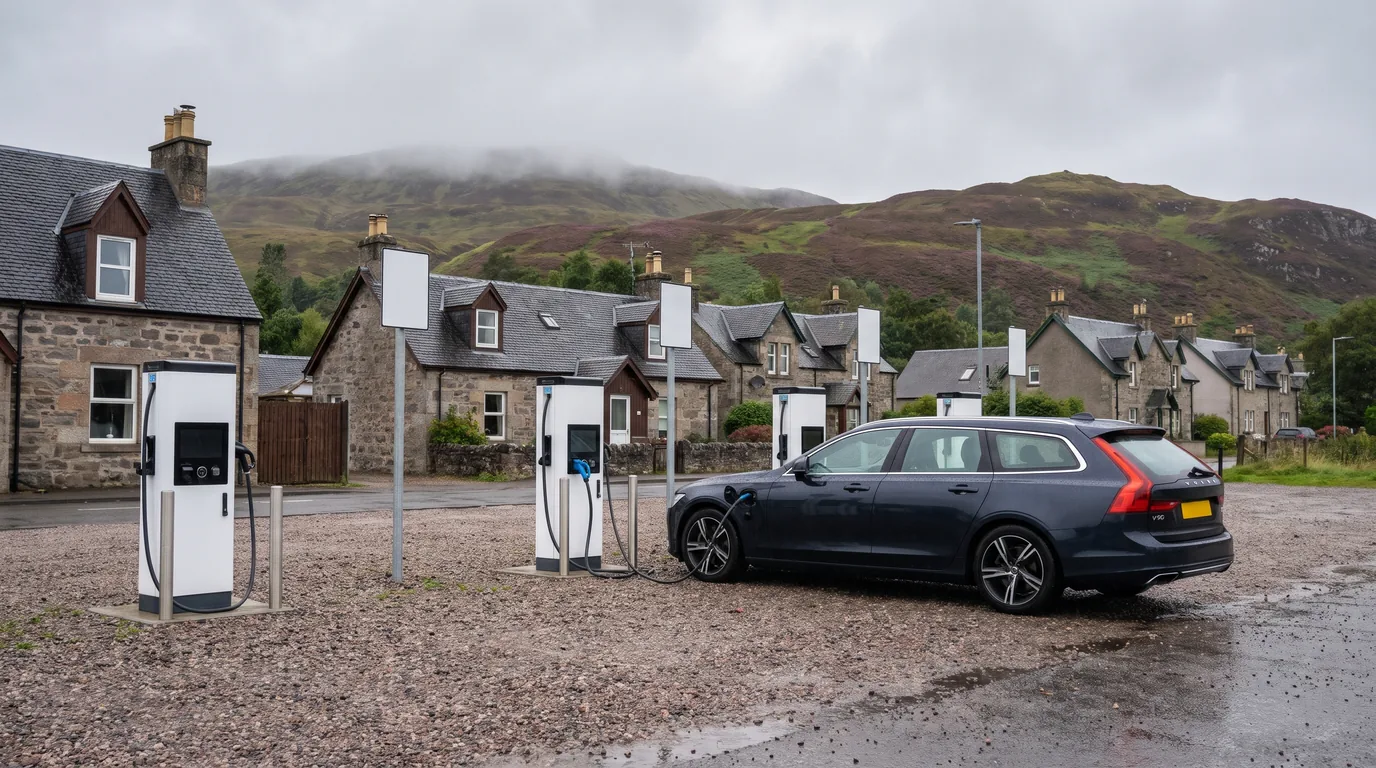
Quick answers
- Ireland-based EZO has reached financial close on a €150m investment-grade senior debt facility to fund more than 3,000 charge points across the UK and Ireland.
- The chargers add more than 100,000kW of capacity and are expected to generate well over £1bn of electricity sales over 20 years.
- Lenders include Aberdeen Investments and Standard Life; revenue from the chargers is ring-fenced to repay the debt over seven years.
- EZO's UK contracts include a 20-year concession across four counties in northern Scotland and a 15-year, £176m deal for Leicestershire, Rutland, Warwickshire and Worcestershire.
- The Midlands deal covers 250 new chargers, focused on rapid and ultra-rapid charging in areas reliant on on-street parking.
- EZO says the UK will be its main market by 2027, and its UK contracts are worth more than £1bn in total.
Irish charging company EZO has raised €150m to build more than 3,000 public charge points across the UK and Ireland, most of them under long-term contracts with councils. The investment-grade debt facility, announced on 14 October 2026 and reported by AFP, comes from lenders including Aberdeen Investments and Standard Life. EZO says the chargers will add more than 100,000kW of capacity and generate well over £1bn of electricity sales over 20 years.
For drivers in northern Scotland and the English Midlands, where EZO holds big council contracts, it means new chargers are funded and on the way. For the wider market, it shows a new way of paying for public charging that could speed up the roll-out in places commercial operators have tended to skip.
What has EZO announced?
EZO has closed a €150m senior debt facility to fund the design, installation, operation and maintenance of more than 3,000 charge points. The key points:
| Detail | Figure |
|---|---|
| Debt facility | €150m, investment grade |
| Charge points funded | More than 3,000 |
| Capacity | More than 100,000kW |
| Expected electricity sales | Well over £1bn over 20 years |
| Repayment | From ring-fenced charger revenue over seven years |
| Lenders | A consortium including Aberdeen Investments and Standard Life |
EZO’s backers believe it is the first financing of its kind in EV charging, where the money is used to install chargers and the revenue from those chargers is ring-fenced to repay the debt. “It is expected to become the preferred method of financing this collateral going forward,” said Conor Kelly, chief executive of Rubicon, EZO’s majority owner.
Where will the chargers go?
EZO’s UK work is built on long-term contracts with councils. Its announced UK contracts are worth more than £1bn in total and include:
- Northern Scotland: a 20-year concession across four counties, reported earlier as a £300m contract.
- The English Midlands: a 15-year, £176m deal covering Leicestershire, Rutland, Warwickshire and Worcestershire, awarded by the Fourth Midlands EV Infrastructure Consortium with Midlands Connect. It will install 250 new chargers, focused on rapid and ultra-rapid charging and on areas where people rely on on-street parking, according to Fleet News.
EZO says further long-term public sector contracts will be announced in the coming months and that it is pursuing more work across Scotland, England and Wales. It already operates more than 5,600 charge points across Ireland and the UK, according to The Herald.
How do the council concessions work?
The contracts are concessions, similar to public-private partnerships. EZO builds and runs the chargers for a long period, and in return gets:
- Good locations chosen with the council.
- Flexible pricing, within the contract.
- Exclusivity over certain regions.
- Help with permits and grid connections, often the slowest part of building chargers.
- Public funding, in some concessions, which is expected to be paid back to the public sector over time through revenue sharing.
At the end of the concession, ownership of the chargers transfers back to the public authority. Councils get chargers without paying the full capital cost upfront; EZO gets a long, predictable stream of income.
“EZO’s clear ambition is to make reliable public EV charging more accessible for drivers and communities,” said chief executive Ollie Chatten. “Our focus is on working with strong public and private sector partners to build charging networks at scale across Ireland and the UK.”
Why does this financing model matter?
Because charging is expensive to build and slow to pay back. Many operators are still not profitable and rely on investors betting on future EV numbers. That makes them sensitive to policy changes such as the review of the ZEV mandate. A ChargeUK survey found weakening the mandate could cut operators’ investment by about half, as we covered in our ZEV mandate cost analysis.
Long council contracts with guaranteed sites and exclusivity reduce that risk. That lets lenders offer cheaper, investment-grade debt rather than relying only on expensive equity. If the model spreads, more chargers could reach rural and suburban areas that purely commercial networks have struggled to justify.
There are trade-offs. Exclusivity means less competition between networks in a given area, so pricing depends on what the council negotiated. Drivers should expect prices in line with other public chargers rather than cut-price deals.
What does it mean for drivers?
If you live in one of EZO’s contract areas, you should see new public chargers over the next few years, including rapid ones in towns where on-street parking is common. That matters most in rural areas such as the north of Scotland, where long distances and sparse charging have been a real barrier.
Public charging still costs more than charging at home, partly because of the 20% VAT on public charging. Our guide to the public charging VAT gap explains why, and our Scotland EV charging grants guide covers support available north of the border.
Is UK charging investment growing?
The picture is mixed. The number of public chargers has grown fast, with about 120,000 by mid-2026 according to ChargeUK. New factories, such as Connected Kerb’s in Aberdeen, which we cover in our Connected Kerb report, show confidence. But charging firms are warning that policy uncertainty could slow the next wave.
EZO itself is betting heavily on the UK. It says Britain will be its main market by 2027, and Rubicon is exploring further fundraising, including a possible stock market listing in 2028.
Who owns EZO?
EZO is majority owned by Rubicon Capital Management and its affiliated entities, including Rubicon Capital Advisors, an Irish regulated investment banking firm. Rubicon first invested in 2020 with a 35% stake, which has now risen to over 60%, including shares bought alongside the debt financing. A Spanish family office, Whitehole, which specialises in electrification technology, has also joined the shareholder group. Rubicon acted as EZO’s financial adviser on both the equity and debt raises and is exploring other options, including a possible stock market listing in 2028.
How do public-private charging partnerships work?
EZO’s council contracts include several features that make them more like public-private partnerships than simple supply contracts:
- Long terms. Fifteen or twenty years give the operator time to recover its investment.
- Revenue sharing. A share of charging income goes back to the public sector.
- Subvention funding. In some concessions, public money helps pay for the roll-out and is expected to be returned over time through revenue sharing.
- Practical help. Councils help with sites, permits and grid access.
- Asset transfer. Chargers pass to the public authority at the end of the contract.
The idea is to combine private sector delivery and capital with public funding and land, sharing the risks. Rubicon’s chief executive, Conor Kelly, described it as “a true partnership between the public and private sectors”.
What are the risks?
Every model has trade-offs. For drivers, the main ones are:
- Less competition. Exclusivity over certain areas means one operator may dominate public charging in a district, so pricing depends on the contract terms rather than competition.
- Delivery risk. Large roll-outs depend on grid connections, which are often slow.
- Operator risk. If an operator struggles, councils can be left with problems, as North Yorkshire found when its installer went bust, which we cover in our North Yorkshire report.
Well-capitalised operators with ring-fenced financing reduce some of those risks. EZO’s backers argue that its structure, with revenue dedicated to repaying the debt, makes it more resilient.
How many public chargers does the UK have?
The Department for Transport found there were 116,052 publicly available chargers at the start of 2026, almost double the number of fuel pumps, according to Fleet News. ChargeUK said the network passed 120,000 later in the year, with more than 1,000 large charging hubs. MPs have said the UK is on track for the 300,000 chargers needed by 2030, but that too many are concentrated in London and the South East.
Contracts like EZO’s in northern Scotland and the Midlands, and Believ’s in Ayrshire, are aimed at spreading chargers more evenly, particularly in towns and rural areas where many people park on the street. Our Ayrshire report covers a similar deal.
What will the chargers cost to use?
EZO has not published prices for its new UK sites, and concession contracts allow “flexible price setting”. Expect public charging prices broadly in line with other networks, which are higher than home charging because of 20% VAT, energy costs and the cost of building chargers. Rapid charging usually costs much more than slower on-street charging.
Our view
EZO’s deal is less eye-catching than a new car launch, but it may matter more to drivers in places like the Highlands and the Midlands shires. Long-term council concessions, backed by investment-grade debt, are a practical way to build chargers where the market alone would not. The test will be whether EZO delivers on time and keeps its chargers reliable, which is what drivers judge any network on.
How we test and where our numbers come from
Range figures are official WLTP combined values taken from manufacturer UK specification pages, with real-world estimates drawn from independent comparative testing. Prices are UK list prices at the time of the latest update. Tax, grant and charging-scheme figures come from GOV.UK and HMRC publications. We re-check every guide when pricing, specification or policy changes. Last checked 24 October 2026. How we work out our own figures.
Frequently asked questions
What is EZO?
EZO is an Ireland-headquartered EV charging company that builds and runs public charging networks under long-term contracts with local authorities. It operates more than 5,600 charge points across Ireland and the UK and expects the UK to be its main market by 2027.
Where is EZO installing chargers in the UK?
EZO's announced UK contracts include a 20-year concession covering four counties in northern Scotland and a 15-year contract for Leicestershire, Rutland, Warwickshire and Worcestershire in the Midlands. It says more contracts will be announced in the coming months.
How is EZO's charger rollout being paid for?
Through a €150m senior debt facility from lenders including Aberdeen Investments and Standard Life, plus public funding in some concessions. Revenue from the chargers is ring-fenced to repay the loan over seven years, and part of the income is shared with councils.
Who owns the chargers at the end of the contract?
Under the concessions, ownership of the chargers transfers back to the public authorities when the contract ends, according to reports of the deal. In the meantime, EZO runs them and shares part of the revenue with the public sector.
Will EZO chargers be rapid chargers?
The Midlands contract focuses on rapid and ultra-rapid chargers, especially in areas where people rely on on-street parking. Across the full programme, EZO says the chargers add more than 100,000kW of capacity.
Sources and further reading
- afp.comAFPPrimary source referenced in this article.
- heraldscotland.comMore than 3,000 new EV charge points planned across UKThe northern Scotland concession, transfer of ownership to public authorities and EZO's 5,600 charge points.
- fleetnews.co.ukEV charging supplier named for Midlands councilsThe 15-year, £176m Midlands contract, 250 chargers, its focus and the earlier £300m Scottish contract.

EV Compared
The EV Compared editorial team tracks the UK electric vehicle market full time: new model launches, list prices, WLTP and real-world range, public charging tariffs and the tax rules that decide what an EV actually costs to run. Every guide is checked against manufacturer specifications and official GOV.UK figures, and updated whenever the numbers move.
Related reading
View all
A weaker ZEV mandate could cost the Treasury up to £16.7bn, industry warns
As ministers lean towards a 60% target for 2030, charging firms, energy groups and campaigners have put numbers on what a softer mandate would cost in lost tax, slower charger roll-out and air pollution.
Ayrshire to get 600 new EV chargers in a 15-year deal with Believ
Three councils have signed a 15-year deal backed by £2.8m of Scottish Government funding and more than £15m from Believ. It covers towns, rural areas and the Isle of Arran, and Believ will also take over existing ChargePlace Scotland chargers.
Connected Kerb opens Aberdeen factory to build 25,000 on-street chargers by 2030
The on-street charging firm is moving manufacturing to Scotland after buying Trojan Energy and its flush kerbside chargers. For drivers without a driveway, it signals more residential chargers on the way.
Public EV charging keeps 20% VAT as home electricity goes to 0%
Drivers without a driveway now pay 20% VAT at the plug while home charging pays none. Here is what a Budget cut to 5% or 10% would save, and why the Treasury has so far said no.
Scotland EV charging grants 2026-27: £17.8m, what you can claim
Scotland funds its own EV charging grants on top of UK schemes: rural and island chargers, cross-pavement home charging, flats and microbusinesses. Here is who qualifies and how much each pays.
Half of UK councils still offer no on-street EV charging, FOI finds
More than 90% of councils now have public chargers, yet half offer nothing on-street. New LEVI deals in Hampshire, Peterborough and West Sussex show where help is arriving first.