What Happens If an Electric Car Runs Out of Battery?
An electric car warns you repeatedly, then limits its power, then stops, and it has to be given a roadside boost or carried on a flatbed to a charger.
Quick answers
- If an electric car runs out of battery it gives several warnings, then cuts motor power so speed will not rise, and finally stops once the battery is empty.
- Running out of charge is rare: the AA said 1.4% of its electric car call-outs in June 2024 were for flat batteries, down from 8% in 2015.
- The RAC says its EV Boost vans can give a stranded electric car a 10 mile boost, enough to reach the nearest charge point.
- Kia UK says an electric car should go on a flatbed rather than be towed on its wheels, and the RAC says its vans lift all four wheels of an electric car off the road.
- You cannot push start an electric car: Kia's owner's manual says not to push or pull the car to start it.
- On a Range Rover Electric with 372 miles of WLTP range, the last 10% of the battery is about 37 miles, and ten minutes on a rapid charger adds about 118 miles, by EV Compared's figures.
If an electric car runs out of battery, it does not cut out without warning: it alerts you several times, then limits its power so it cannot speed up, and finally stops. From there it needs a small charge at the roadside or a flatbed to a charger, because an electric car should not be towed on its wheels and cannot be push started.
It happens less often than people fear. The AA said that in June 2024 only 1.4% of its electric car call-outs were for flat batteries, down from 8% in 2015, and in most of those cases the car still had a little charge left when the patrol arrived. This guide covers what the car does as the battery runs low, what to do when it stops, whether you can push or tow it, and a worked UK example that turns the last few per cent of a battery into miles.
What happens when an electric car runs out of battery while driving?
The car gives you a staged run of warnings and power cuts before it stops, so you have time to reach a charger or a safe place. Nissan’s owner’s manual for the Leaf sets out the sequence clearly, and it is a useful guide to what most electric cars do.
| Stage | What you see | What the car does |
|---|---|---|
| Low battery | Low battery light, master warning, “Charge now” message, range figure flashing | Drives normally; the navigation suggests nearby chargers |
| Very low | Range display changes to dashes | Drives normally, but no longer shows a range |
| Power limitation | Power limitation light and a “Power reduced” warning | Motor output is cut and speed will not increase |
| Empty | No response to the accelerator | Stops; it will not drive again until it is recharged |
Once the power limitation light is on, the car will not speed up even if you press the accelerator. That is the point to leave a motorway or a fast A-road, not to press on for one more junction. Nissan’s instruction is to stop somewhere safe before the battery is completely empty.
The power fades in steps, and the car tells you at each one. Use the warning stages to choose where you stop: a lay-by, a car park or a side road is far better than wherever the car happens to give up.
What should you do if your electric car runs out of charge?
Pull over somewhere safe, put the hazard lights on and call your breakdown provider. Kia UK gives the same steps: pull over as soon as you can, turn on the hazards, switch the car off and call roadside assistance.
On a motorway, the Highway Code says the safest place to stop is a service area, with lay-bys, emergency areas and hard shoulders as other places of relative safety, though hard shoulders give less protection (rule 275). Running out of charge is a breakdown, so it counts as the kind of emergency for which the hard shoulder may be used (rule 269). Once stopped, use the free emergency telephone or call 999 (rule 277).
If you still have a few miles showing, you have two better choices. One is to drive gently to the nearest charger. The other is to stop somewhere safe before the car does it for you. The AA’s figures suggest many drivers already do this, since most of its “out of charge” call-outs reach cars that are nearly, not completely, empty.
The nearest public charger will usually fit your car. Our guide to whether you can charge any EV at any public charger explains the connectors and the exceptions.
Can a breakdown service charge an electric car at the roadside?
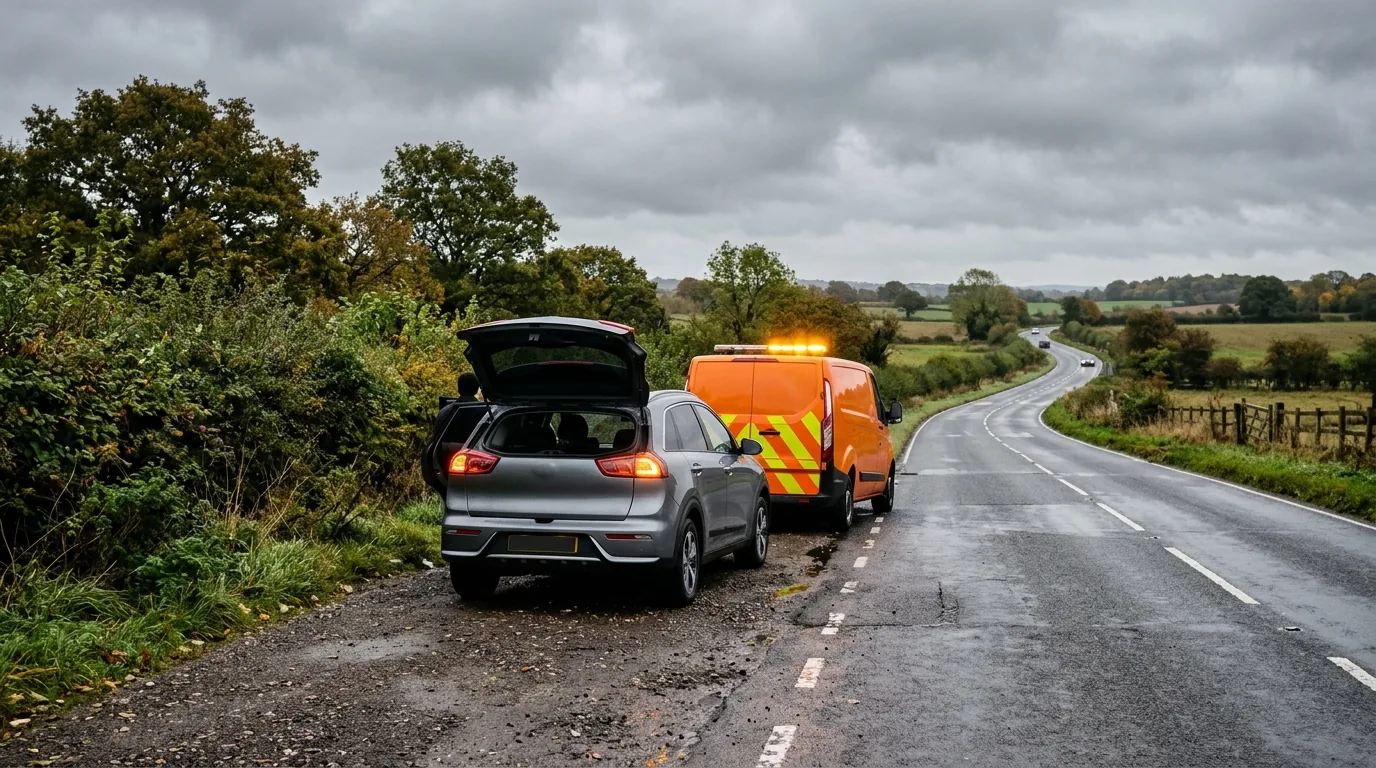
Yes, some can, but only enough to reach a charger. The RAC says its EV Boost vans can give a stranded electric car a 10 mile boost to get it to the nearest charge point. The RAC announced the system in 2019: a generator on the van’s engine feeds the car through an inverter, using the Type 1 and Type 2 connectors that the RAC said then covered 99% of electric cars on UK roads.
Ten miles is a rescue, not a refill. If the nearest working charger is further away, or the car cannot be charged where it stands, it goes on a flatbed to a charger. What you get depends on your provider and policy, so read the wording before you need it, especially if you drive long distances in rural areas.
Most of the AA’s work with electric cars has nothing to do with range. It said in July 2024 that the commonest reasons for electric car call-outs were tyres, wheels and the 12 volt battery, as they are for petrol and diesel cars. Our report on the AA’s flat battery figures looks at the trend in more detail.
Can you push an electric car?
You can push an electric car a few metres to safety only if the car lets you select neutral and release the electronic parking brake, and you cannot push start one. If neutral will not engage, the parking brake stays on and the car will not roll, so do not try to force it.
Push starting is not possible. Kia’s owner’s manual for its electric cars says plainly not to push or pull the vehicle to start it, because it could damage the car or injure you. The AA says cars with automatic transmissions cannot be push started, and that pushing a car anywhere near moving traffic or pedestrians puts everyone at risk.
So if your electric car stops in a live lane, get everyone to a safe place first and leave the car to the recovery service. Pushing it only makes sense on a quiet road, at walking pace, to clear a junction or a driveway.
Can you tow an electric car with a rope?
No. An electric car should be moved on a flatbed or with all four wheels lifted off the road. Kia UK explains why: a petrol or diesel car is towed in neutral, but an electric car has no neutral gear in that sense, and towing it in drive or reverse builds up energy that damages the battery.
That is why breakdown services carry electric cars rather than drag them. The RAC says its vans can lift all four wheels of an electric car off the ground, so it can be recovered without waiting for a separate lorry. If a friend offers a tow rope, say no.
Towing is a different question when the electric car is doing the pulling. Many can tow a caravan or trailer, and our guide on towing with an electric car covers the limits and what towing does to range.
How far can you go on the last few per cent? A worked UK example
The last 10% of a big battery is worth a useful number of miles. Take the Range Rover Electric, which JLR prices from £154,070 for the EV550 Autobiography SWB in November 2026, with a 118.5 kWh usable battery and 372 miles of WLTP range.
EV Compared’s method divides WLTP miles by usable battery capacity for efficiency, prices public rapid charging at 82p/kWh from Zapmap’s October 2026 price index and home charging at 6.5p/kWh, and ignores charging losses (see our methodology). On those inputs:
- Efficiency is 3.14 miles per kWh, so the last 10% of the battery is about 37 miles of WLTP range.
- A 10 mile roadside boost from the RAC is about 3 kWh, under 3% of this battery.
- Ten minutes on a rapid charger adds about 118 miles, because JLR quotes 10 to 80% in about 22 minutes on a 350 kW charger.
- Rapid charging costs about 26.1p a mile, so those 118 miles cost around £30.80. A full battery costs £97.17 at a rapid charger, against £7.70 on an off-peak home tariff.
The lesson is that ten minutes at a rapid charger is worth more than ten times any roadside boost, so stopping early to charge beats running the battery down. WLTP figures are test results, and real range falls at motorway speeds and in cold weather; our guide on how far an electric car really goes on one charge puts numbers on the gap.
Does running out of charge damage the battery?
Makers design their warnings to stop you running the battery to empty, so treat zero as something to avoid and recharge as soon as you can. Nissan tells Leaf drivers to stop somewhere safe before the battery is completely discharged, and, if the power reduced warning appears because the battery is extremely low, to stop in a safe location and contact a Nissan certified electric vehicle dealer. Long-term ageing is a separate question, covered in our explainer on what happens to an EV battery at the end of its life.
If you are buying second-hand, how a car has been charged and stored matters more than one flat battery on the hard shoulder. Our used EV buying checklist covers the battery health report to ask for.
How do you avoid running out of charge?
Charge before you need to, plan longer trips around chargers, and treat the low battery warning as an instruction. A driver who charges at home and starts most days with a well charged battery will rarely see the warnings at all. If you are new to it, our guide on how to charge an electric car covers home, workplace and public charging, and Best Chargers compares home wallboxes.
On a long journey, plan to arrive at a rapid charger with 10 to 20% left rather than 2%, so a broken or busy charger is an inconvenience rather than a breakdown. In winter, allow for a slower charge as well as a shorter range: our explainer on why EVs charge more slowly in the cold explains what is going on.
What it means for choosing an electric car
Running out of charge should not decide whether you buy an electric car, but range should decide which one. Kia UK quotes an SMMT average UK range of 236 miles; a car whose range comfortably covers your longest regular journey, plus a home charger, will rarely get near empty.
If you mostly drive locally and charge at home, a smaller battery suits you and the risk of running out is low. If you regularly cover long motorway journeys or cannot charge at home, choose a car with a longer range and fast DC charging, so a ten minute stop adds a useful number of miles. Whatever you buy, check that your breakdown cover includes roadside charging or flatbed recovery for electric cars.
Our verdict, based on published manufacturer and breakdown service information rather than our own testing: running out of charge is rare, gradual and recoverable. The car gives you plenty of warning, the realistic outcome is a short boost or a flatbed to the nearest charger, and the habit that prevents it is simple, charging well before the warning lights come on.
How we test and where our numbers come from
Range figures are official WLTP combined values taken from manufacturer UK specification pages, with real-world estimates drawn from independent comparative testing. Prices are UK list prices at the time of the latest update. Tax, grant and charging-scheme figures come from GOV.UK and HMRC publications. We re-check every guide when pricing, specification or policy changes. Last checked 10 November 2026. How we work out our own figures.
Frequently asked questions
What happens when an electric car runs out of battery while driving?
The car slows to a stop in stages rather than cutting out at once. Nissan's Leaf manual describes a low battery warning first, then a power limitation light that reduces motor output so speed will not increase. Once the battery is empty the car will not drive, so steer somewhere safe while you still can.
Can you push an electric car?
You can push an electric car a short distance on a quiet road only if the car lets you select neutral and release the electronic parking brake. You cannot push start one: Kia's owner's manual says not to push or pull the car to start it, and the AA says automatics cannot be push started.
Can an electric car be towed if it runs out of charge?
Yes, but on a flatbed or with all four wheels lifted, not on a rope. Kia UK says towing an electric car in drive or reverse damages the battery, and the RAC says its vans lift all four wheels of an electric car off the ground.
Will the AA or RAC charge my electric car at the roadside?
The RAC says its EV Boost vans can give a 10 mile boost to reach the nearest charge point. Where a roadside charge is not possible, the car goes on a flatbed to a charger. What you get depends on your provider and your policy, so check it before you need it.
How often do electric cars run out of charge?
Rarely. The AA said 1.4% of its electric car call-outs in June 2024 were for running out of charge, against about 1% of petrol and diesel call-outs for running out of fuel. Out of up to 8,000 breakdowns a day, the AA handles five or six flat EVs.
Can I stop on the hard shoulder if my electric car runs out of charge?
Yes, a breakdown is an emergency, and the Highway Code allows the hard shoulder only in an emergency. It says the safest place to stop on a motorway is a service area, with lay-bys, emergency areas and hard shoulders as other places of relative safety. Use the emergency telephone or call 999.
Sources and further reading
- autoexpress.co.ukEVs with flat batteries now almost as rare as ICE cars running out of petrol or dieselAA figures, 18 July 2024: 1.4% of EV call-outs in June 2024 were out of charge, against 1.6% in 2023, 2.8% in 2021, 4.6% in 2019 and 8% in 2015; about 1% of petrol and diesel call-outs are out of fuel; up to 8,000 breakdowns a day with five or six flat EVs; most cars still have a little charge when the patrol arrives; tyres, wheels and the 12 volt battery are the commonest causes.
- rac.co.ukElectric car breakdown coverRAC EV Boost vans give a 10 mile boost to the nearest charge point, and its vans lift all four wheels of an electric car off the ground.
- mynewsdesk.comRAC develops UK's first lightweight charger to deliver a journey-saving boost to electric vehiclesRAC press release, 30 April 2019: EV Boost runs from a generator on the patrol van's engine through an inverter and works with Type 1 and Type 2 connectors, which the RAC said covered 99% of EVs on UK roads.
- kia.comWhat happens if my electric car runs out of charge?Kia UK: an EV will not operate once the battery is empty; pull over, hazards on, switch off, call roadside assistance; EVs have no neutral gear and towing in drive or reverse damages the battery, so they go on a flatbed; SMMT average UK EV range of 236 miles.
- nissan.com.mtNissan Leaf owner's manual: driving with a discharged Li-ion batteryLow battery warning, master warning and 'Charge now' message, flashing range, navigation suggests chargers, range display turning to dashes, then power limitation that reduces motor output and speed; stop somewhere safe before the battery is completely discharged.
- nissan.com.cyNissan Leaf 2025 owner's manual: battery charge is low, power reduced, charge nowWhen battery capacity is extremely low, speed will not increase because of the power limitation; stop in a safe location and contact a Nissan electric vehicle dealer.
- kia.comKia Electric Vehicle Guide: owner's manualDo not push or pull the vehicle to start it, as this could damage the vehicle or injure you; the car starts only with the shifter in P.
- theaa.comPush or bump starting your carCars with automatic transmissions cannot be push started; cars with stop/start, keyless start or electronic parking brakes are unlikely to suit it; pushing near traffic or pedestrians puts everyone at risk.
- gov.ukThe Highway Code: breakdowns and incidents (274 to 287)Rule 275: stop in a place of relative safety; on motorways a service area is safest, with lay-bys, emergency areas and hard shoulders as other places, and hard shoulders give less protection. Rule 277: use the free emergency telephone or call 999.
- gov.ukThe Highway Code: motorways (253 to 273)Rule 269: you must not use a hard shoulder except in an emergency.
- jlr.comRange Rover Electric: a new era for the original luxury SUVJLR, 2 September 2026: Range Rover Electric from £154,070, 118.5 kWh usable battery, up to 372 miles WLTP, 10 to 80% in about 22 minutes on a 350 kW charger.

EV Compared
The EV Compared editorial team tracks the UK electric vehicle market full time: new model launches, list prices, WLTP and real-world range, public charging tariffs and the tax rules that decide what an EV actually costs to run. Every guide is checked against manufacturer specifications and official GOV.UK figures, and updated whenever the numbers move.
Related reading
View all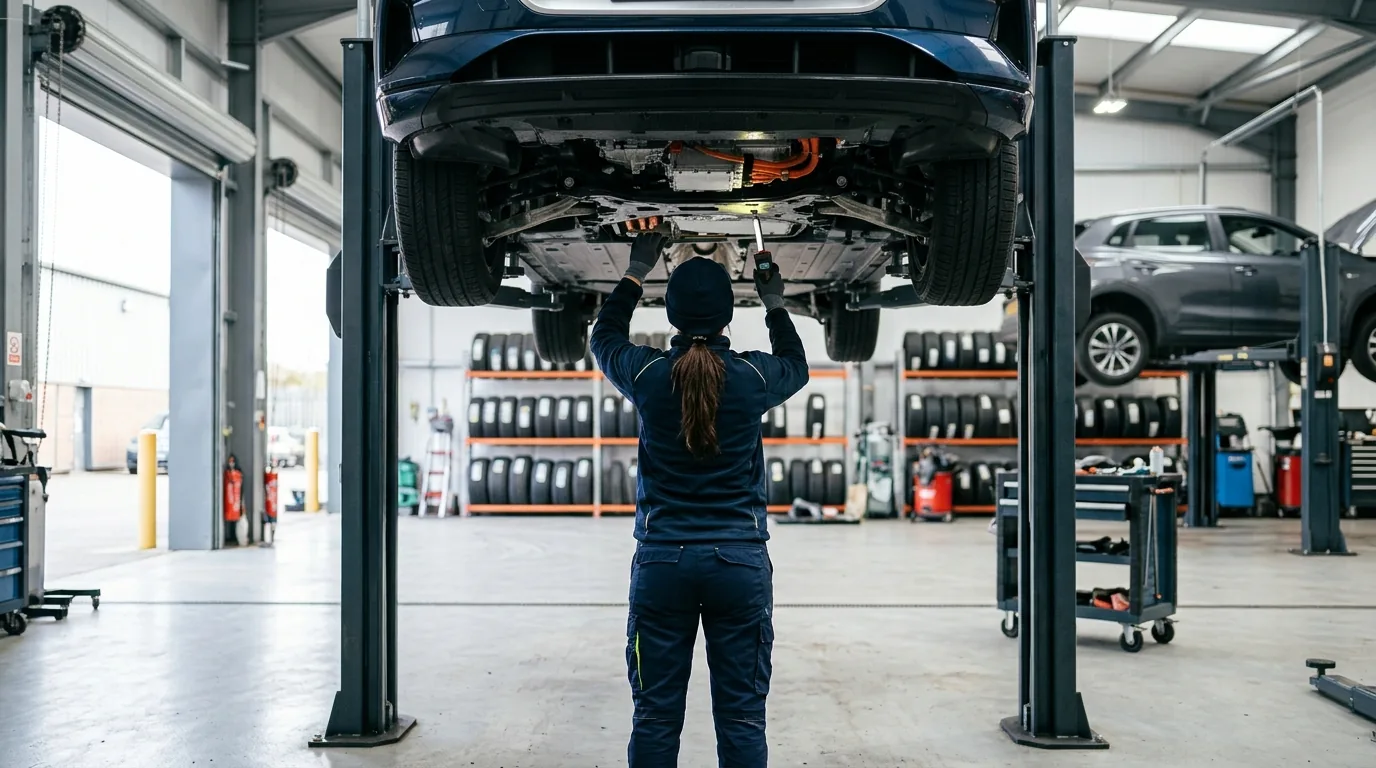
Do Electric Cars Need Oil? What EVs Use Instead and What Still Needs Servicing
Electric cars need no engine oil or oil changes, but most still carry reduction gear oil, coolant and brake fluid that the maker's schedule checks or replaces.
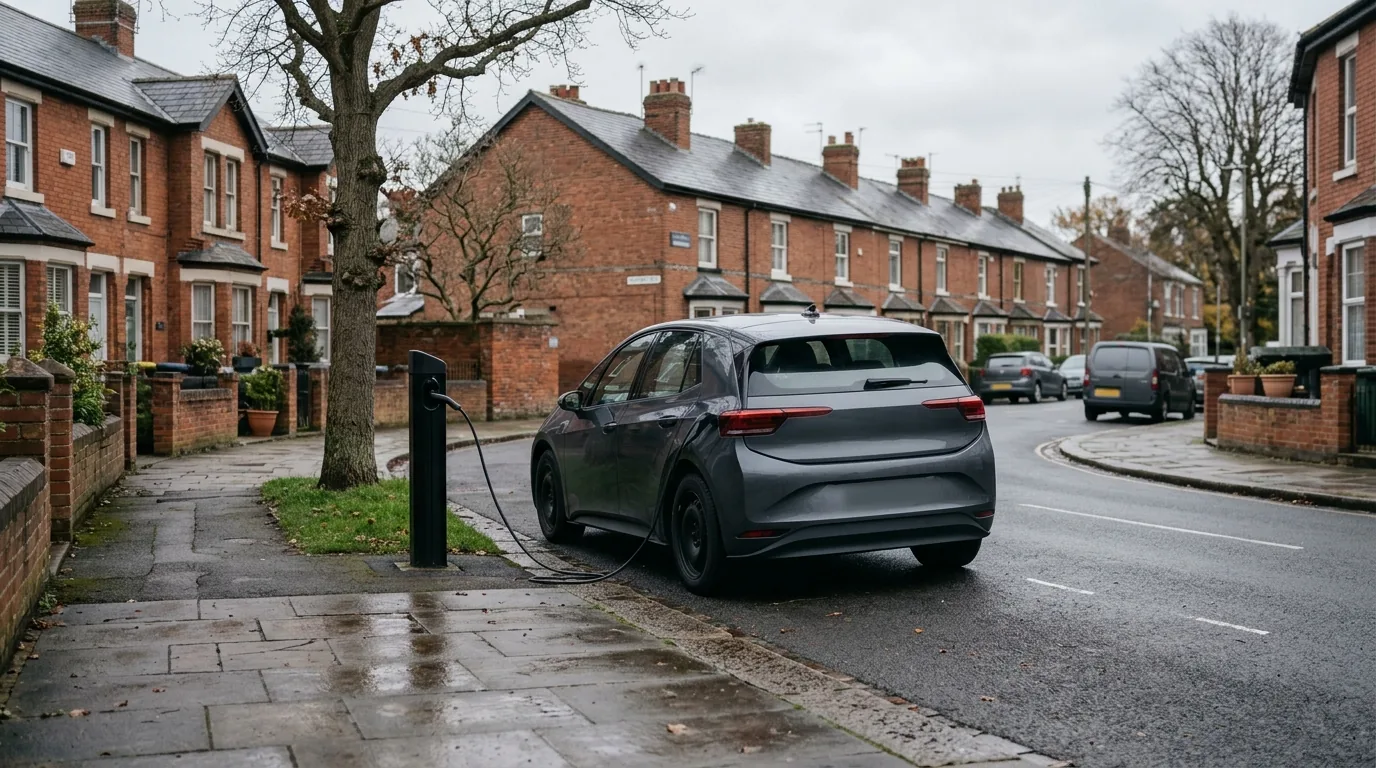
Electric car battery capacity ranked: which EVs have the biggest battery?
The Range Rover Electric has the biggest usable battery in our UK data at 118.5 kWh, but efficiency, not capacity, decides how far a car goes on each kWh.
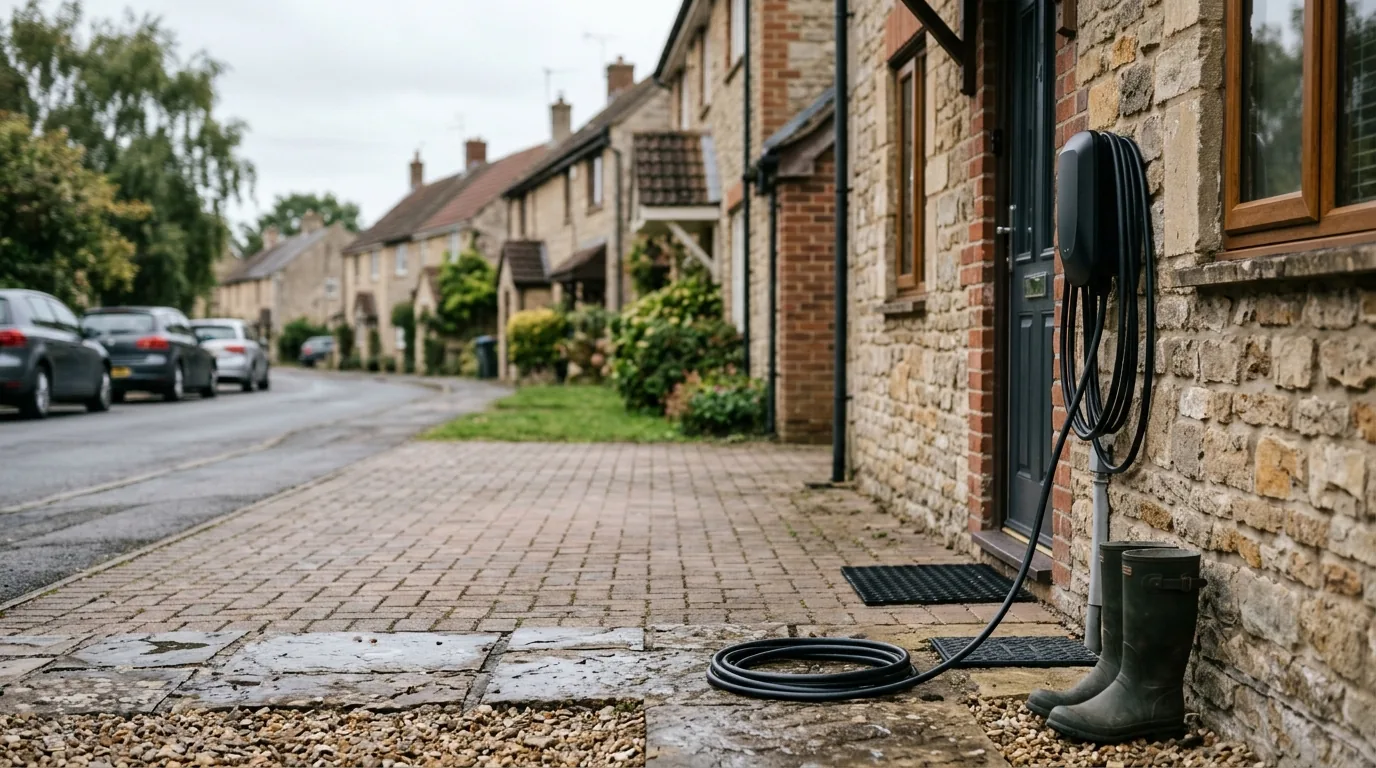
Electric car charging time: every charger speed and every popular model
Most electric cars fill overnight on a 7 kW home wallbox and add 10 to 80% in 12 to 35 minutes on a rapid charger, depending on the car.
EV road tax 2025 and 2026: VED rates, the £50,000 supplement and Tesla examples
A new electric car pays £10 of vehicle tax in its first year and £200 a year after that, with an extra £440 a year from year two to year six if its list price is over £50,000.
How Does the Heater Work in an Electric Car? Heat Pumps Explained
An electric car heats its cabin with power from the drive battery, either through a resistive heater or a more efficient heat pump that moves heat in from outside and from the car's own motors.
Common Problems with Electric Cars (and How to Avoid Them)
Most problems with electric cars come from the small 12-volt battery, software and tyres rather than the motor or battery pack, and most can be avoided with a few habits and the right checks.