Kerbo Charge review: the cross-pavement channel explained, with prices and councils
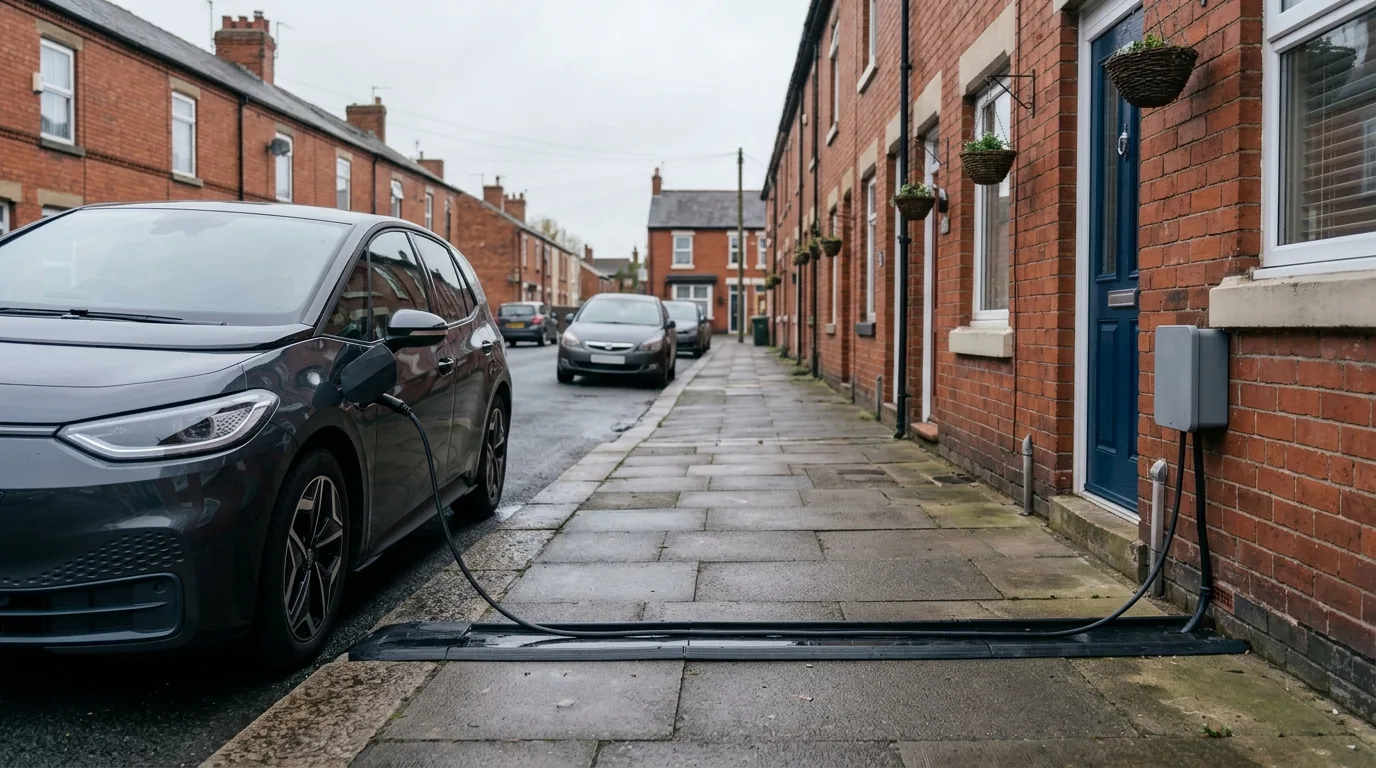
Kerbo Charge is a self-closing channel set into the pavement that carries your charging cable from a home charger to a car parked at the kerb, fully installed from £999 ex VAT where your council has signed up.
Kerbo Charge at a glance
| Operator | Kerbo Charge Ltd, founded in 2022 by Michael Goulden and Ben Whitaker |
|---|---|
| Kerbo Charge channel, fully installed (checked 10 November 2026) | From £999 ex VAT (£1,198.80 with VAT); your council sets the final price |
| myenergi Zappi GLO untethered, 22 kW on three-phase (checked 10 November 2026) | £490 inc VAT with the £500 grant applied |
| Electricity through the channel: home charger, price cap rate, October to December 2026 | 26.32p/kWh |
| Electricity through the channel: Intelligent Octopus Go off-peak (checked 10 November 2026) | From 6.5p/kWh |
| For comparison: ubitricity lamppost, off-peak to peak (checked 10 November 2026) | 45p to 67p/kWh |
| Kerbo Charge subscription or per-kWh fee | None |
| What it is | A uPVC cable channel set flush in the pavement with a self-closing lid |
| Councils | Live with 58 local authorities, with 22 more trials confirmed (Kerbo Charge, November 2026) |
| Cable | Any Type 2 cable up to 20mm in diameter |
| Lid strength | Rated to 250 kN |
| Guarantee | 10-year product guarantee and 3-year labour guarantee |
| Grant | Up to £500 per socket for homes with only on-street parking, to 31 March 2027 |
| Contact | No phone line listed; Kerbo Charge Ltd, 5th Floor, 167 Great Portland St, London W1W 5PF |
Quick answers
- Kerbo Charge is a narrow channel cut into the pavement with a self-closing lid, so a cable from a home charger can reach a car parked at the kerb without lying across the footway.
- Kerbo Charge lists the channel as fully installed from £999 ex VAT in November 2026, which is £1,198.80 with VAT at 20%, and says your council sets the final price.
- Kerbo Charge says it is live with 58 local authorities across the UK, with 22 more trials confirmed, and it only takes orders where it already has a council partnership.
- Homes with only on-street parking can claim a government grant of up to £500 per socket towards a cross-pavement solution and charger until 31 March 2027.
- Since 21 October 2026 a qualifying cross-pavement channel in England needs no separate planning application, but the highway authority must still consent and conservation areas are excluded.
- On EV Compared's sums, a 10 to 80% charge of a 60 kWh battery costs £11.05 at home on the price cap rate of 26.32p, against £23.52 at a 56p ubitricity lamppost.
- A £1,688.80 channel and charger package pays back after about 5,690 kWh against a 56p lamppost, or about 3,412 kWh on a 6.5p smart EV tariff.
Kerbo Charge is a narrow channel set into the pavement with a self-closing lid, so the cable from a charger on your house wall can reach a car parked at the kerb. It costs from £999 ex VAT fully installed in November 2026, and you can only order one where your council has a partnership with the company.
What is Kerbo Charge, and who runs it?
Kerbo Charge is a cross-pavement cable channel, the kind of product the government’s grant scheme calls a charging gully, made by Kerbo Charge Ltd of London. Michael Goulden and Ben Whitaker founded the company in 2022, and Deborah Meaden invested £50,000 for 6% of the business on Dragons’ Den.
It is not a charging network. There is no Kerbo charge point, app or per-kWh fee: you fit your own home charger, and the channel carries its Type 2 cable across the footway. According to Indra, a charger maker that says it has worked with Kerbo Charge for two years, the channel is uPVC and sits flush with the pavement. Kerbo Charge rates the lid to 250 kN, likens it to an articulated lorry parked on it on a single tyre, and says BSI tested it to BS EN1433. The lid opens and closes “like a zip”, the company says, which is what separates it from a cable mat or a gap left open in the paving.
The cable in the channel must be no more than 20mm across, which covers standard EV charging cables, and Kerbo Charge gives the channel a life expectancy of over 25 years.
How much does Kerbo Charge cost?
Kerbo Charge’s price page lists the channel as fully installed from £999 ex VAT on 10 November 2026, which is £1,198.80 with VAT at the standard 20%. That price includes a survey of the house and footpath, the council permissions and a ten-year product warranty, and the company says the exact price is set by your local authority and may be higher. Whether your council takes part at all is covered in our guide to the council postcode lottery on pavement gullies.
The charger is extra. Kerbo Charge offers two, with installation managed by its partner, Qvanta:
| Item | Price (10 November 2026) | Notes |
|---|---|---|
| Kerbo Charge channel, fully installed | From £999 ex VAT (£1,198.80 with VAT) | Council sets the final price |
| myenergi Zappi GLO, untethered | £490 inc VAT | £500 grant already applied; up to 22 kW on three-phase |
| myenergi Zappi GLO, tethered | £550 inc VAT | £500 grant already applied; cable up to 6.5m |
| Pod Solo 3s | Price not listed | 7.4 kW; £100 off for Kerbo customers |
| Electricity through the channel | Your home tariff | No Kerbo per-kWh fee or subscription |
What grant can you get?
The government pays up to £500 per socket towards a chargepoint for homes with only on-street parking, if it is installed with a permanent cross-pavement solution such as a charging gully. The grant rose from £350 on 1 April 2026 and runs to 31 March 2027. You must own or rent the home, cable covers and mats do not qualify, and your installer claims the grant once both the charger and channel are in. In Scotland, check the separate schemes in our Scotland EV charging grants guide.
How do you pay for charging through Kerbo Charge?
You pay for the electricity on your household bill, at whatever rate your supplier charges, because the charger runs off your home supply. That is the whole point of the product: it opens up domestic tariffs to people who would otherwise pay public prices.
The gap is large. Ofgem’s price cap for 1 October to 31 December 2026 sets electricity at 26.32p per kWh by Direct Debit, Intelligent Octopus Go charges smart-charging cars from 6.5p per kWh overnight, and a ubitricity lamppost charges 45p to 67p per kWh depending on the hour. Our explainer on how smart charging cuts your bill covers how the overnight rates work.
What does a 10 to 80% charge cost through a Kerbo channel?
A 10 to 80% charge of a 60 kWh battery costs £11.05 at home on the price cap rate, against £23.52 on a ubitricity lamppost at its standard rate. We multiplied 42 kWh, which is 70% of a 60 kWh battery, by each price per kWh and ignored charging losses and the standing charge you pay anyway (how we work out costs).
| Where you charge | Price per kWh | 10 to 80% of a 60 kWh battery (42 kWh) |
|---|---|---|
| Home, Intelligent Octopus Go off-peak | From 6.5p | £2.73 |
| Home, Ofgem price cap rate | 26.32p | £11.05 |
| ubitricity lamppost, off-peak | 45p | £18.90 |
| ubitricity lamppost, standard | 56p | £23.52 |
| ubitricity lamppost, peak | 67p | £28.14 |
On a 7.4 kW Pod Solo 3s, those 42 kWh take about 5.7 hours, so the charge fits into a night. See the best time to charge at home for when to plug in.
Does Kerbo Charge pay for itself?
Yes, for most drivers who would otherwise use lampposts, but how quickly depends on your home tariff. There is no subscription, so the break-even is the up-front cost divided by what you save on each kWh. We used the channel at £1,198.80 plus the untethered Zappi GLO at £490 with the grant applied, a total of £1,688.80.
| Home rate | Public rate replaced | Saving per kWh | Break-even energy | 10 to 80% charges of a 60 kWh battery |
|---|---|---|---|---|
| 6.5p (Intelligent Octopus Go) | 56p lamppost | 49.5p | 3,412 kWh | About 81 |
| 6.5p (Intelligent Octopus Go) | 45p lamppost | 38.5p | 4,386 kWh | About 104 |
| 26.32p (price cap) | 56p lamppost | 29.68p | 5,690 kWh | About 135 |
| 26.32p (price cap) | 45p lamppost | 18.68p | 9,041 kWh | About 215 |
To turn the break-even energy into miles, multiply it by your car’s efficiency in miles per kWh. Kerbo Charge’s own sum is quicker: it says you typically save £25 each time you charge at home off-peak rather than at a public charger, and break even after around 40 charges. Against a lamppost, our table shows a longer wait. Our guide to what it costs to charge an EV at home has the wider running-cost picture.
Where is Kerbo Charge available?
Kerbo Charge says it is live with 58 local authorities across the UK, with a further 22 trials confirmed, on its locations page on 10 November 2026. It takes an order only where it already has a partnership with your local authority.
The areas it names include Bedford, Bexley, Bradford, Central Bedfordshire, Cornwall, Coventry, Devon, Durham, East Lothian, Enfield, Hartlepool, Kingston upon Thames, Lancashire, Leeds, Manchester, Milton Keynes, Newport, Northern Ireland, Plymouth, Reading, Richmond upon Thames, Slough, Southampton, Stirling and West Berkshire, though the page does not say which are live and which are trials. Its home page gives a lower count of 55 councils, so treat the postcode checker on its website as the final word for your street.
Kerbo Charge does not install across roads because, it says, it is not entirely safe for users to stand in the carriageway, so the car must be parked on your side of the street.
What changed with planning rules?
Since 21 October 2026, a qualifying cross-pavement solution in England no longer needs a separate planning application, which the government says saves up to £300. The highway authority, usually your council, must still consent, and the right does not apply in a conservation area, on a scheduled monument site or within a listed building’s curtilage. Our report on the 21 October planning change explains the detail.
Is Kerbo Charge reliable, and who is liable if someone trips?
Kerbo Charge backs the channel with a 10-year product guarantee and a 3-year labour guarantee, and says it needs no maintenance beyond clearing leaves and dirt now and then. Whoever installed it, the council or Kerbo Charge depending on local arrangements, repairs faults with the product.
Owners on Trustpilot rate it highly: 39 reviews on 10 November 2026, 92% of them five stars, most praising neat, flush installations and quick replies. The complaints were slow communication, one poor finish that the company disputes, and one reviewer who found crouching to feed the cable in difficult with limited mobility.
You are responsible for using it correctly: Kerbo Charge says the resident must make sure the cable is properly inserted. Who pays if someone trips is set out in our guide to trip claims and EV cable gullies.
How do you get and use Kerbo Charge, step by step?
Getting a channel takes a postcode check and a survey; using it takes about 30 seconds a time, according to Kerbo Charge.
- Enter your postcode on Kerbo Charge’s website. If your council is not signed up, join the waiting list and use its template email to ask your council.
- Order online. Kerbo Charge surveys the house and footpath and arranges the council permissions.
- The channel is fitted, which Kerbo Charge says can take under an hour, in bitumen, paving stones or brick.
- Have a home charger fitted on your wall. For charger options and installers, see Best Chargers.
- To charge, lift the lid, feed your Type 2 cable into the channel and plug into the car.
- When you finish, pull the cable out.
Most cables reach one space up or down from the house. If those spaces are taken, you wait, but Kerbo Charge says most drivers only need to charge twice a week.
Who is Kerbo Charge for?
Kerbo Charge suits drivers in terraced streets who can usually park outside or next door, live in a council area it covers, and would otherwise pay 45p to 67p per kWh at a lamppost. On a smart EV tariff from 6.5p, a typical package pays back in about 81 to 104 full 10 to 80% charges of a 60 kWh battery.
It suits drivers less well where parking outside is rare, the street is in a conservation area, or the council is not a partner. Other options are covered in our guide to charging without a driveway. Our verdict, based on published prices, council data and owner reviews rather than our own test, is that Kerbo Charge is a sound way to get home charging prices without a driveway, provided your council says yes and you can park outside your door most nights.
How we test and where our numbers come from
Prices are the operator's published pence-per-kWh rates on the date shown, checked against the operator's app and Zapmap's price index. Networks change prices without notice; if a figure here is out of date, tell us and we will correct it. Last checked 10 November 2026. How we work out our own figures.
Frequently asked questions
How much does Kerbo Charge cost?
Kerbo Charge lists its channel as fully installed from £999 ex VAT in November 2026, or £1,198.80 with VAT, including the survey and council permissions. It says your local authority sets the exact price and it may be higher. The home charger is bought separately, from £490 for a Zappi GLO with the £500 grant applied.
Is Kerbo Charge any good?
On published evidence it is a well-reviewed product that works only where your council allows it. Kerbo Charge had 39 Trustpilot reviews on 10 November 2026, 92% of them five stars, praising tidy, flush installations. The criticisms were slow communication, one disputed poor finish and the effort of crouching to feed the cable in.
Can I get a grant for Kerbo Charge?
Yes, if you own or rent your home and have only on-street parking. The government's grant pays up to £500 per socket towards a chargepoint installed with a permanent cross-pavement solution such as a charging gully, until 31 March 2027. Your installer claims it once both the charger and the channel are in.
Do I need planning permission for a Kerbo Charge channel?
Not in England since 21 October 2026, if the installation meets the permitted development conditions. The highway authority, usually your council, must still consent, and the right does not apply in conservation areas, on scheduled monument sites or within a listed building's curtilage.
What is the Kerbo Charge contact number?
Kerbo Charge does not list a phone number on its contact page. It gives partnerships@kerbocharge.com for partnership enquiries, marketing@kerbocharge.com for press and a registered address of 5th Floor, 167 Great Portland St, London W1W 5PF. Residents start by entering their postcode on its website.
What happens if someone parks in front of my house?
You wait for the space to free up, because a Kerbo Charge channel does not reserve a bay. Kerbo Charge says most cables reach one space up or down from the house, and that on average most drivers only need to charge twice a week.
Is Kerbo Charge the same as a charging gully?
Yes, Kerbo Charge is one brand of cross-pavement channel, the kind of permanent solution the government's grant guidance calls a charging gully. Cable covers and mats laid over the pavement are a different thing and do not qualify for the £500 grant.
Sources and further reading
- kerbocharge.comKerbo Charge pricingFully installed from £999 ex VAT; price set by the local authority and may be higher; survey, permissions and ten-year warranty included; Kerbo's claims of £25 saved per off-peak home charge and break-even after around 40 charges. Checked 10 November 2026.
- kerbocharge.comKerbo Charge FAQs£500 grant; orders only where a council partnership exists; BS EN1433 testing, UKCA and CE; cables up to 20mm; life expectancy over 25 years; 10-year product and 3-year labour guarantee; no road crossings; maintenance; most drivers charge twice a week.
- kerbocharge.comKerbo Charge home pageCable in and out in 30 seconds; lid rated to 250 kN; opens and closes like a zip; backed by Deborah Meaden; live or trialling with 55 councils; company number 14147745.
- kerbocharge.comHow Kerbo Charge worksPostcode check, ordering, installation in under an hour, use steps, reach of one space either side, surfaces it can be fitted in.
- kerbocharge.comKerbo Charge locationsLive with 58 local authorities and 22 further trials confirmed; named councils. Checked 10 November 2026.
- kerbocharge.comKerbo Charge chargersZappi GLO untethered £490 and tethered £550 inc VAT with the £500 grant applied; Pod Solo 3s at 7.4 kW with £100 off; channel bought separately from the charger; Qvanta manages installation.
- kerbocharge.comAbout Kerbo ChargeFounded in 2022 by Michael Goulden and Ben Whitaker.
- kerbocharge.comKerbo Charge on Dragons' DenDeborah Meaden invested £50,000 for 6% of the business.
- kerbocharge.comKerbo Charge contactEmail addresses and registered address; no phone number listed.
- gov.ukElectric vehicle chargepoint grantsUp to £500 for households with on-street parking installing a cross-pavement solution such as a charging gully; eligibility conditions.
- find-government-grants.service.gov.ukElectric Vehicle Chargepoint Grant for Households with On-Street ParkingUp to £500 per socket; funding confirmed to 31 March 2027; no temporary cable covers or mats; highway authority consent; installer claims.
- gov.ukChanges to electric vehicle chargepoint grant schemes from 1 April 2026Maximum grant for residents and landlords rose from £350 to £500 per socket on 1 April 2026; funding to 31 March 2027.
- gov.ukDrivers to save up to £300 when installing EV chargers at homeFrom 21 October 2026 no planning permission needed for cross-pavement chargers; saving of up to £300.
- planningportal.co.ukElectric vehicle charging: permitted developmentConditions for cross-pavement solutions in England: highway authority approval, exclusions for conservation areas, scheduled monuments and listed building curtilage.
- ofgem.gov.ukEnergy price cap unit rates and standing chargesElectricity 26.32p per kWh by Direct Debit, 1 October to 31 December 2026.
- octopus.energyIntelligent Octopus GoSmart charging from 6.5p per kWh, six hours a night from 23:30 to 05:30.
- ubitricity.comPricing for ubitricity-operated charging stationsLamppost prices of 45p off-peak, 56p standard and 67p peak per kWh.
- gov.ukVAT ratesStandard VAT rate of 20%.
- trustpilot.comKerbo Charge reviews39 reviews, 92% five stars; themes of praise and complaint. Checked 10 November 2026.
- indra.co.uk£25m helps driveway-free EV owners with Indra and Kerbo ChargeIndra and Kerbo Charge had worked together for two years at the time of writing; channel made of uPVC, flush with a self-closing lid.

EV Compared
The EV Compared editorial team tracks the UK electric vehicle market full time: new model launches, list prices, WLTP and real-world range, public charging tariffs and the tax rules that decide what an EV actually costs to run. Every guide is checked against manufacturer specifications and official GOV.UK figures, and updated whenever the numbers move.
Related reading
View all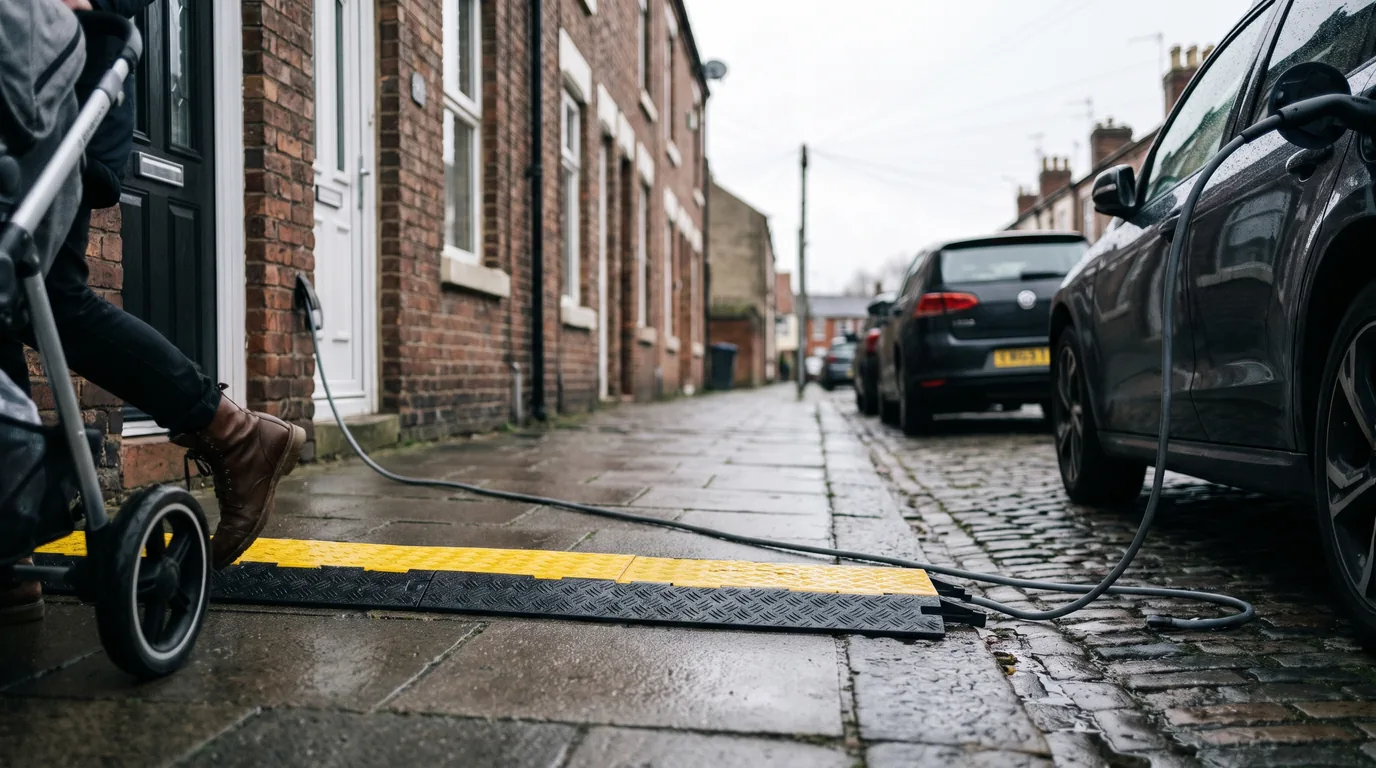
Trailing EV cables and pavement gullies: who is liable if someone trips?
As cross-pavement charging becomes easier, liability is the main reason some councils still say no. Here is what the law and Highway Code say, what insurers warn, and how gullies change the picture.
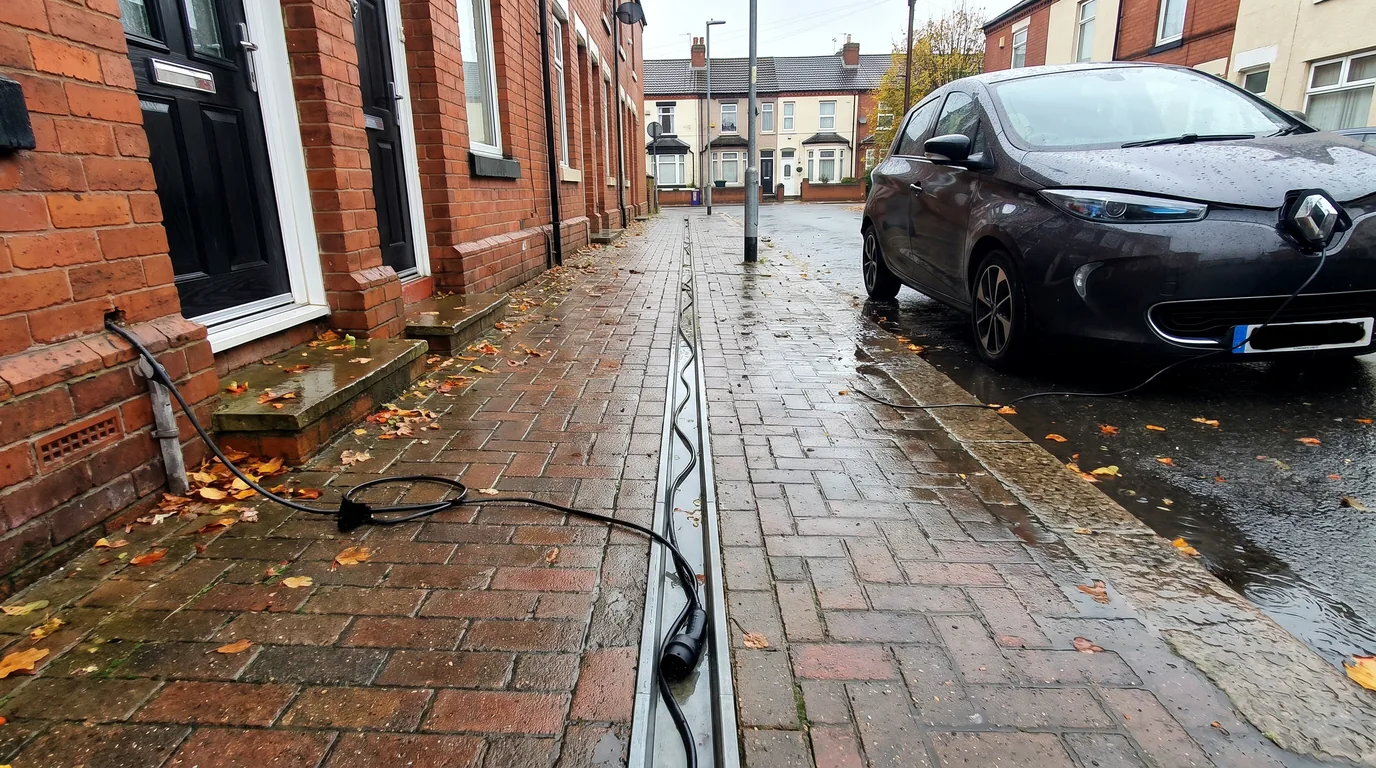
Pavement charging gullies: planning rule scrapped, but 20 councils still say no
Drivers in England without a driveway no longer need planning permission for a pavement cable channel, saving £300 to £500. But costs range from free to £1,200 depending on your council, and some councils still refuse them outright.
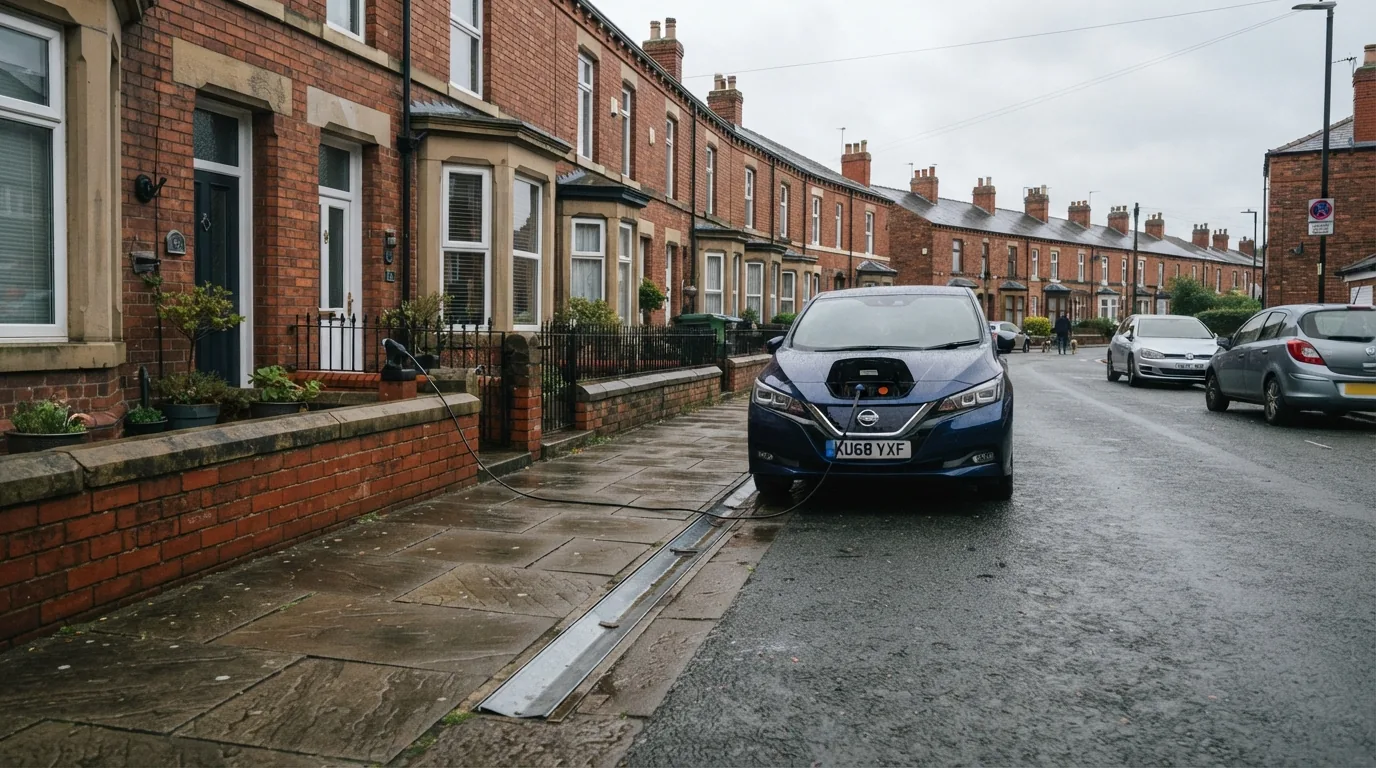
Cross-pavement EV charging in England: planning rules ease 21 October
Drivers without a driveway will soon skip a separate planning application for a pavement cable channel. But the council still controls the footway, and nobody gets a reserved bay.