Allye MEV: a UK-built rapid charger with storage made from old EV batteries
British firm Allye Energy has launched the MEV, a fixed charger with 155kWh or 232kWh of storage built from whole second-life EV packs. It fills up slowly from an ordinary supply and releases the energy quickly to vans and cars. Deliveries are expected from spring 2027.
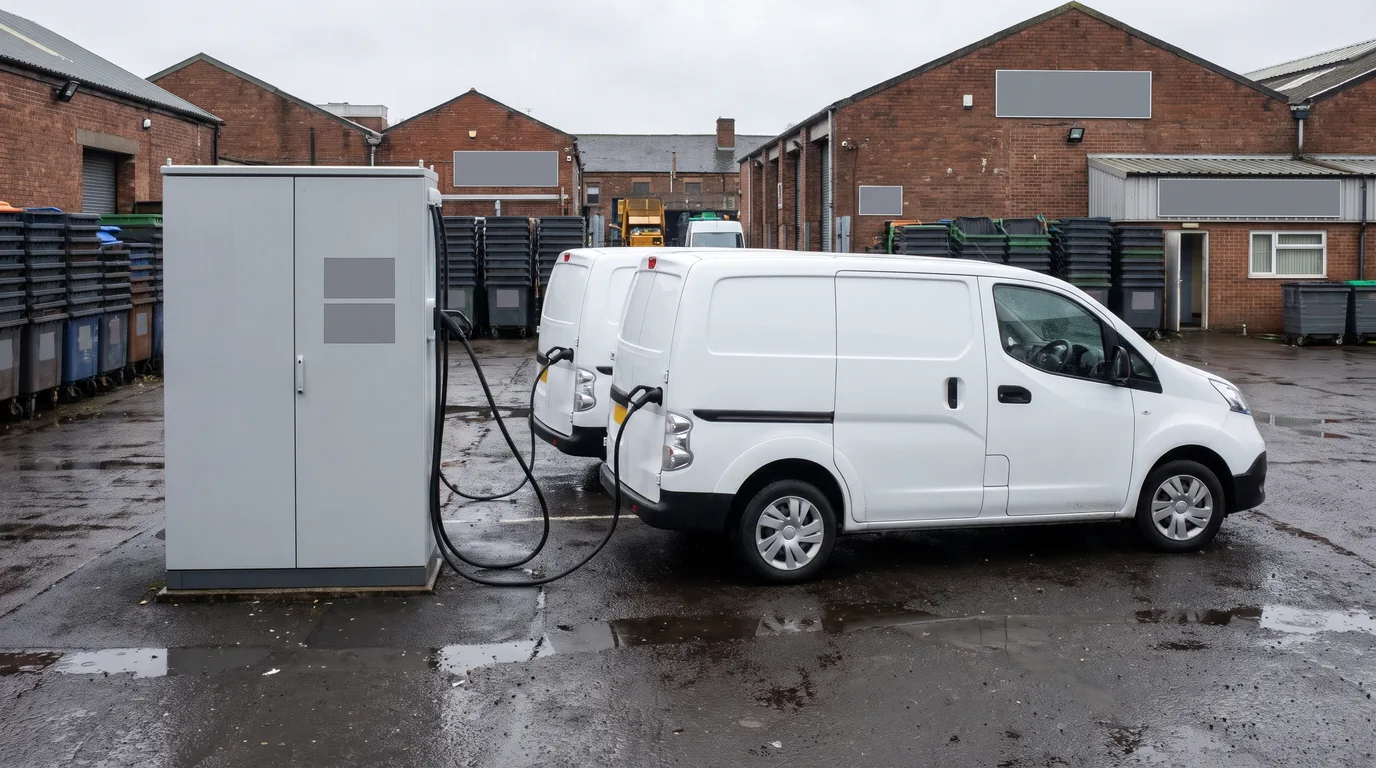
Quick answers
- Allye Energy launched the MEV (MAX for EV) on 27 October 2026, a fixed EV charger with built-in battery storage made from whole repurposed EV battery packs.
- There are two versions: the MEV200 with 155kWh of storage and the MEV300 with 232kWh, both running from a three-phase supply of between 16A and 125A.
- Launch coverage says the MEV can deliver up to 400kW to two vehicles at once, but Allye's own product page lists 200kW for the MEV200 and 300kW for the MEV300.
- Allye's product page says the MEV starts at £70,000 excluding VAT, and Renewable Energy Magazine reports a subscription from £1,900 a month for a MEV200.
- Allye says deliveries are anticipated from the second quarter of 2027, in time for fleets applying to the next round of the government's Depot Charging Scheme.
- The MEV builds on a trial at J&M Murdoch's refuse depot in Glasgow, where a grid upgrade had been quoted at £300,000 and a battery unit now buffers a 32A supply.
- Our sums show a 32A three-phase supply delivers about 22kW, so it would take roughly 10.5 hours to refill a 232kWh MEV300 from empty, which is why these units suit depots with overnight downtime.
British company Allye Energy has launched a fixed electric vehicle charger with a large battery built from whole repurposed EV packs. The MEV, short for MAX for EV, fills its battery slowly from a site’s existing electricity supply, then releases that energy quickly into cars and vans. Allye says it lets depots add rapid charging without waiting for, or paying for, a grid upgrade. The launch was announced on 27 October 2026, according to EV Infrastructure News, and Allye says deliveries are anticipated from the second quarter of 2027.
For most UK drivers, the first place you might plug into one is not a motorway services but a works depot, a council yard or a company car park. That matters because grid capacity, not the charger itself, is often what stops vans, refuse trucks and pool cars going electric.
What has Allye launched?
The MEV is a stationary charger with built-in battery storage. It comes in two sizes, and both can be plugged into an industrial socket or hard-wired, according to Allye’s product page.
| MEV200 | MEV300 | |
|---|---|---|
| Battery storage | 155kWh | 232kWh |
| DC output (Allye product page) | 200kW | 300kW |
| Connectors | Two CCS2 | Two CCS2 |
| Grid supply | 16A to 125A three-phase | 16A to 125A three-phase |
| Typical site, per Allye | Vans, cars and pool vehicles on 32A three-phase or less | Busier depots, larger vans and trucks, 63A or more |
| Starting price | From £70,000 excluding VAT, depending on specification |
There is one discrepancy to flag. Launch coverage, including EV Infrastructure News and Renewable Energy Magazine, says the MEV can deliver “up to 400kW to two vehicles at once”. Allye’s own product page lists 200kW for the MEV200 and 300kW for the MEV300, and the 400kW figure appears there for its mobile MAX300 unit. We have used the product page figures in the table.
A MEV200 can be upgraded to a MEV300 by adding a third battery pack on site. Allye says the charger uses an 800V design that can serve both 400V and 800V vehicles.
How does a battery-buffered charger work?
A normal rapid charger draws all its power straight from the grid at the moment you plug in. A 150kW charger needs a grid connection that can supply about 150kW, and if the site does not have one, the operator has to apply to the local network operator for an upgrade. That can mean long waits, new cables and a large bill.
A battery-buffered charger splits the job in two:
- Filling: the internal battery charges slowly from whatever supply the site already has, ideally overnight or when electricity is cheap.
- Emptying: when a vehicle plugs in, the battery discharges quickly, at rapid charging speeds, topped up by the grid supply at the same time.
The trade-off is energy rather than power. The charger can deliver high power for a while, but over a whole day it can only hand out what the battery holds plus what the small supply can add. That is why these units suit depots with predictable use and long quiet periods, rather than a busy motorway hub where cars arrive every few minutes.
Allye also says the unit can recharge off-peak and earn money from grid services when it is idle, using its energy management software.
How much power does a small supply actually give? Our calculation
To show why this matters, we worked out how much a typical depot supply delivers. A UK three-phase supply runs at 230V per phase, so power is roughly 3 × 230V × current. These are our estimates, ignoring conversion losses.
| Three-phase supply | Approximate power | Energy in 8 hours | Time to refill 155kWh (MEV200) | Time to refill 232kWh (MEV300) |
|---|---|---|---|---|
| 16A | 11kW | 88kWh | About 14 hours | About 21 hours |
| 32A | 22kW | 177kWh | About 7 hours | About 10.5 hours |
| 63A | 43.5kW | 348kWh | About 3.6 hours | About 5.3 hours |
| 125A | 86kW | 690kWh | About 1.8 hours | About 2.7 hours |
On a 32A supply alone, putting 60kWh into a van would take nearly three hours at 22kW. With a full MEV300, the same 60kWh could in principle go in far faster, limited mainly by how quickly the van itself can accept charge.
Allye says one MEV on a 63A supply over eight hours is designed to serve seven to ten vehicles taking 55 to 70kWh each. That is 385kWh to 700kWh in total. By our sums, a full 232kWh battery plus eight hours at 63A gives roughly 580kWh, so the lower end of that range looks reachable and the top end would need smaller top-ups or a longer charging window.
Why does it help sites with weak grid connections?
Grid connections are one of the biggest obstacles for fleets. The clearest example comes from Allye’s own trial. At J&M Murdoch’s refuse depot in Glasgow, a grid upgrade had been quoted at £300,000, according to Renewable Energy Magazine. Instead, Allye and Chargepoly installed a MAX300 battery unit that buffers the depot’s existing 32A (22kW) supply and powers a DC fast charger supporting two EVs. It supplies around 200kWh a day, and InsideEVs reports it was online within a day. Allye describes this set-up as the basis for the fixed MEV.
Here is a simple comparison using the published figures:
- Grid upgrade quote at the Glasgow depot: £300,000.
- MEV starting price: £70,000 excluding VAT, from Allye’s product page.
- MEV200 subscription: from £1,900 a month, according to Renewable Energy Magazine, or £22,800 a year.
At £22,800 a year, it would take about 13 years of subscription payments to reach the £300,000 upgrade quote. That is our arithmetic, not a like-for-like costing: a grid upgrade gives permanent capacity, while the subscription includes the charger itself.
There are running costs too. Renewable Energy Magazine reports Allye’s estimate that an extra 200kVA of capacity on a 2026/27 South West tariff carries capacity charges of about £8,900 a year, which a depot on a smaller supply avoids. Allye also estimates that a MEV200 pays back its extra cost over a conventional 200kW charger in two to three years. These are the company’s figures, and we have not been able to check them independently.
“If the charger stays put and only ever charges vehicles, MEV does it on the supply you already have,” said Jonathan Carrier, Allye’s founder and chief executive, quoted by EV Infrastructure News. “To deploy charging at the pace the transition needs, we have to make it far cheaper.”
Where do the batteries come from?
Each MEV holds two or three whole EV battery packs that have come out of cars. Allye says the units are engineered and built in the UK, using batteries from UK-registered vehicles and about 95% British-sourced components, as The Energyst reports.
The packs do not need to match. Allye’s PackFlex system gives each pack its own battery management and power control, so packs of different sizes, ages and chemistries can share one cabinet. According to Renewable Energy Magazine, Allye estimates that reusing packs avoids 15 to 24 tonnes of CO2e per MEV compared with using new cells.
This is a practical use for batteries that are no longer ideal in a car but still hold plenty of energy. Our guide to what happens to an EV battery at the end of its life explains the options, from second-life storage to recycling.
Is it safe?
Allye lists a pyrotechnic fuse on every pack, off-gas detection and fire barriers between packs as standard, with fire suppression available for critical sites. InsideEVs adds that the units have anti-theft features including cut detection, forensic marking and quick-release terminals. We have not seen any independent safety assessment of the MEV, and deliveries have not started.
Where might these chargers appear?
Allye is aiming first at fleets. Its product page names fleets whose vans, cars and pool vehicles return to base, and depots such as council yards and ambulance stations. EV Infrastructure News says the MEV also targets public charging.
Its mobile MAX systems give a clue. More than 20 are in service with customers including JLR and Roadchef, according to Renewable Energy Magazine. At Roadchef’s Killington Lake services, a MAX300 has run for over two years.
The timing is tied to government funding. Allye says deliveries are anticipated from the second quarter of 2027, in time for fleets applying to round two of the Department for Transport’s Depot Charging Scheme. According to a summary by installer ElectrAssure, the scheme’s first window paid 70% of eligible chargepoint and civil costs, and a second window of about £38m was expected to open on 28 October 2026. The grant rate and terms for that window had not been confirmed, and we could not open the official guidance today, so check the GOV.UK listing before planning around it.
Depot charging is changing fast. We covered Fuuse and Drax taking on bp pulse’s fleet depot customers this month, and van makers are pushing harder after a record month for electric van sales in September.
What does it mean for drivers and fleets?
If you run vans from a yard with a modest supply, the MEV is one more option alongside a grid upgrade or slow AC charging. Practical steps:
- Find your supply. Ask your electrician for your depot’s incoming supply in amps and phases. Allye recommends at least 32A three-phase for a full overnight recharge.
- Work out your daily energy. Multiply the number of vehicles by the kWh each needs per shift, and compare it with our table above.
- Get a grid quote anyway. Knowing the cost and wait of an upgrade gives you a figure to compare against.
- Check grant terms. Confirm whether battery-buffered charging counts as an eligible cost before you apply.
For car drivers, the speed you see depends on your car as much as the charger. Our explainer on rapid and ultra-rapid charging explains how charging curves work. If you are looking for a home charger rather than depot kit, our sister site Best Chargers covers those.
Our view
Battery-buffered charging is a sensible answer to a real British problem: plenty of sites have room for a charger but not the grid capacity to run one. Using second-life EV packs makes it cheaper and keeps usable batteries in service. The MEV’s claims are still the company’s own, though, with a mismatch between 400kW in the launch coverage and 300kW on Allye’s product page, and no units delivered until 2027. Fleets should treat the payback figures as a starting point, run their own numbers on supply and daily energy, and compare them with a firm grid quote.
How we test and where our numbers come from
Range figures are official WLTP combined values taken from manufacturer UK specification pages, with real-world estimates drawn from independent comparative testing. Prices are UK list prices at the time of the latest update. Tax, grant and charging-scheme figures come from GOV.UK and HMRC publications. We re-check every guide when pricing, specification or policy changes. Last checked 1 November 2026. How we work out our own figures.
Frequently asked questions
What is a battery-buffered EV charger?
It is a rapid charger with a large battery inside. The battery fills slowly from a small grid supply, then discharges quickly into a car or van. This lets a site offer rapid charging without paying for a bigger grid connection.
How fast does the Allye MEV charge?
Allye's product page lists 200kW for the MEV200 and 300kW for the MEV300, shared across two CCS2 connectors. Launch coverage quoted up to 400kW to two vehicles at once. The actual speed also depends on what each vehicle can accept.
How much does the Allye MEV cost?
Allye's product page says the MEV with integrated DC charging starts at £70,000 excluding VAT, depending on specification. Renewable Energy Magazine reports a charging as a service option from £1,900 a month for a MEV200, with no upfront cost.
Where will I see Allye MEV chargers?
Mainly at depots for vans, refuse trucks and pool cars, run by fleets and councils. Allye says it also targets public charging, and its MAX systems are already in service with customers including Roadchef, where a MAX300 has run at Killington Lake services for more than two years, according to Renewable Energy Magazine. No public MEV sites have been named.
Are second-life EV batteries safe to use in a charger?
Allye says each pack has its own pyrotechnic fuse, with off-gas detection and fire barriers as standard and fire suppression available for critical sites. Each pack also has its own battery management, so packs of different ages and chemistries can share one cabinet.
Sources and further reading
- allye.comAllye EnergyPrimary source referenced in this article.
- renewableenergymagazine.comFirst dedicated battery-buffered EV charger built from repurposed EV battery packs delivers up to 400kW ultra-rapid chargingThe J&M Murdoch Glasgow trial and £300,000 grid quote, Roadchef Killington Lake, £1,900 a month subscription, payback and savings estimates, capacity charges and quotes.
- evinfrastructurenews.comAllye Energy launches ESS-integrated EV charger using repurposed EV battery packsLaunch date of 27 October 2026, the 400kW claim from a 16A connection, PackFlex, 800V architecture, depot and public use, and Jonathan Carrier's quotes.
- theenergyst.comAllye launches EV charger built from repurposed batteriesUK-built units, batteries from UK-registered vehicles, 95% British components and the charging as a service model.
- insideevs.comThis 400 kW EV Charger Uses Old EV Batteries To Avoid Costly Grid UpgradesGlasgow unit online within a day delivering about 200kWh a day, anti-theft features and the three-phase 16A minimum supply.
- electrassure.co.uk2026/27 Depot Charging Scheme: full guideDepot Charging Scheme funding, window dates and the window 1 grant rate, from a commercial installer's summary; window 2 terms not yet confirmed.

EV Compared
The EV Compared editorial team tracks the UK electric vehicle market full time: new model launches, list prices, WLTP and real-world range, public charging tariffs and the tax rules that decide what an EV actually costs to run. Every guide is checked against manufacturer specifications and official GOV.UK figures, and updated whenever the numbers move.
Related reading
View all
Electric van sales hit record 4,832 in September, still short of target
Battery electric vans took 9.6% of the UK market in September, a record month by volume but less than half the 24% the ZEV mandate requires this year. Here is what it means for van buyers.
What Happens to an EV Battery at the End of Its Life?
Second-life energy storage, recycling processes and what UK infrastructure exists for end-of-life EV batteries
Rapid vs Ultra Rapid Charging: What Is the Difference?
A plain-English guide to the kW bands, real charging times, costs and what each tier means for your EV
E.ON Next Drive Smart cuts overnight EV charging to 6.5p per kWh
E.ON Next has cut its smart EV tariff from 8p to 6.5p per kWh overnight and says it is the lowest off-peak rate on the market. The day rate is 34.04p, the window is six hours and you need a supported car or charger. Here is what a year of charging costs on it and its rivals.
Intelligent Octopus Go drops to 6.5p, level with E.ON Next Drive Smart
Octopus put a variable Intelligent Octopus Go on sale on 29 October at 6.5p per kWh overnight, a day after E.ON Next's Drive Smart went to the same rate. Here is what each costs per mile and per year, and where they differ.
Chery plans UK fast charging and energy storage stations from 2027, with no sites named yet
The group behind Omoda, Jaecoo, Chery, Lepas and the coming iCaur brand announced the plan at its summit in Wuhu. It has not said how many stations, where, how fast or at what price. Here is what is confirmed, what is not, and what charging costs its drivers today.